Part I
Medicinal herbs
Garden and hedgerow plants used as teas, salves, and traditional medicine.
134 plates in this section
 No. 001
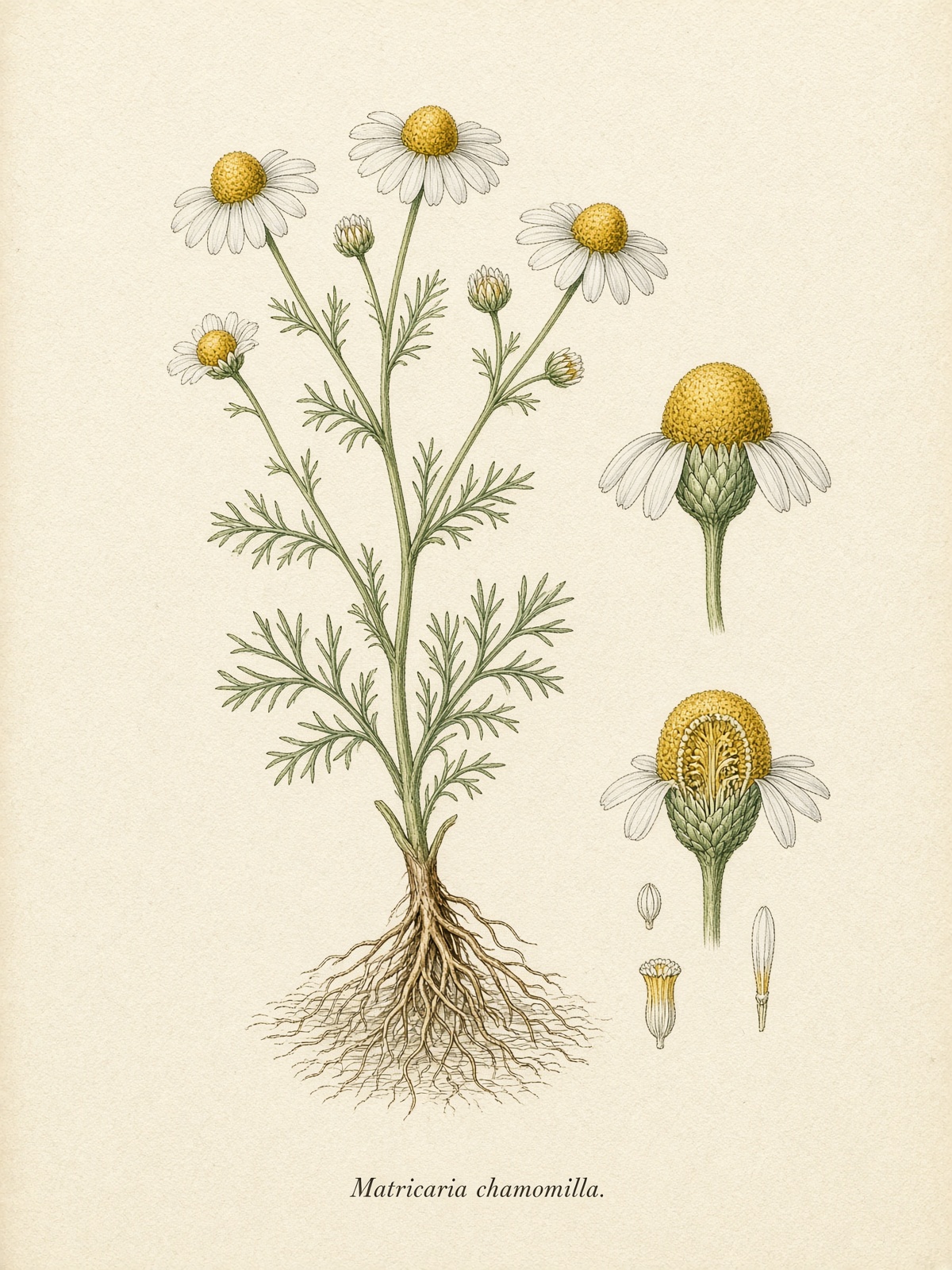
Chamomile
Matricaria chamomilla
A small daisy used for centuries as an evening tea for restlessness and mild digestive cramp.
Apple-sweet, hay, and a faint bitterness — like a warm orchard in a cup.
Harvest: 60–70 days from sow to first flush
Egyptians dedicated a daisy to the sun; medieval monks planted it in infirmary lawns so that to walk was to bruise medicine. The apple smell is why the Spanish still call it manzanilla — little apple — and why a pub in Spain can mean a pale sherry or a bedtime flower, depending on the hour.
 No. 002
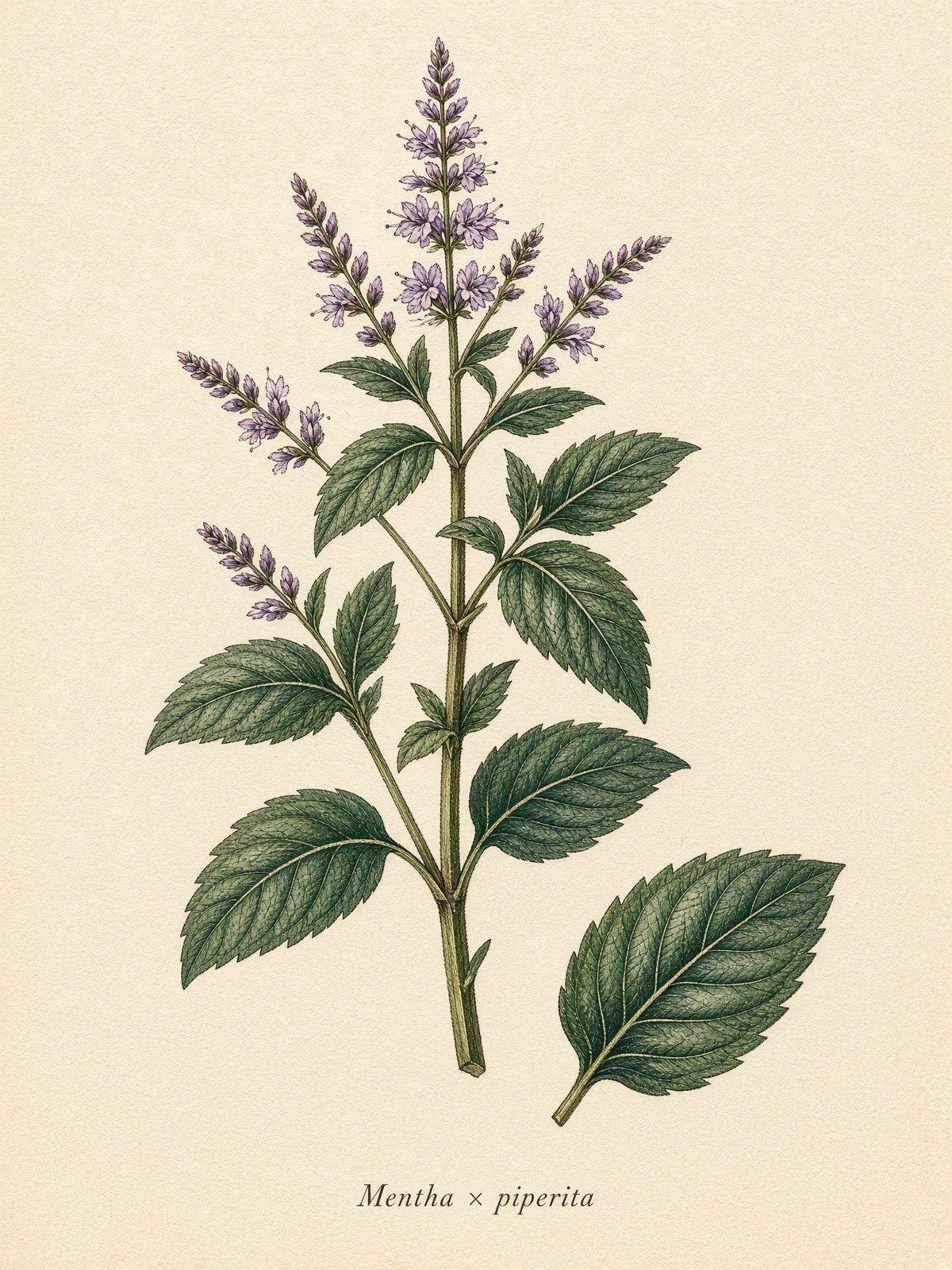
Peppermint
Mentha × piperita
A hybrid mint whose menthol cools the gut and opens the sinuses — classic after-dinner leaf.
Bright menthol cool that fills the nose, then a green sweetness.
Harvest: 60–90 days from cuttings; then cut all season
Peppermint is a sterile hybrid that should not exist in the wild, and yet it does, wherever watermint and spearmint share a ditch. English apothecaries of the 1700s made Mitcham famous for it. The menthol that cools your tongue is the same molecule that makes a cough drop feel like weather.
 No. 003
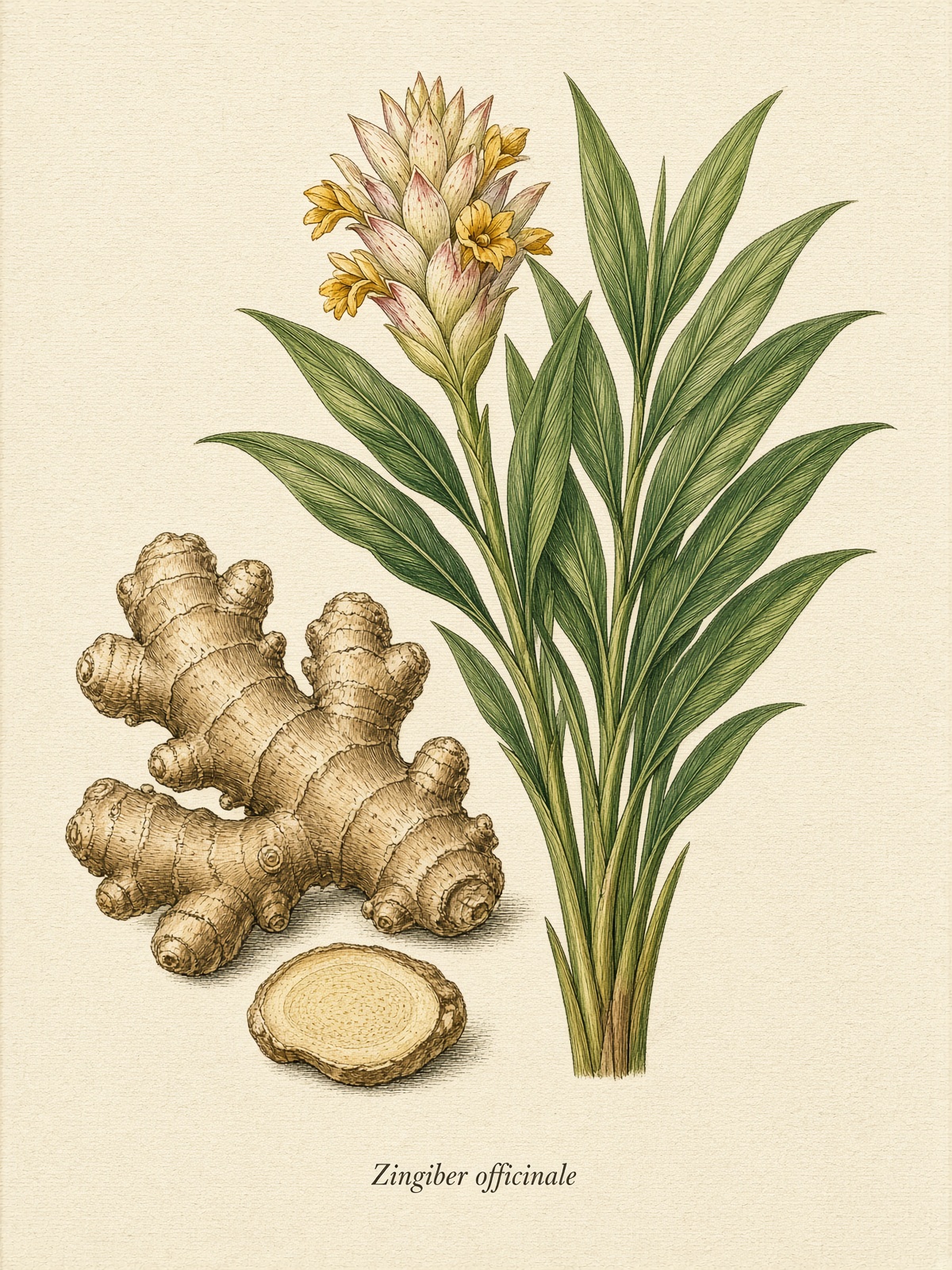
Ginger
Zingiber officinale
A tropical rhizome for queasy stomachs, cold hands, and dull inflammatory ache.
Hot, citrus-pine pungency; fresh is juicier, dried is sharper and more peppery.
Harvest: 120–150 days for baby ginger; 240–300 days for mature knobs
Ginger rode the spice routes so early that the Greeks thought it grew in Arabia. Medieval Europe paid for it by the root as if it were coin. The word itself is Sanskrit śṛṅgavera — ‘horn-body’ — a name for the knobs long before anyone drew the plant.
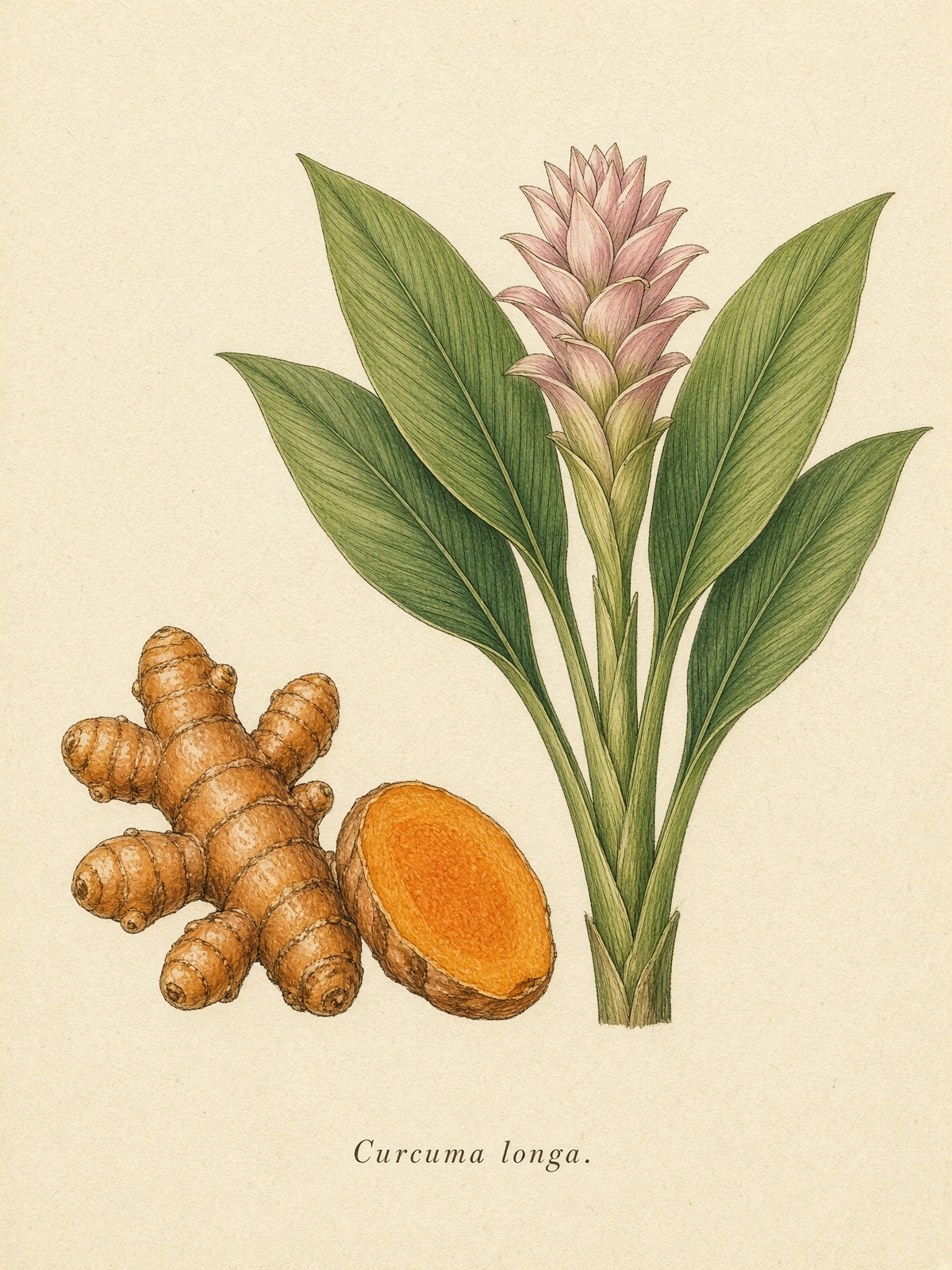 No. 004
Turmeric
Curcuma longa
Golden rhizome of South Asian cooking, taken for stiff joints and low-grade inflammation.
Earthy, mustard-bitter, faintly ginger; stains the tongue gold.
Harvest: 240–300 days from planting the finger
In Sanskrit it is haridra, the yellow one; in Polynesia it is a sacred dye. Marco Polo saw it and thought he had found saffron growing on a root. Kitchen gold and wedding paste are the same rhizome that stains the cutting board forever.
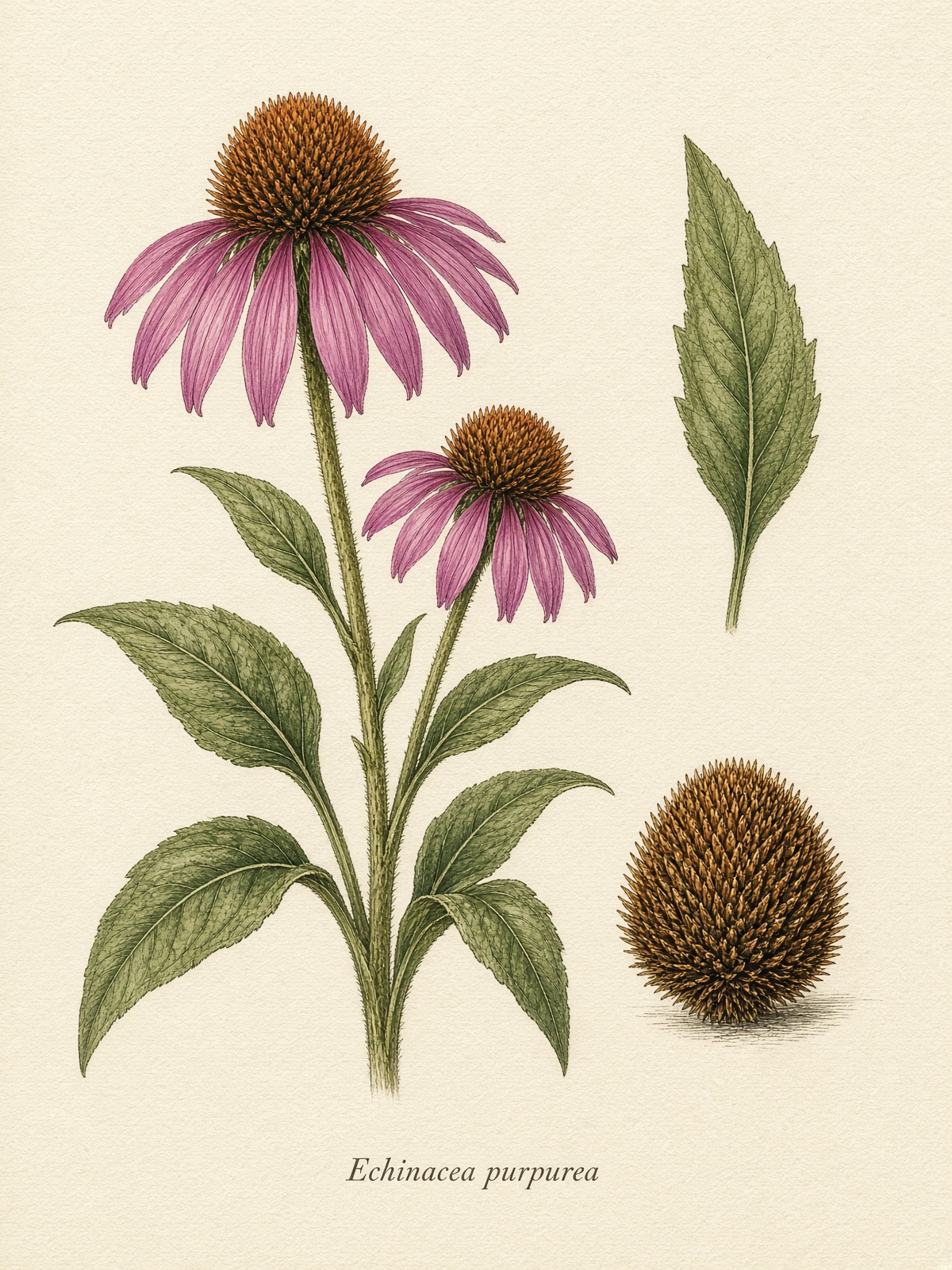 No. 005
Purple coneflower
Echinacea purpurea
Prairie coneflower taken at the first scratch of a cold — immune-modulating, not a daily tonic.
Tingling, numbing, and root-bitter — a buzz on the tongue is the signature.
Harvest: Flowers in year 2 (~400 days); roots autumn of year 3
Plains nations chewed the root for snakebite and colds; 19th-century Eclectic physicians made it an American pharmacy staple, then medicine forgot it, then the 1980s remembered. The tingle on the tongue is the old quality test — if it doesn’t buzz, it isn’t the plant.
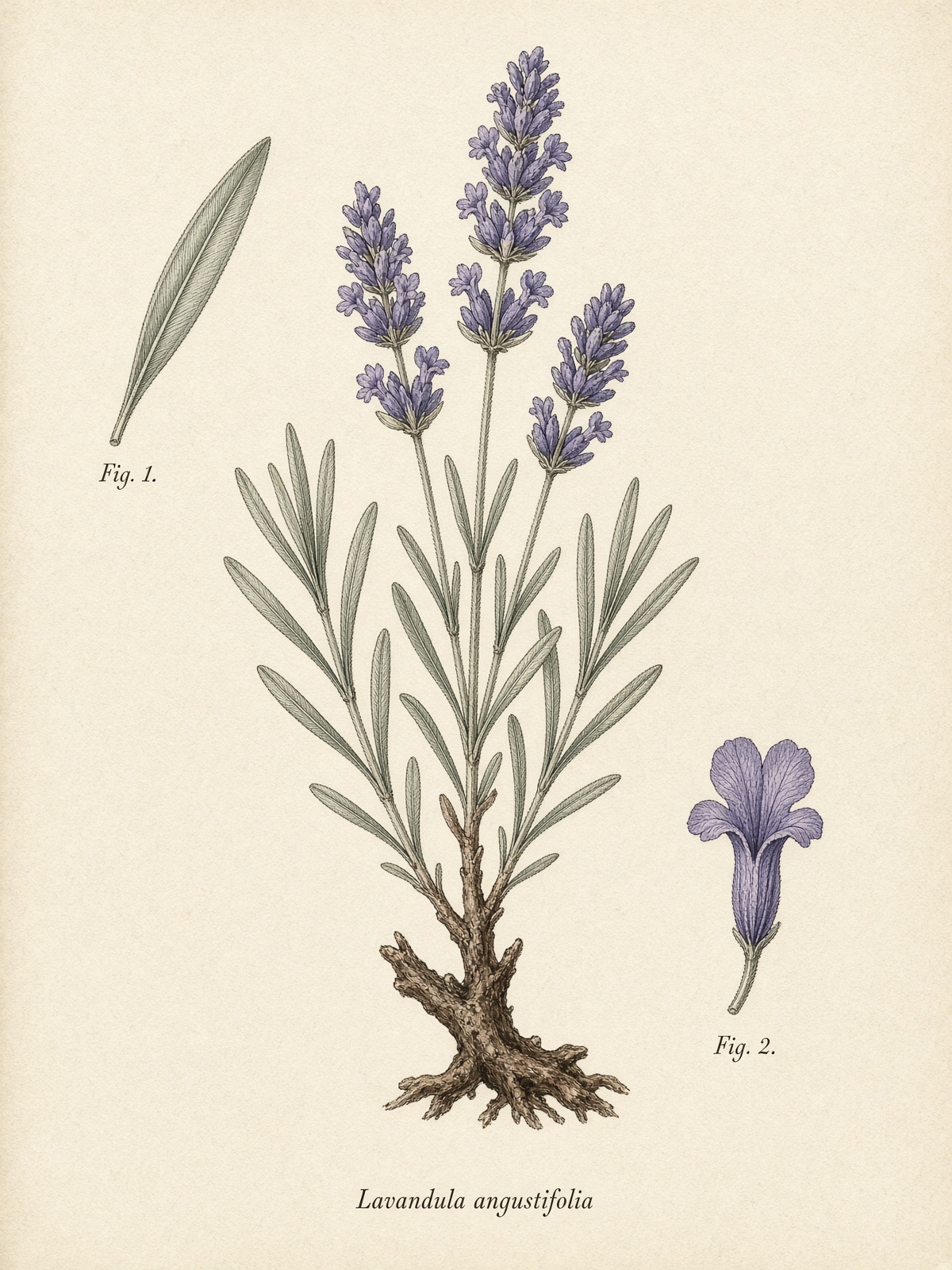 No. 006
Lavender
Lavandula angustifolia
Silver-leaved Mediterranean shrub; the scent alone is a documented mild anxiolytic.
Floral camphor and honey; over-steeped tea turns soapy.
Harvest: First useful bloom 365–450 days from a cutting
Romans scented the wash-water — lavare, to wash — and the name stuck. Provence turned it into a crop and a cliché. The soapiness people complain of in over-steeped tea is the linalool talking; a pinch is a garden, a fist is a sachet.
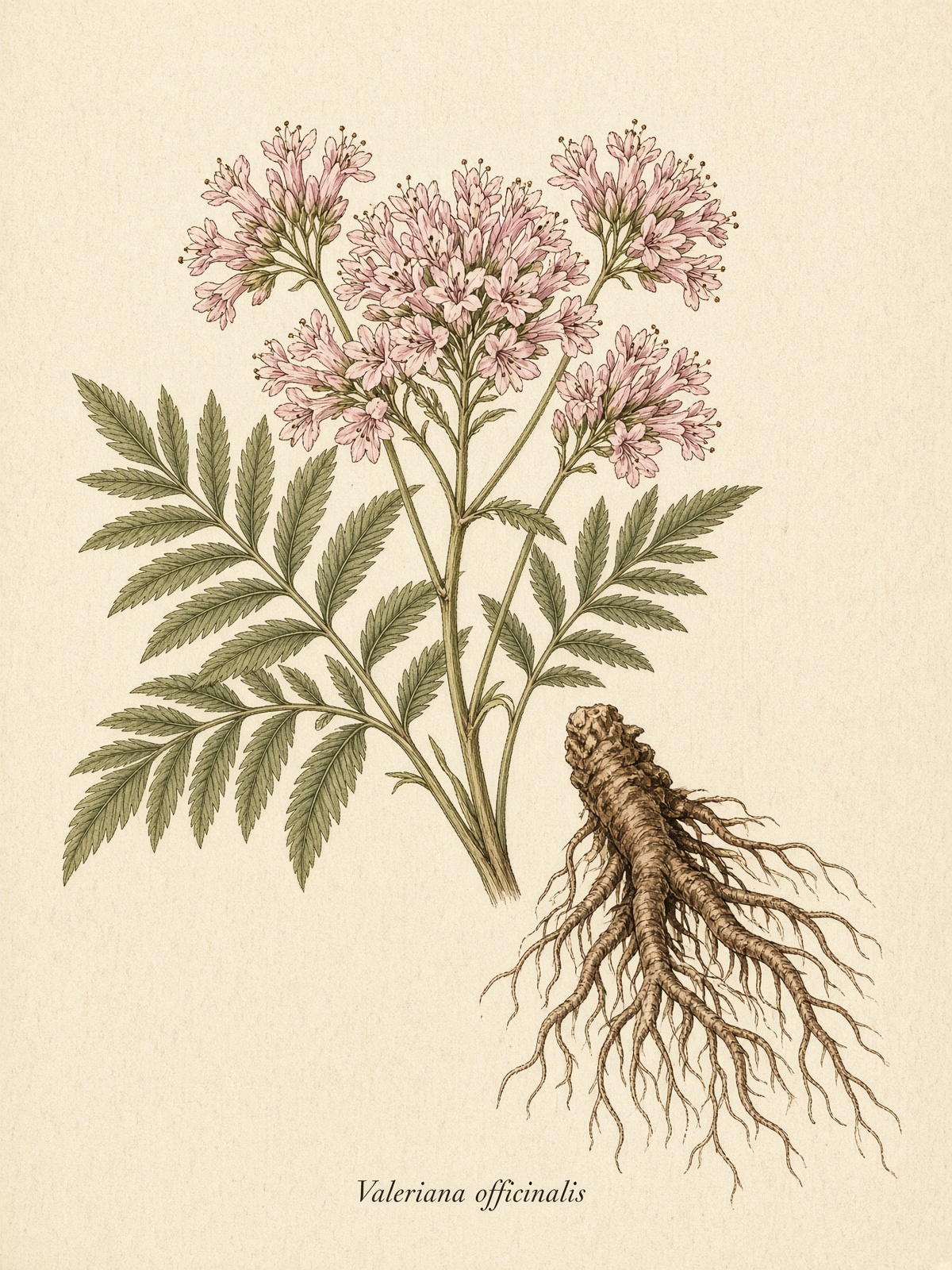 No. 007
Valerian
Valeriana officinalis
Foul-sweet root used as a non-habit-forming night herb — strong, uneven, not for everyone.
Warm earth, old socks, and sweet musk. The smell is the medicine.
Harvest: Second autumn — about 500–600 days from planting
Cats adore it for the same reason they adore catnip: a iridoid that looks to a feline like a good idea. Medieval Europe called it all-heal and tucked it into love charms. The dried root smells of dirty socks and vanilla, and no one has ever bottled that honestly as a perfume.
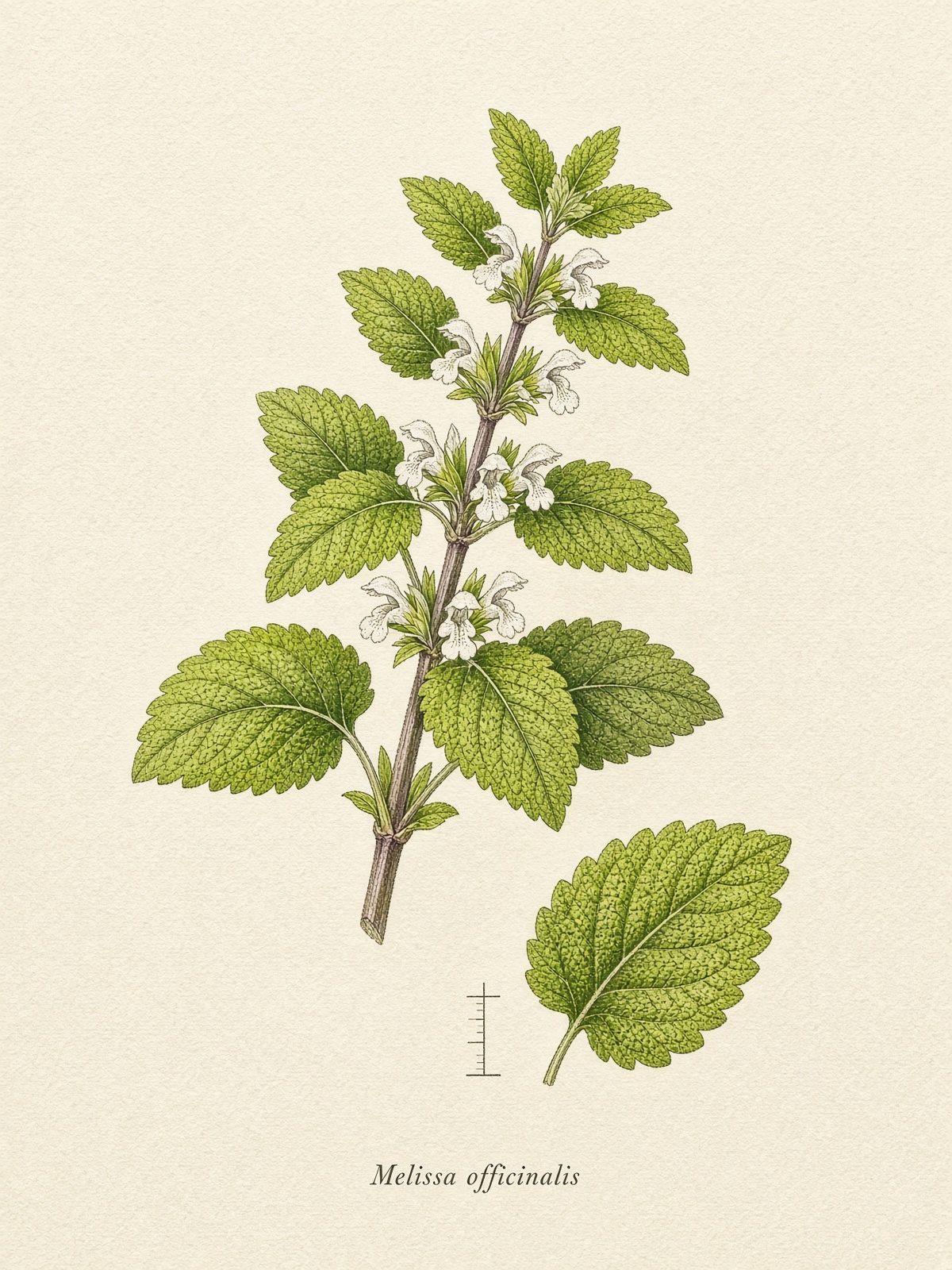 No. 008
Lemon balm
Melissa officinalis
Lemon-scented mint for fretful moods, a racing mind, and cold-sore lips.
Fresh lemon peel over green mint. Dried leaf is quieter.
Harvest: 60–75 days to the first full cut
Paracelsus called it the elixir of life. Carmelite water — a 17th-century lemon-balm spirit — was a convent’s idea of a cordial. Bees prefer it so strongly that the Greek melissa simply means bee.
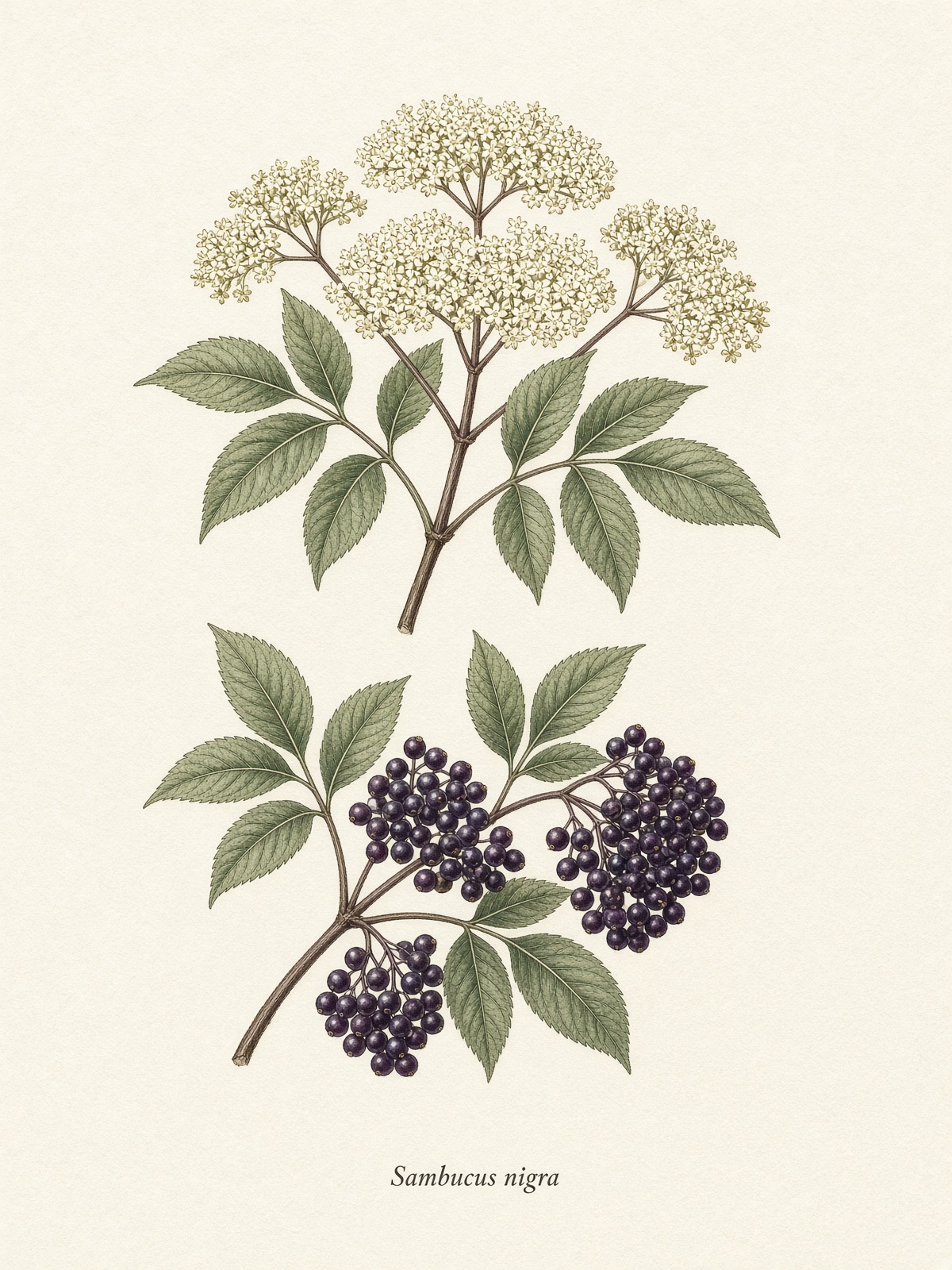 No. 009
Elderberry
Sambucus nigra
Dark berries cooked into syrup at the first winter cough — never eaten raw.
Cooked berries are jammy, wine-dark, and tart; flowers are honey-muscat.
Harvest: First real crop 365–730 days from a cutting
Cut an elder without asking and, in northern folklore, you answer to a woman who lives in the tree. The flowers make a cordial; the raw berries make a complaint. Hippocrates already knew the plant as a medicine chest with rules.
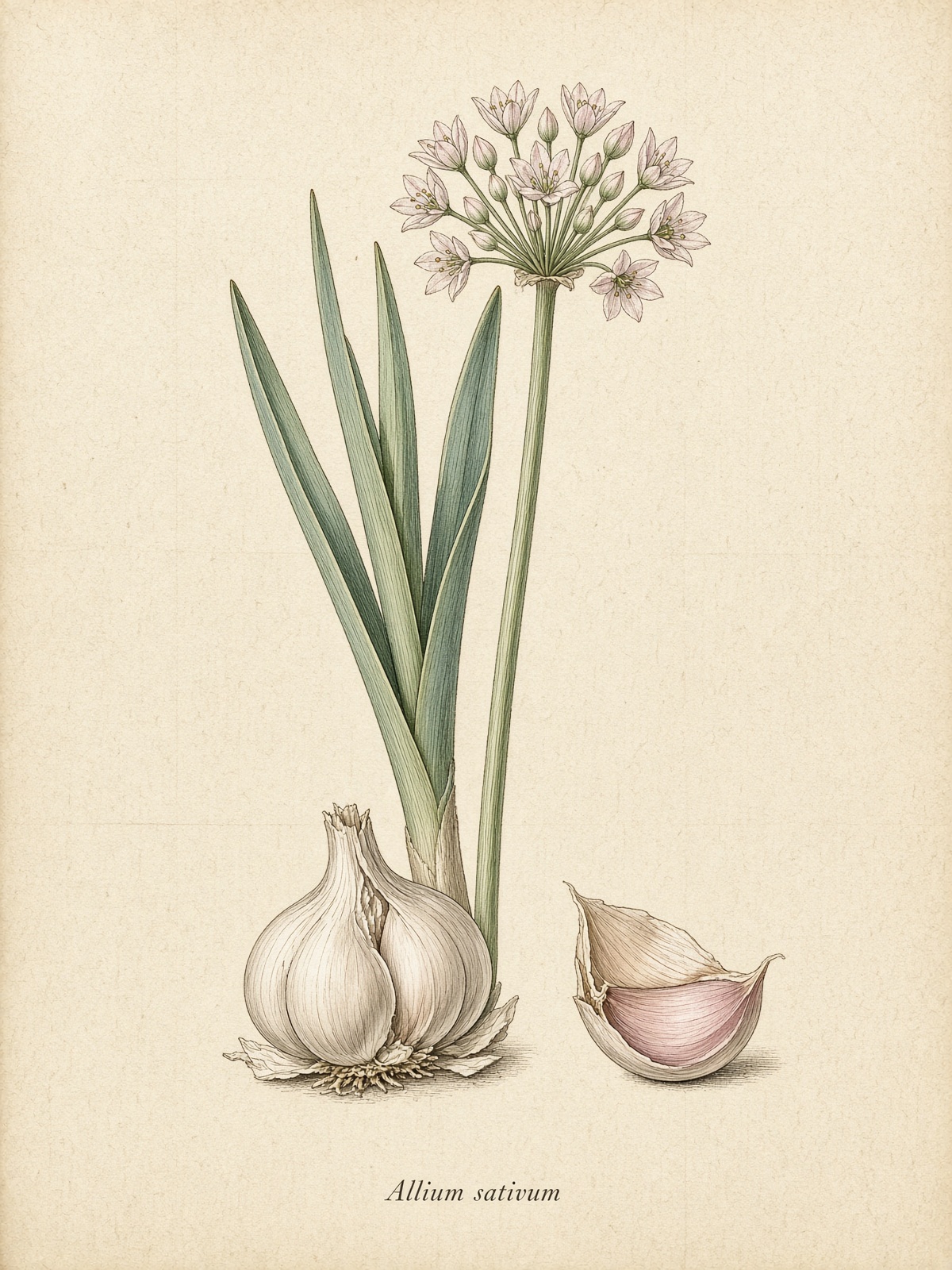 No. 010
Garlic
Allium sativum
The original kitchen antimicrobial — crushed raw for punch, roasted for daily food medicine.
Pungent allium heat that sweetens when roasted.
Harvest: 240–270 days from autumn cloves
Egyptian laborers took it as wages. Horace complained that it was rustic. During the plagues of Europe it hung in doorways, which did nothing for the plague and everything for the smell of the street. Allicin, the bite, only appears after the knife.
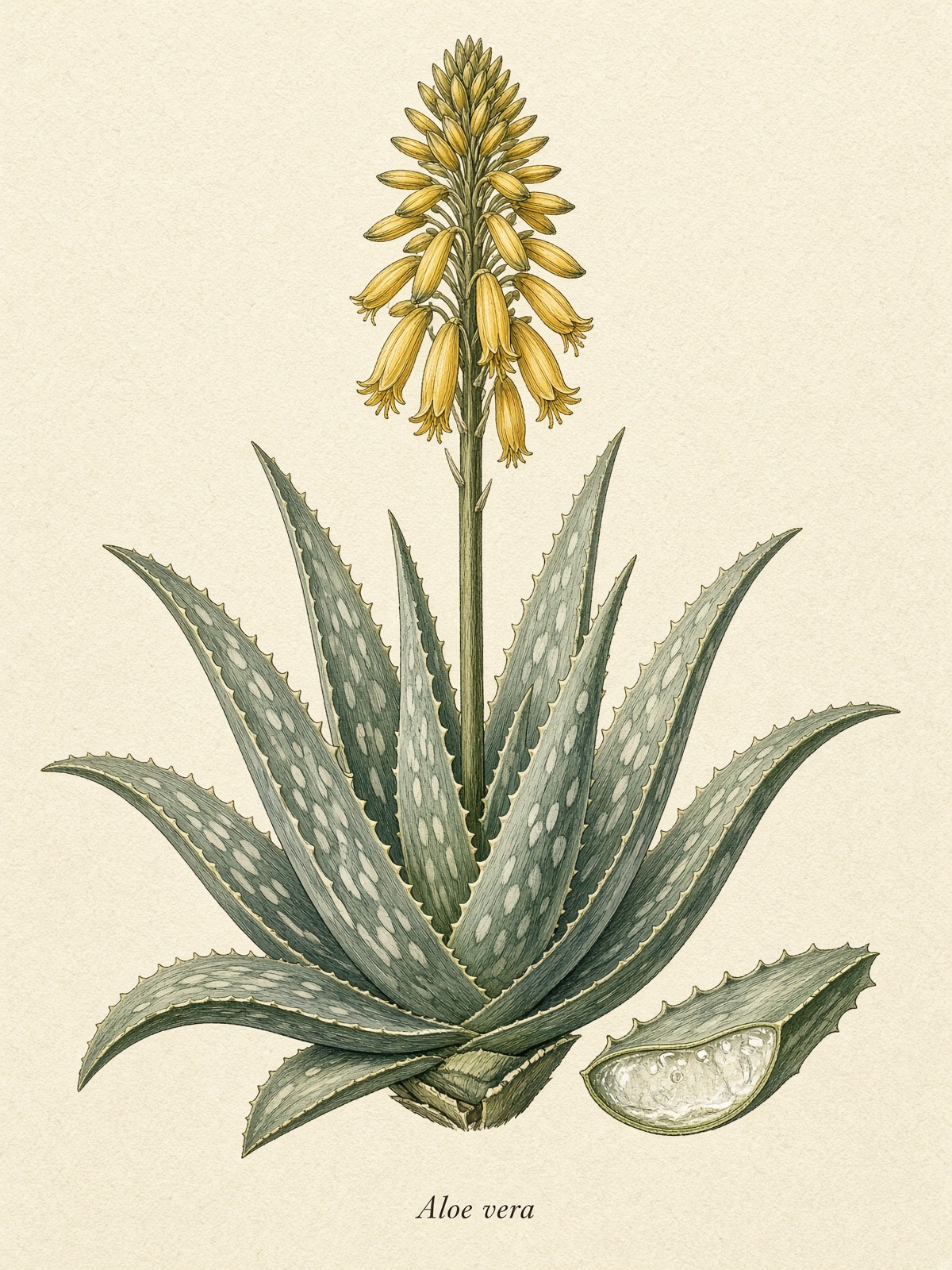 No. 011
Aloe
Aloe vera
A windowsill succulent: clear inner gel for burns — yellow latex is a harsh purgative.
Inner gel is almost flavorless, faintly green and slimy; the yellow latex is intensely bitter.
Harvest: 180–365 days to harvestable outer leaves
Cleopatra’s cosmetics lists are late gossip; what is sure is that the gel traveled the Red Sea as a wound plant for millennia. The yellow latex under the skin is a fierce laxative and a different drug from the clear gel. Rinse it off or you learn why.
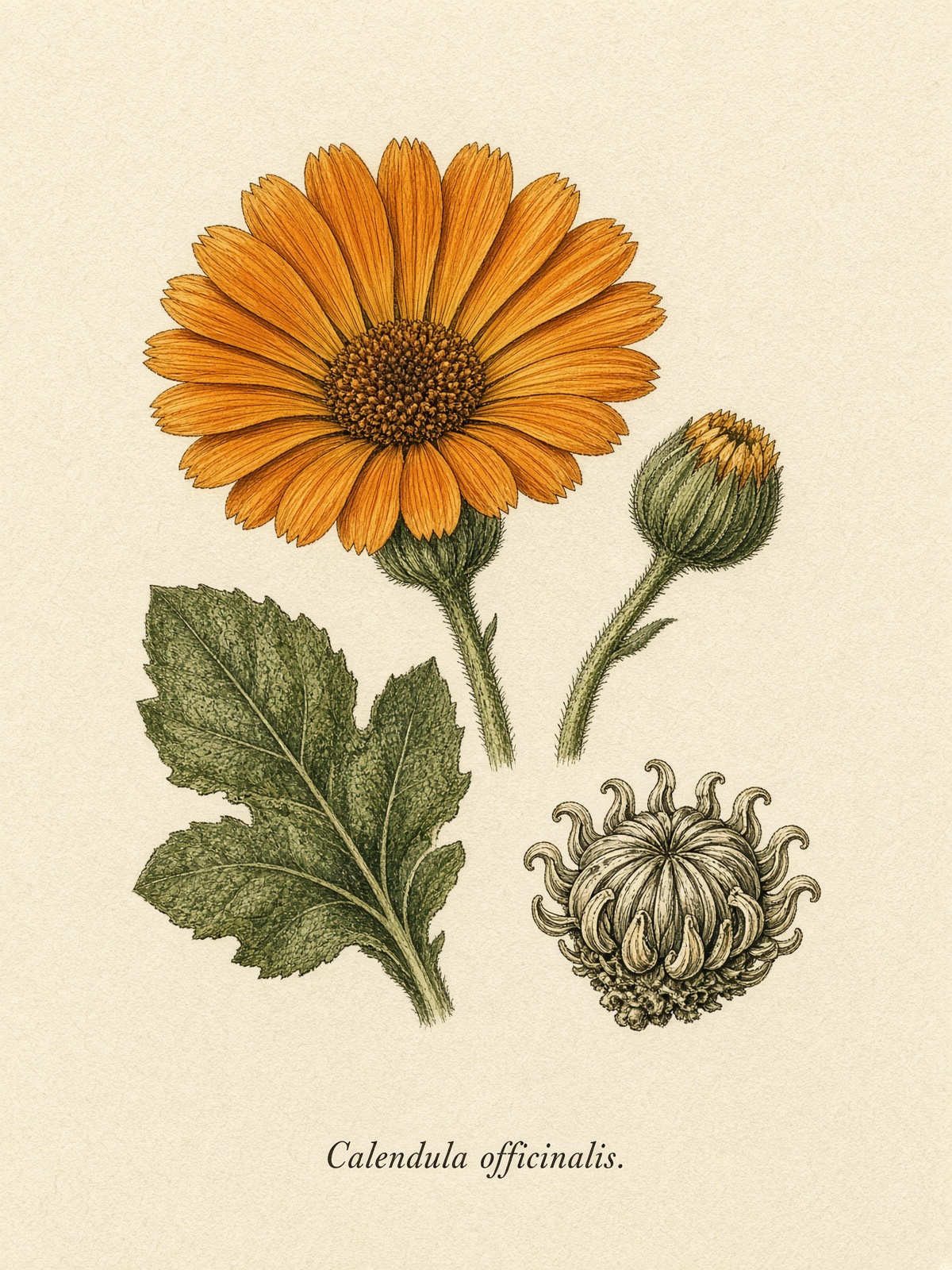 No. 012
Calendula
Calendula officinalis
Pot marigold — the herbalist's everyday skin flower.
Resinous, peppery petals with a marigold bitterness.
Harvest: 50–60 days from sow to first heads
It opens with the sun — calends, the first of the month — and medieval gardens used it as a poor man’s saffron for cheese and butter. The resinous petals still stain oil the color of a bruise salve, which is the other reason it was planted.
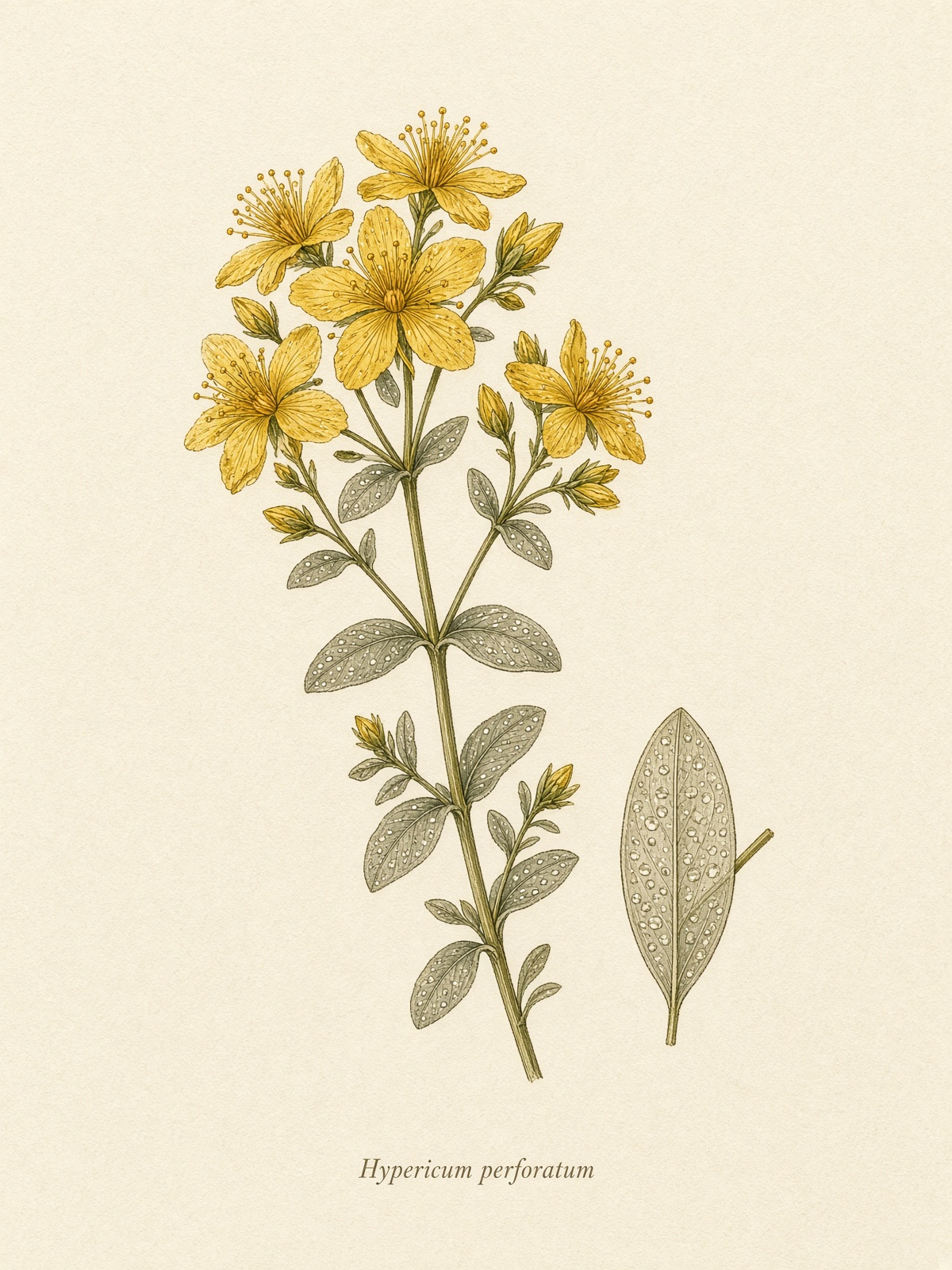 No. 013
St. John's wort
Hypericum perforatum
Sunshine-yellow roadside herb for low mood — famous, effective in mild cases, and a notorious interactor.
Astringent green, then a red-oil balsam. Fresh buds stain purple.
Harvest: 90–120 days of growth before a flowering cut
Picked on St. John’s Day and hung against lightning and low mood. Crush a bud: it bleeds purple. The same plant can make you sunburnt and can make a prescription disappear in the liver.
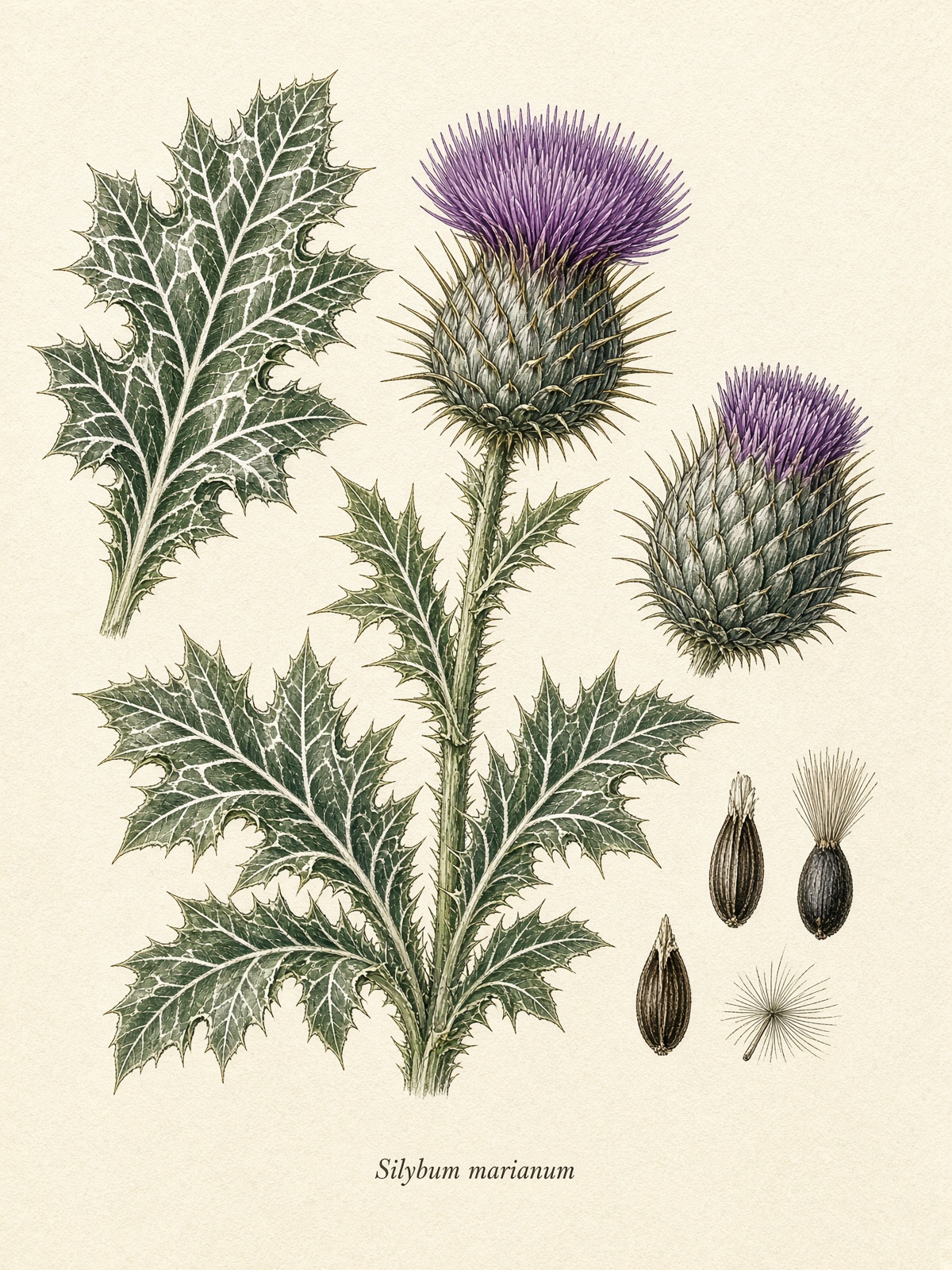 No. 014
Milk thistle
Silybum marianum
Spiny purple thistle whose seeds are the classic liver trophorestorative.
Seeds are oily, bitter, and faintly artichoke.
Harvest: 120–150 days seed-to-seed
Dioscorides already has a thistle for the liver. The white-splashed leaves were said to be Mary’s milk. Silymarin, the seed extract, is one of the few herbal products a modern liver clinic will actually discuss.
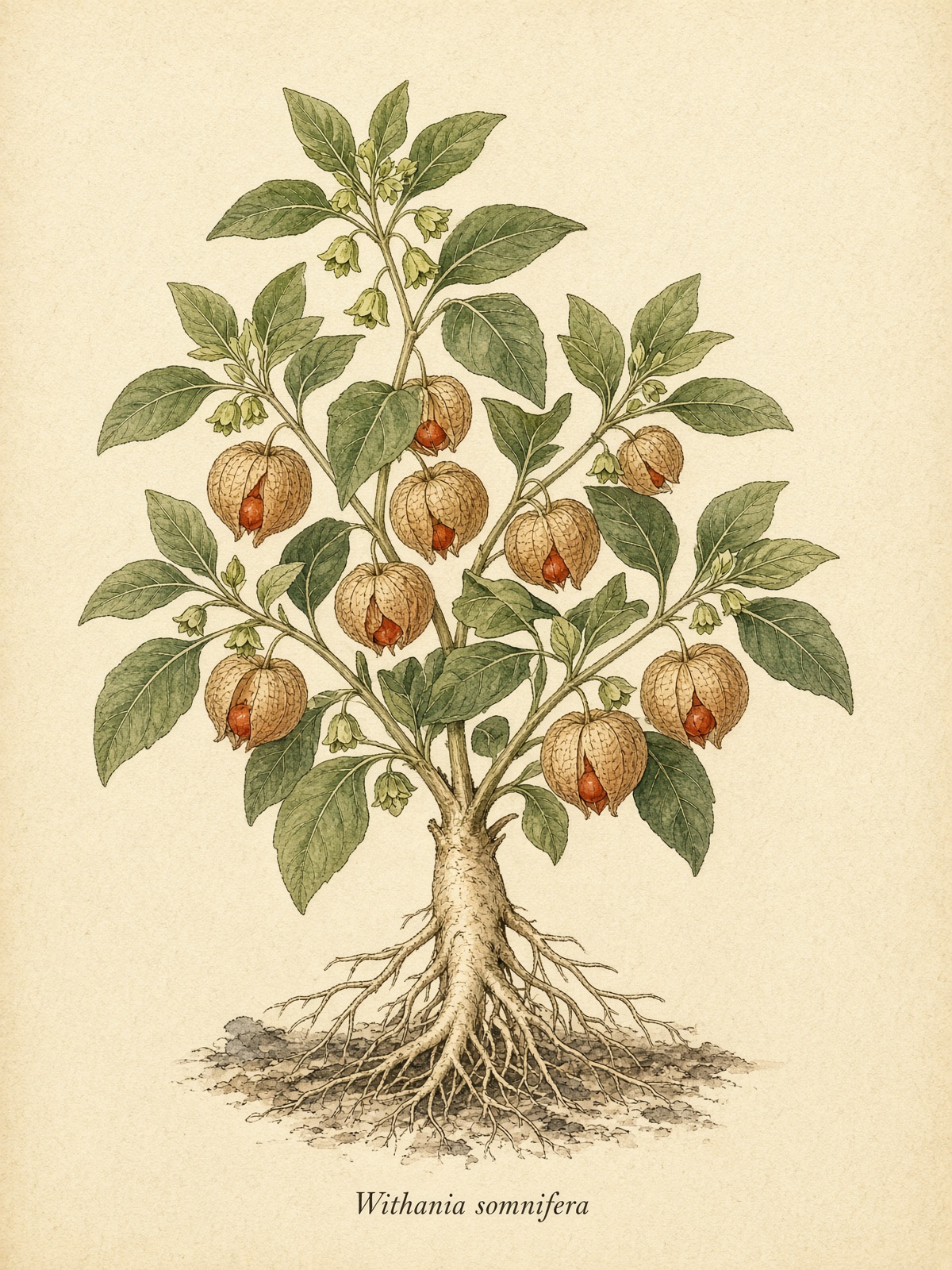 No. 015
Ashwagandha
Withania somnifera
Winter cherry root — an adaptogen for wired-and-tired nights, not a stimulant.
Horse-stable pungent, bitter, and earthy — traditionally hidden in warm milk.
Harvest: 150–180 days to a harvestable root
The name is Sanskrit for ‘smell of a horse’ — stamina, and also the stable. Ayurvedic texts treat the root as rasayana, a rejuvenative, not a coffee. The berries sit in papery lanterns like a quiet physalis.
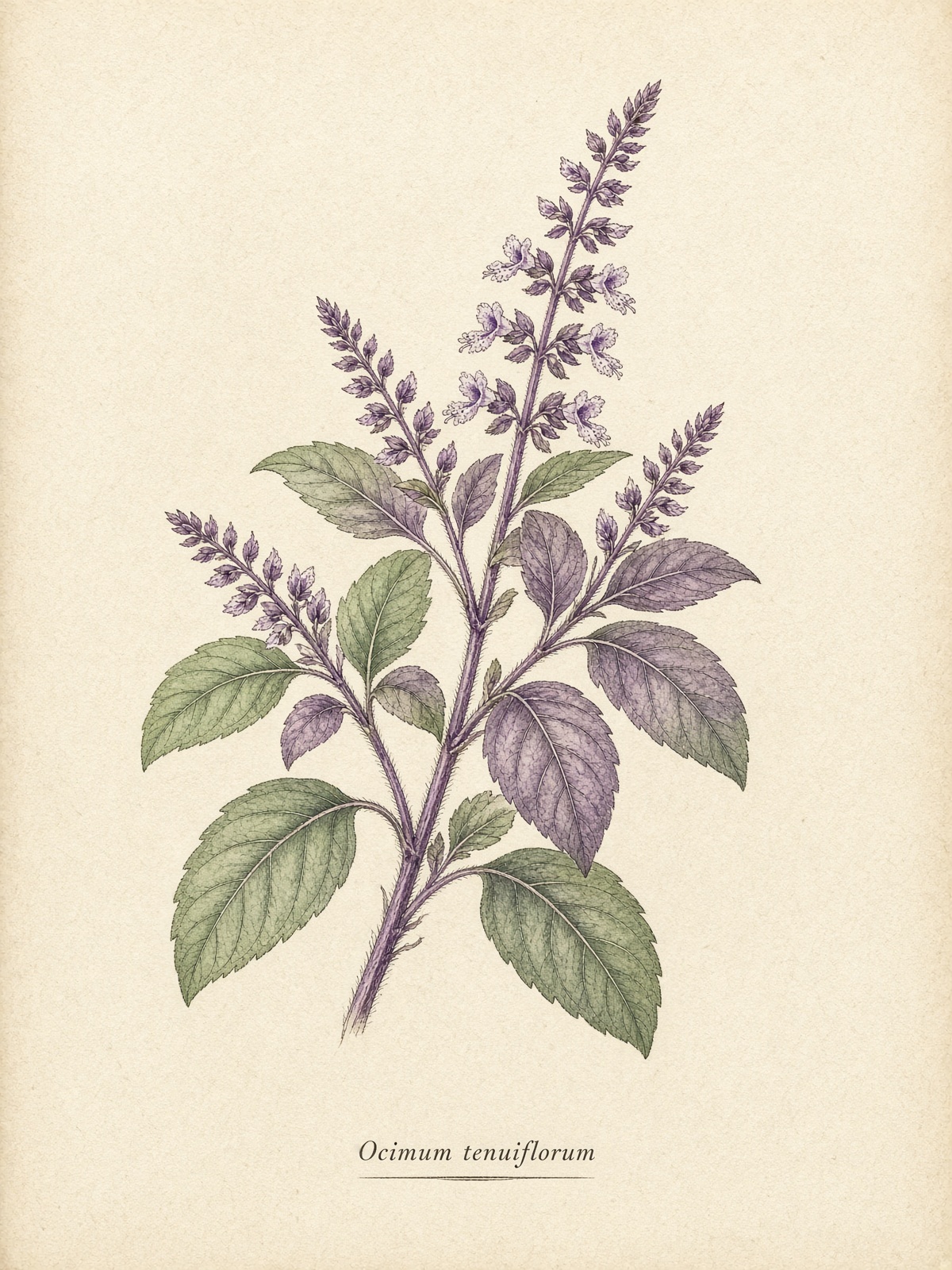 No. 016
Holy basil
Ocimum tenuiflorum
Tulsi — the daily adaptogen tea of Indian households, peppery and clarifying.
Pepper, clove, and sweet basil; Krishna types run more spicy.
Harvest: 60–80 days from transplant
Tulsi is a household goddess in many Indian homes, grown on a courtyard altar and not stepped over. Krishna types run purple and peppery; Rama types are greener. It is Ocimum tenuiflorum, not the pesto basil, and the clove smell is the first hint.
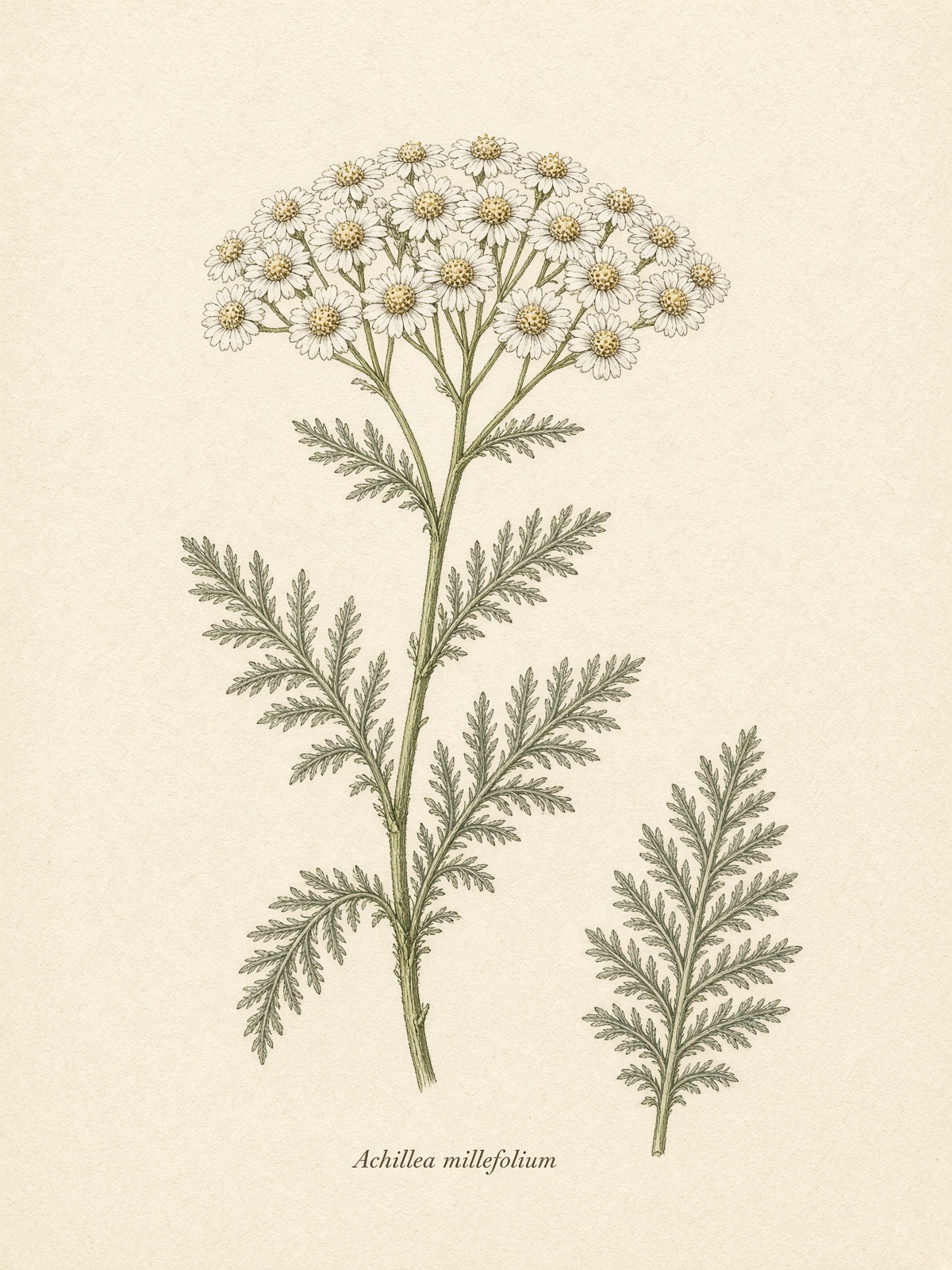 No. 017
Yarrow
Achillea millefolium
Achilles' woundwort — a bitter, aromatic styptic for fevers, cuts, and heavy moons.
Bitter, aromatic, and a little numbing — a true European bitter.
Harvest: 80–100 days first year; then perennial cuts
Achilles staunched wounds with it, hence Achillea. English names include soldier’s woundwort and nosebleed. The feathery leaf is a battlefield plant that later settled into a bitter digestive tea for villages that had run out of wars.
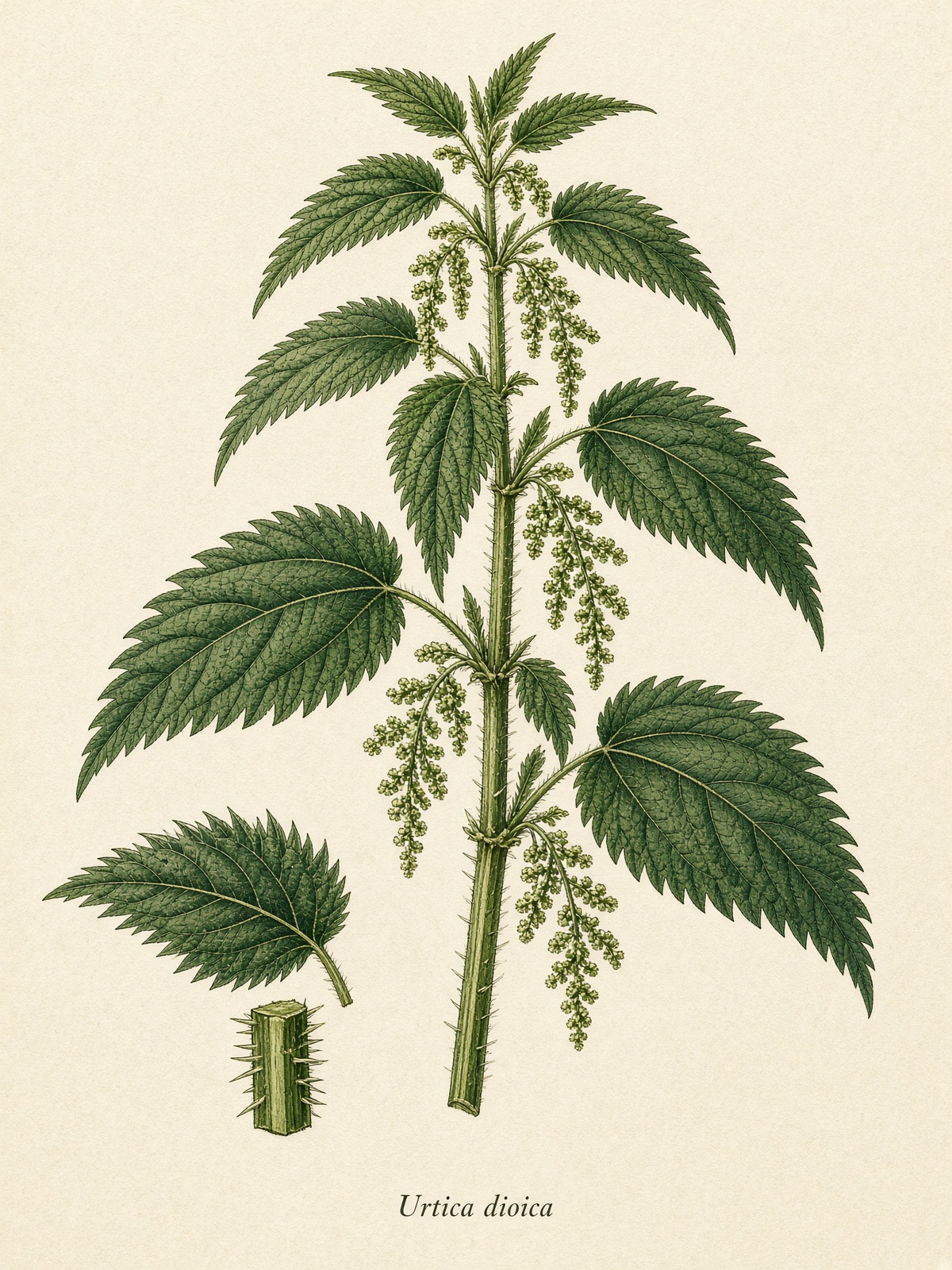 No. 018
Nettle
Urtica dioica
The mineral-rich weed that stings, then feeds — spring tonic, hay-fever leaf, prostate root.
Cooked leaf tastes like spinach and green tea, mineral and clean.
Harvest: 40–60 days for spring tops; roots in year 2
Roman soldiers in Britain were said to flog themselves with nettle to keep warm — a story too good to kill. The sting is formic acid and histamine, and it dies in the pot. Spring greens, cloth, and a mineral tea all come from the plant people step around.
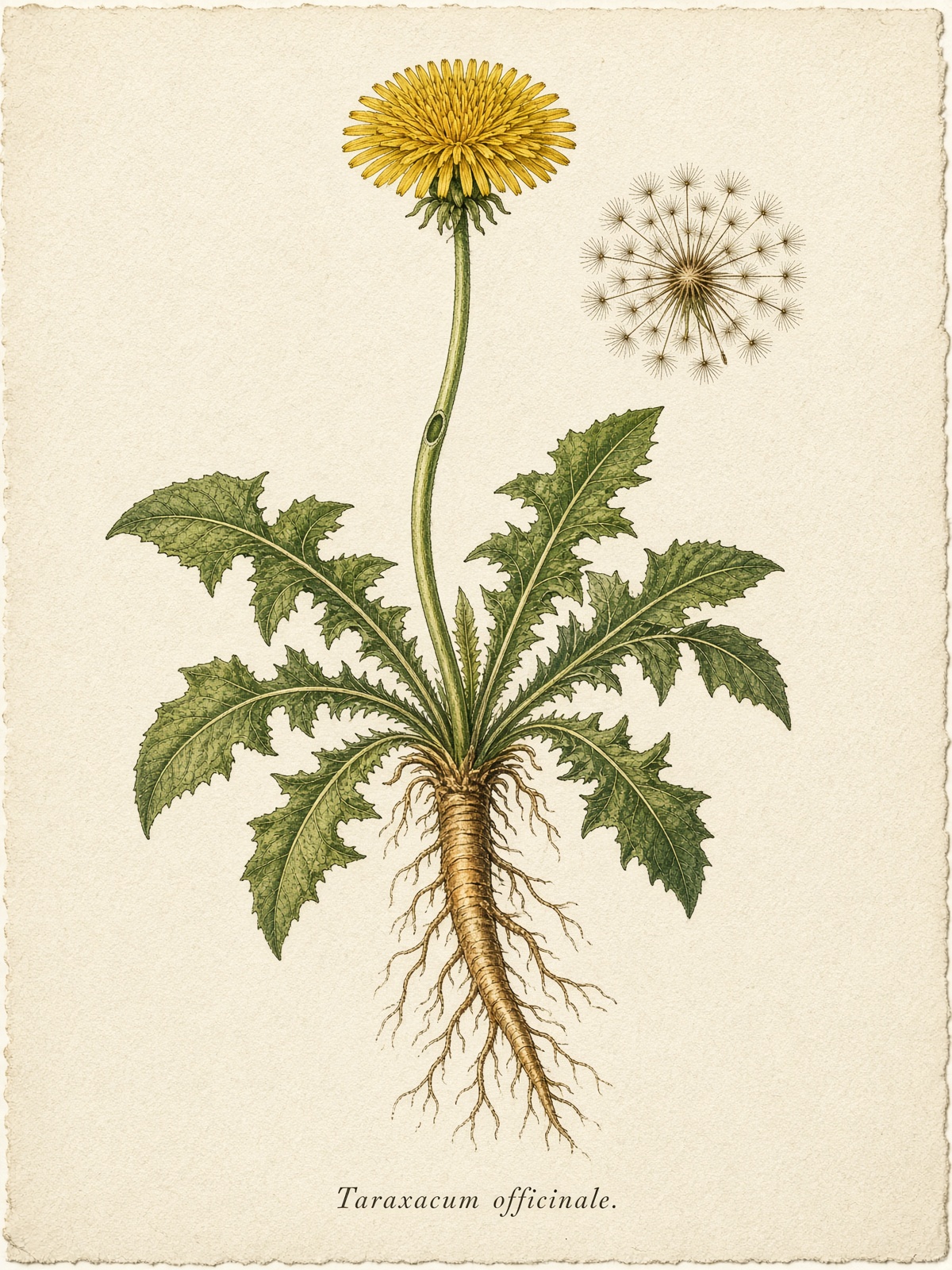 No. 019
Dandelion
Taraxacum officinale
The lawn's bitter physician — leaf as a potassium-rich diuretic, root as a liver bitter.
Leaf is bitter-green; roasted root is chicory, cocoa, and earth.
Harvest: 40–60 days for leaf; 150–180 days for a fat taproot
Dent-de-lion, lion’s tooth, for the leaf. French gardens still sell it as pissenlit, which is a diuretic joke in plain language. The taproot, roasted, fooled no one as coffee and pleased everyone as a bitter.
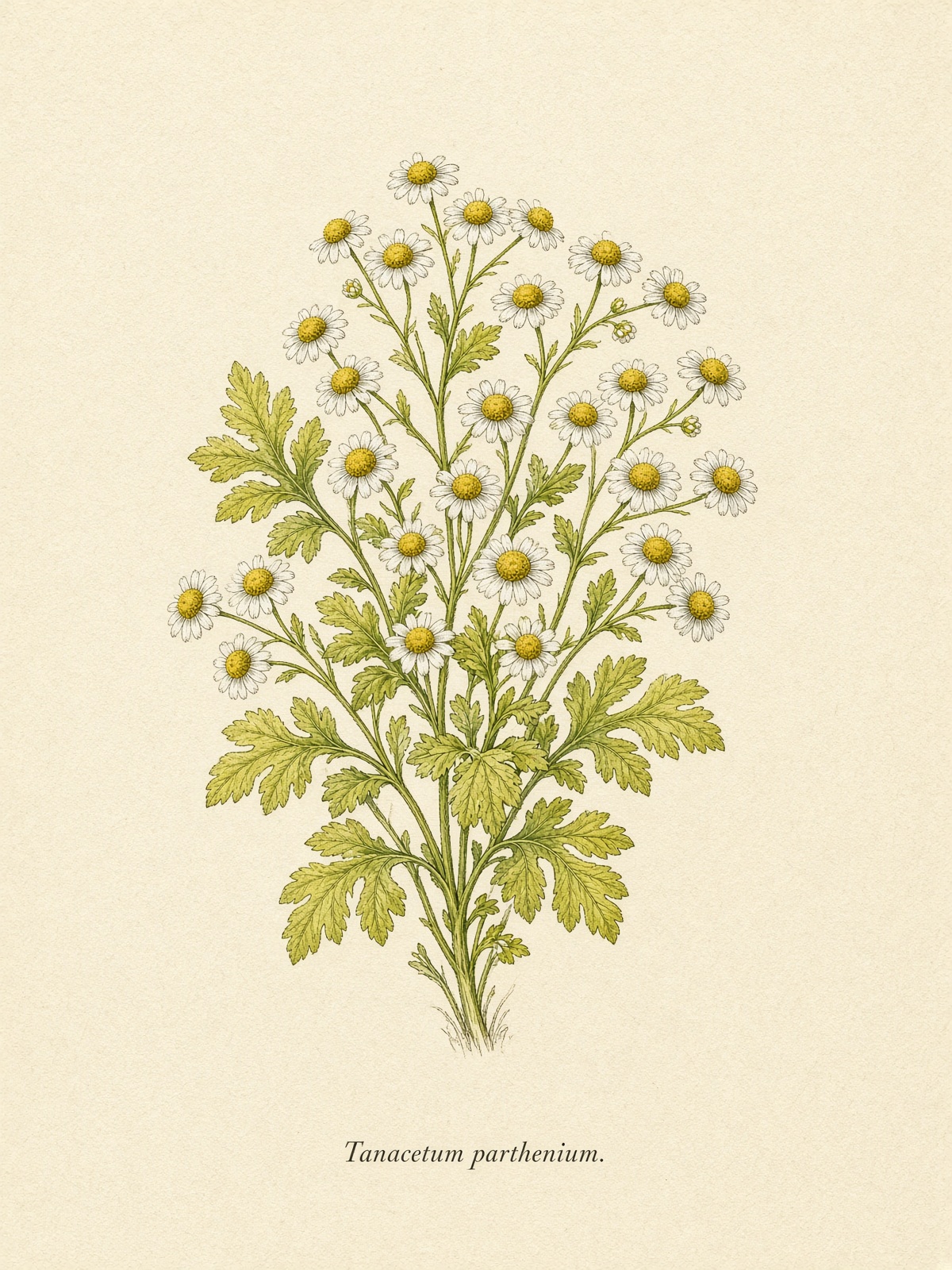 No. 020
Feverfew
Tanacetum parthenium
Tiny daisy chewed (or encapsulated) to cut the frequency of migraine — a prevention herb, not a rescue drug.
Harsh, bitter daisy. Fresh leaf bites the mouth.
Harvest: 70–90 days to a usable leaf flush
Medieval ‘featherfew’ was a fever plant; modern trials are about migraine. Chewing the fresh leaf can ulcerate the mouth, which is why the old advice was a sandwich of bread around it. A cottage-garden daisy with a sharper job than it looks.
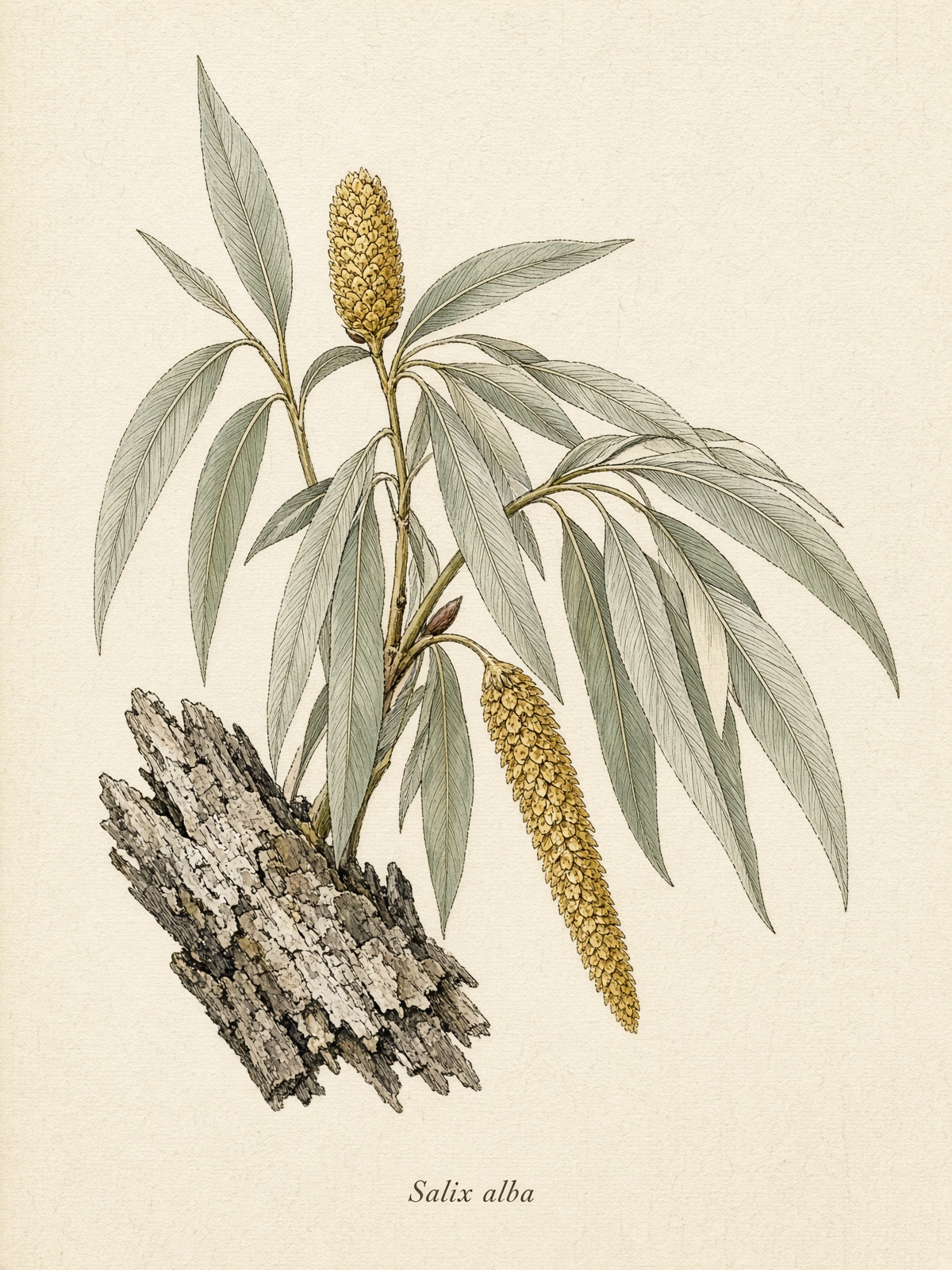 No. 021
White willow
Salix alba
Riverside tree whose bitter bark is the folk parent of aspirin, used for dull inflammatory pain.
Aspirin-bitter bark with a green willow astringency.
Harvest: Bark from prunings after year 3 (not a first-season crop)
Hippocrates chewed the bark; the 19th century found salicin in it and then invented aspirin, which is the same idea with the gut-bleeding turned up. The tree likes wet feet. The tea is bitter in the way a clinic is bitter.
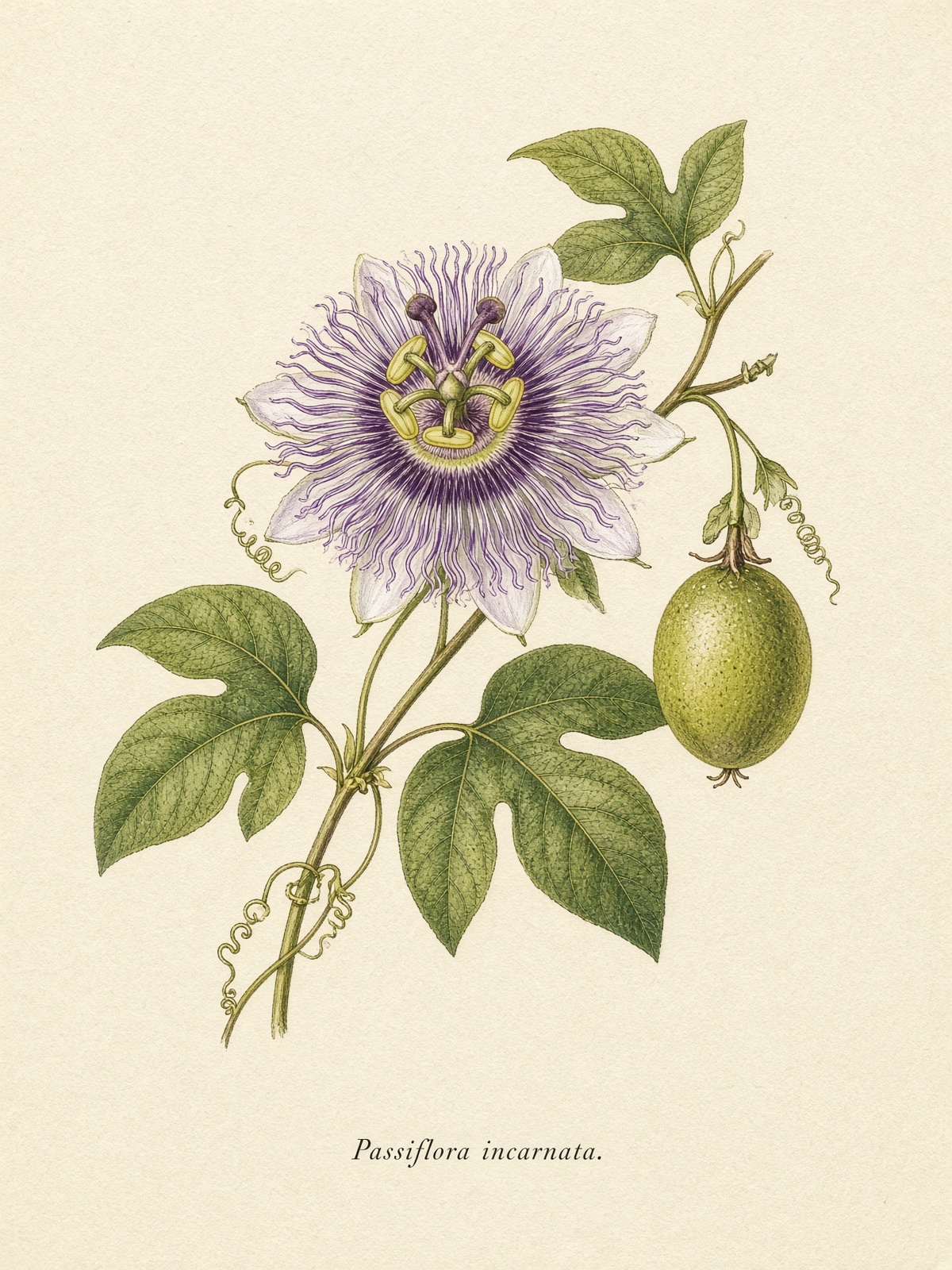 No. 022
Passionflower
Passiflora incarnata
A climbing vine with baroque flowers, used when the mind will not step off the wheel.
Green, hay-like, faintly floral — not a fruit-juice flavor.
Harvest: 90–120 days to flowering vines
Spanish priests in the Americas read the corona as the crown of thorns and named it for the Passion. The maypop of the southeast is the hardy one, not the tropical fruit. It is a vine that looks decorative until you notice people sleep after the tea.
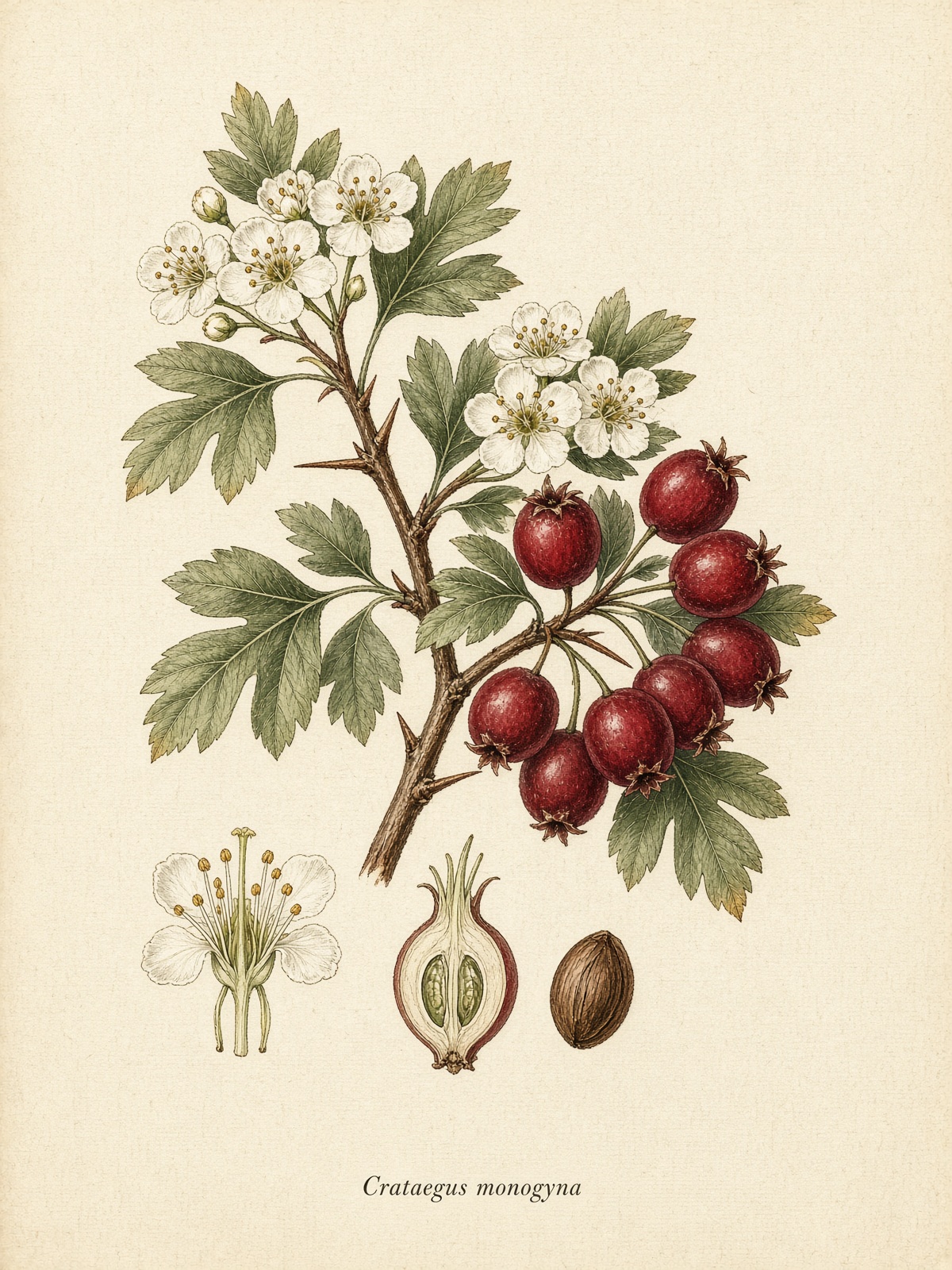 No. 023
Hawthorn
Crataegus monogyna
Hedgerow thorn whose leaf, flower, and berry are Europe's classic heart trophorestorative.
Berry is mealy, tart-sweet, like a dry haw and apple skin.
Harvest: First haws in year 3–5
A hedge plant of boundaries and, in British folklore, unlucky to bring indoors. The berries are a mild cardiac tonic in the European record, a mealy fruit in the hand. May blossom smells of sex and almonds; the old songs knew.
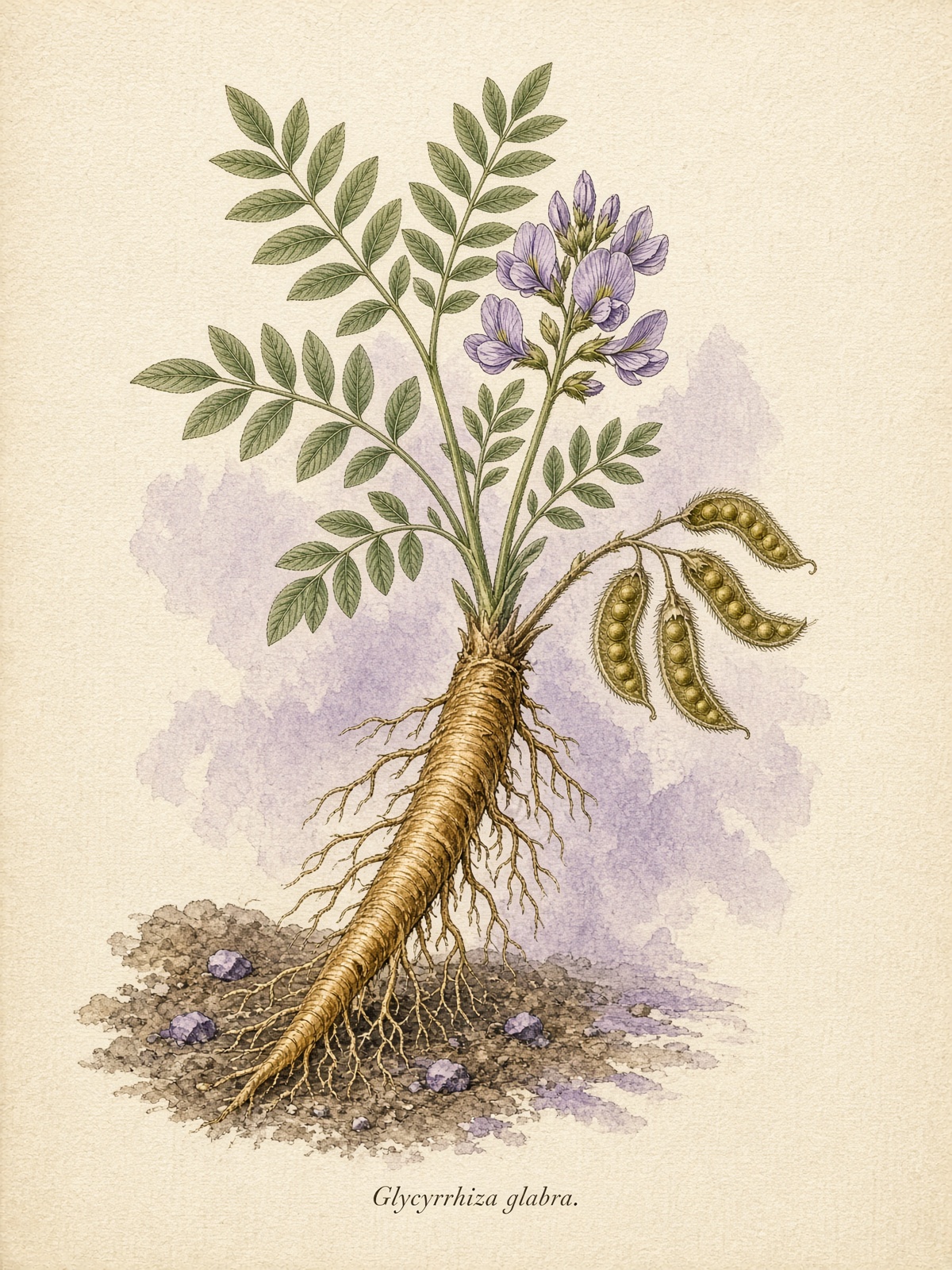 No. 024
Licorice
Glycyrrhiza glabra
Sweet root that soothes mucosa and supports adrenals — and can raise blood pressure if overused.
Intense sweet anise; aftertaste is woody and a little salty.
Harvest: 1,000–1,400 days (year 3–4) for a decent root
Pharaohs were buried with it. The sweetness is glycyrrhizin, fifty times sugar, and the reason a daily pot can raise blood pressure and drop potassium. Dutch drop and Chinese gan cao are the same root in different kitchens.
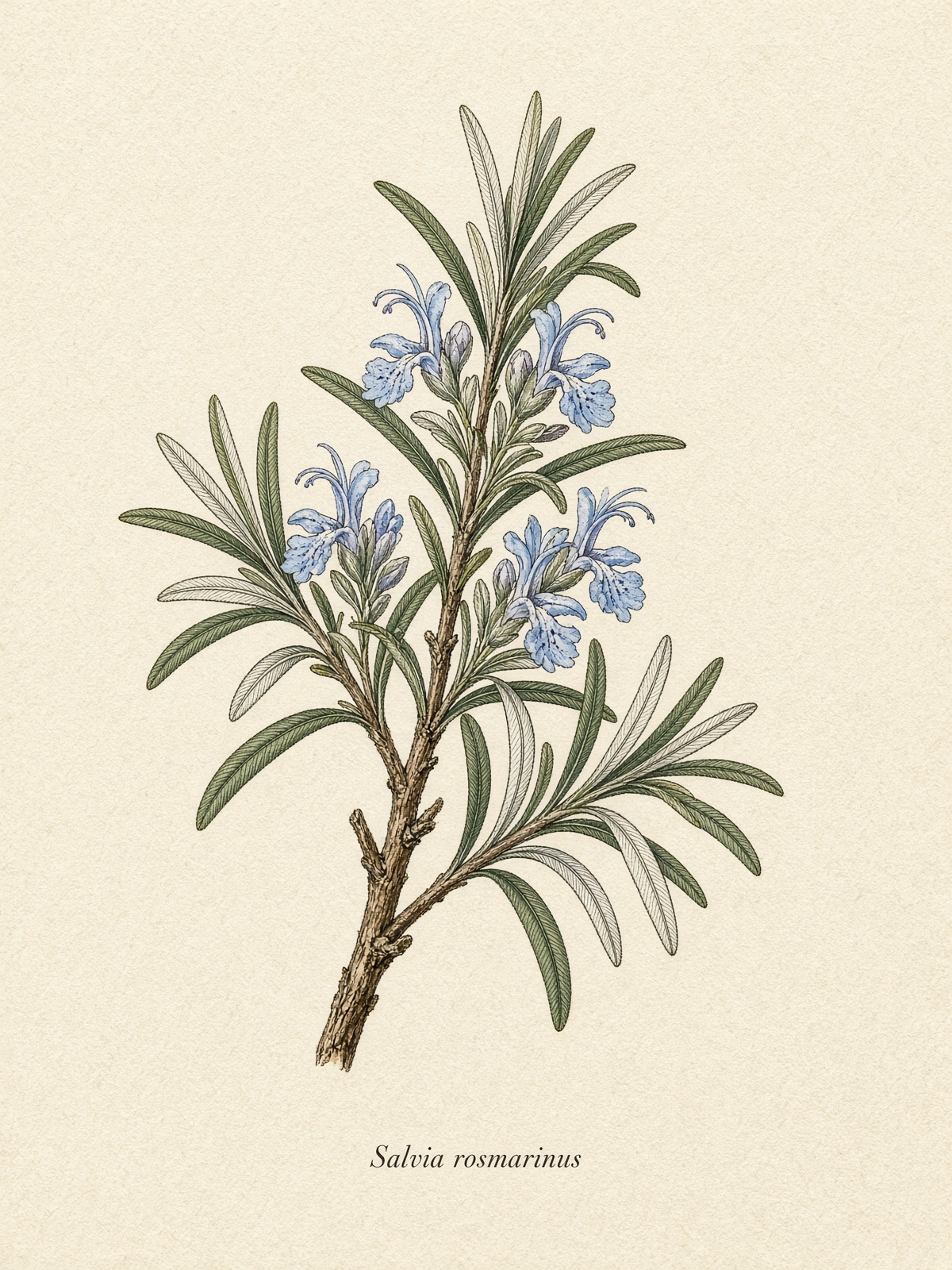
No. 045Rosemary
Salvia rosmarinus
A resinous Mediterranean shrub for memory, circulation, and roast potatoes.
Pine, camphor, and lemon peel — a resinous heat that lingers.
Harvest: 90–120 days from a cutting to a useful bush
Ophelia hands it out for remembrance. Students in Greece supposedly wore it for exams. The Latin ros marinus is dew of the sea, a cliff plant that learned to live in pots and pork roasts.
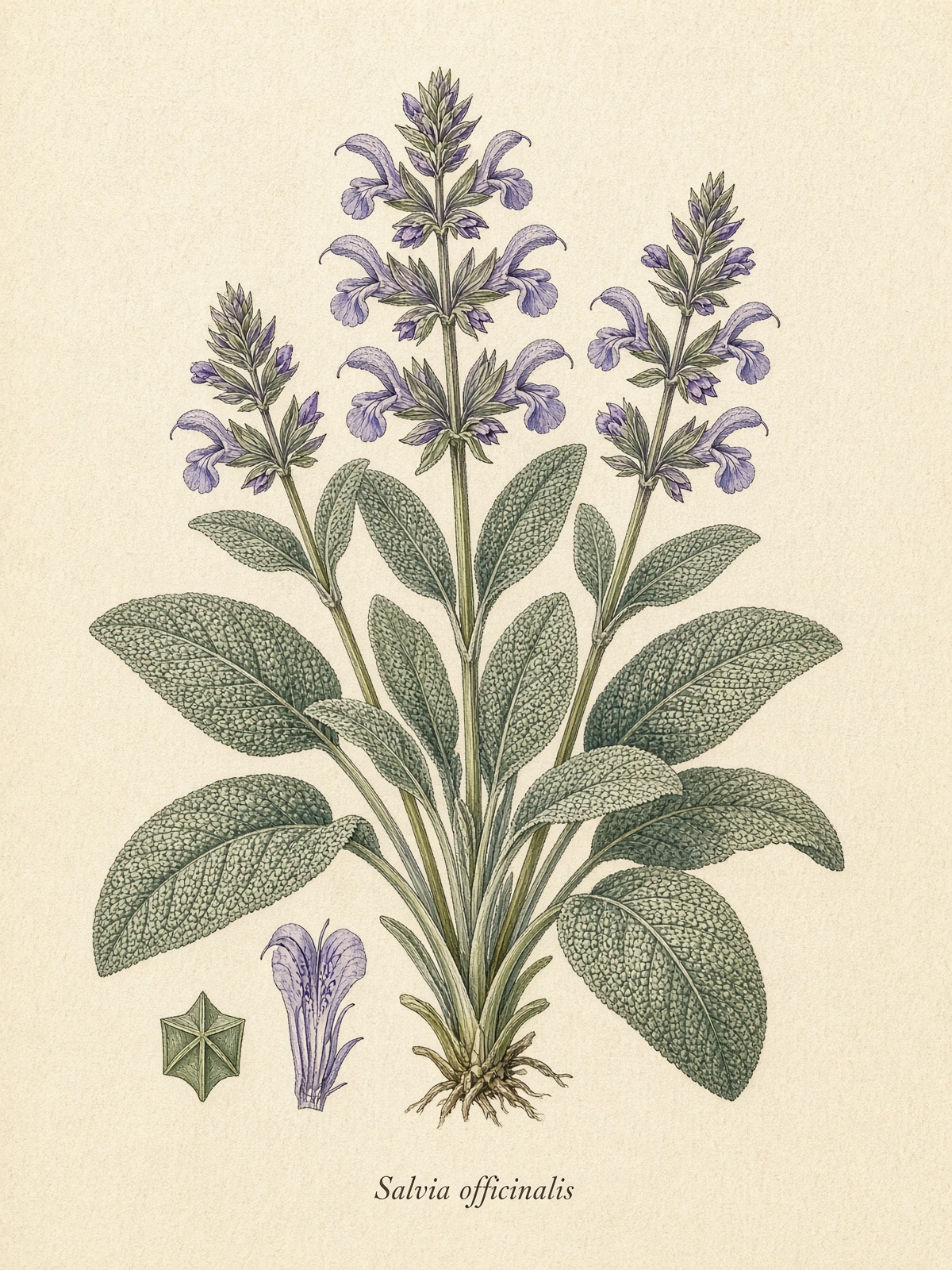 No. 046
Garden sage
Salvia officinalis
The grey kitchen sage — a drying, aromatic leaf for sore throats and rich food.
Camphor, eucalyptus, and a dry velvety bitterness.
Harvest: 70–90 days from a young plant
Salvia, to save. Roman tables and medieval infirmaries agreed on the leaf. The garden plant is not Salvia divinorum. A gargle is an old sore-throat trick; a quart a day is how you meet thujone.
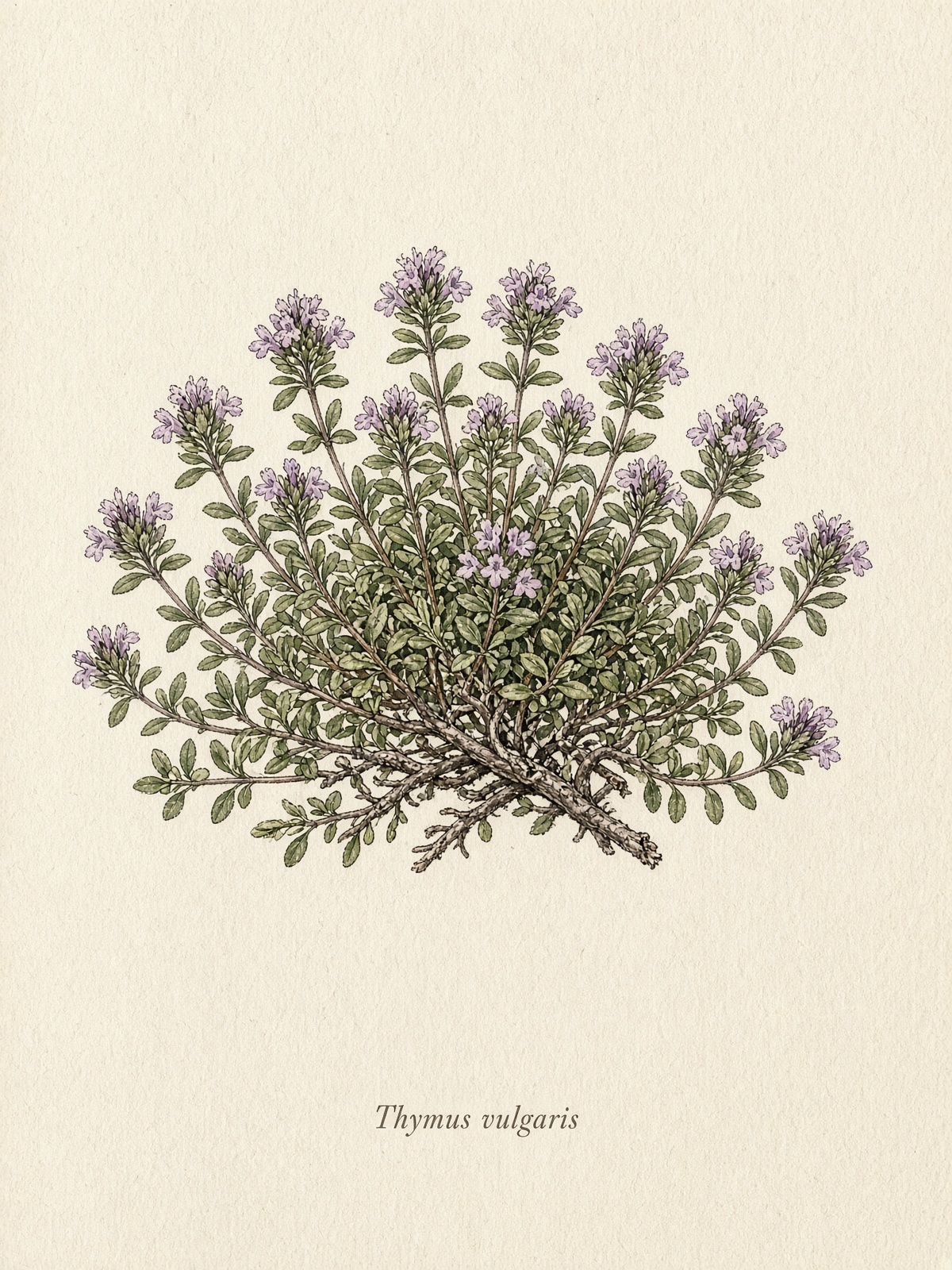 No. 047
Thyme
Thymus vulgaris
A low cushion of thymol — the classic kitchen antimicrobial for coughs.
Warm, medicinal-savory, lemon-pepper when you bruise a leaf.
Harvest: 60–80 days from a small plant
The Greek thymos meant both the herb and courage. Medieval Europe put it under pillows for sleep and into the mouths of knights. Thymol, later, became the antiseptic in the medicine cabinet that still smells like a roast chicken.
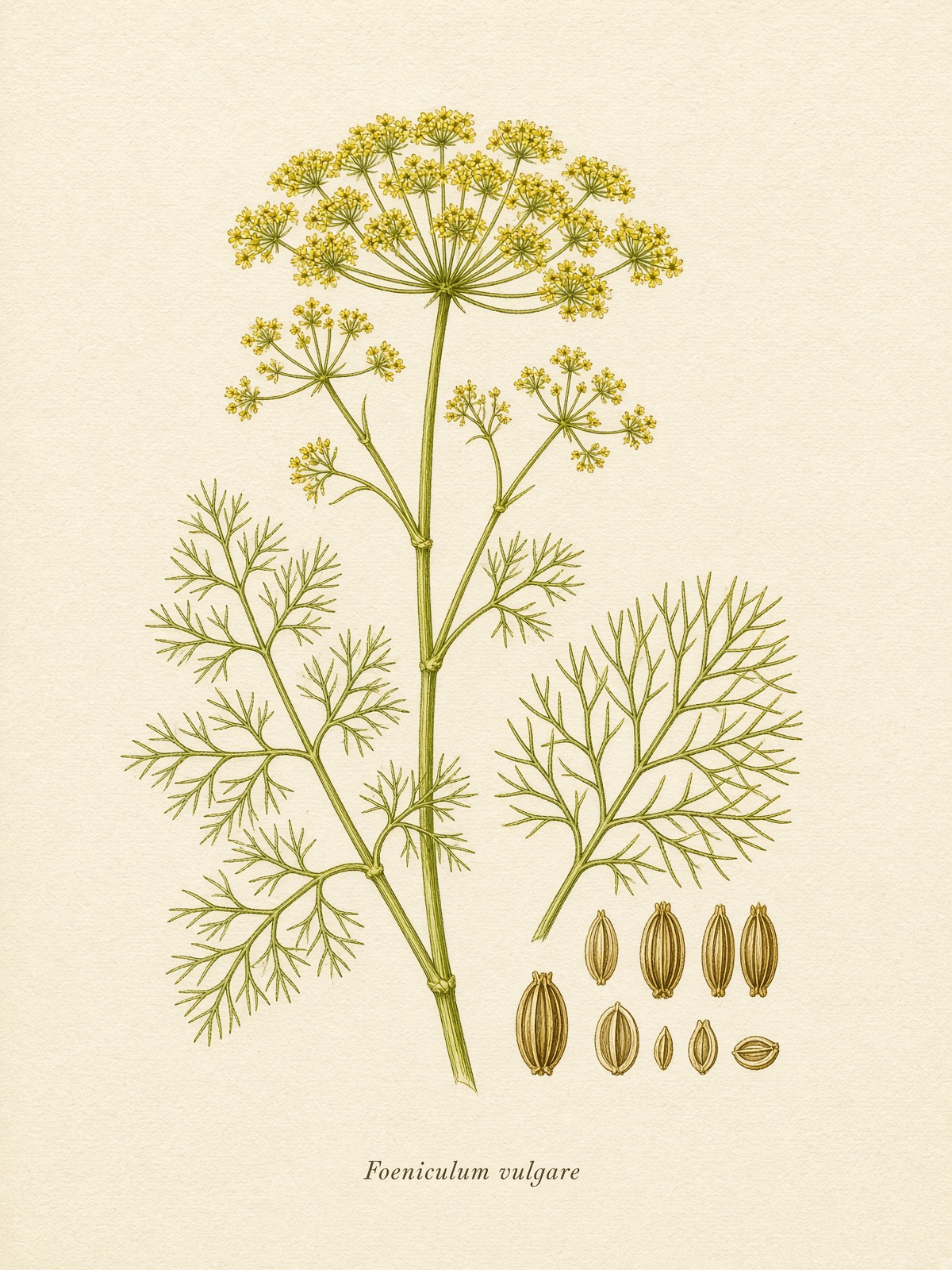 No. 048
Fennel
Foeniculum vulgare
Anise-sweet seed for gas, colic folklore, and after-dinner breath.
Sweet licorice and warm green anise. Seed is sweeter than leaf.
Harvest: 80–100 days for bulb; 120–150 days for ripe seed
Prometheus hid fire in a fennel stalk. Roman women chewed the seed to keep hunger off; the bulb is a later, sweeter invention. The feathery leaf is why people confuse it with things that kill you — look, then cook.
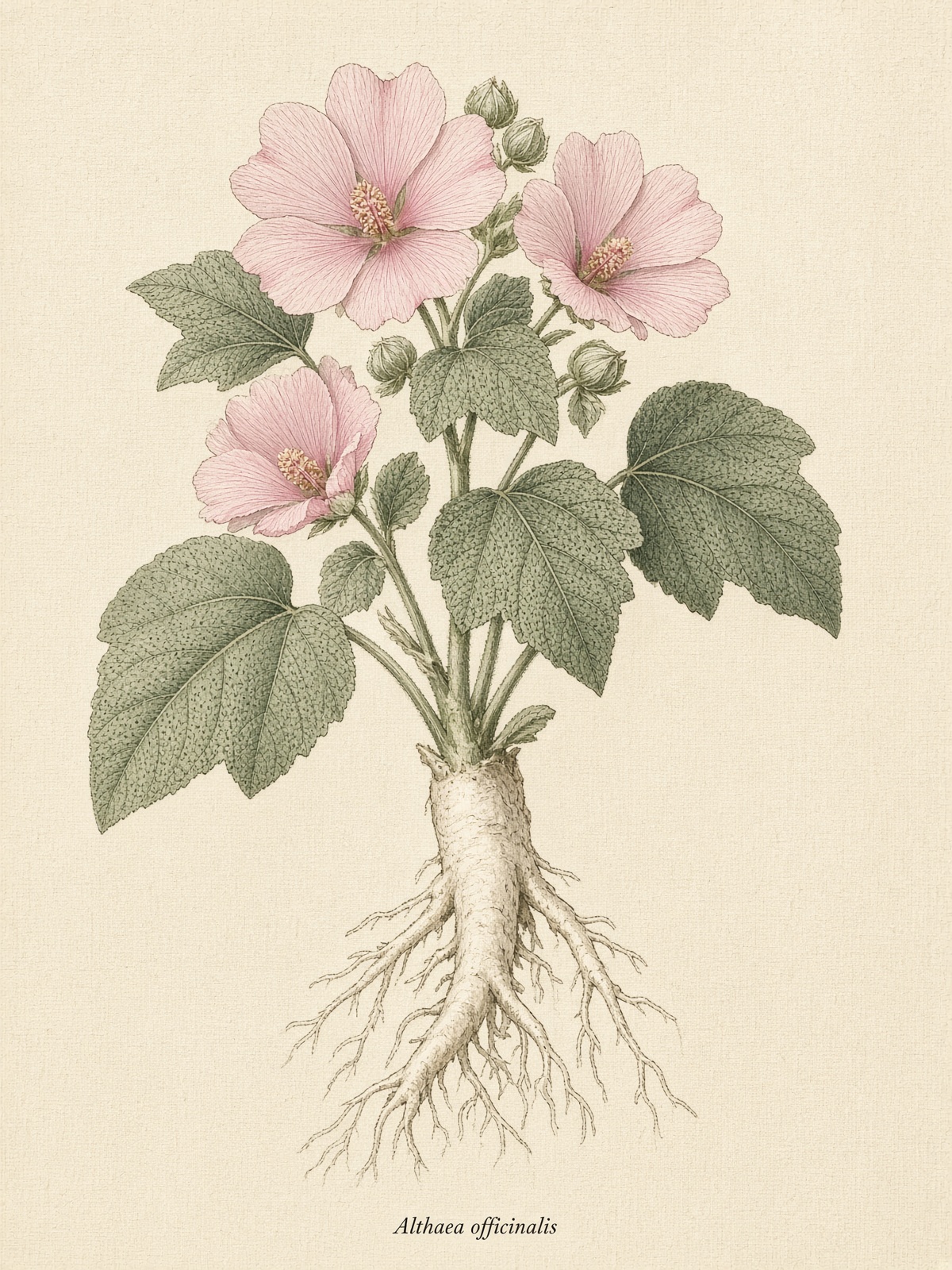 No. 049
Marshmallow
Althaea officinalis
A velvety marsh mallow whose root and leaf soothe raw mucosa.
Mild, sweet-vegetal, and distinctly slippery — almost no bitterness.
Harvest: Leaf 80–100 days; root ~500 days (second autumn)
The original marshmallow was a mucilage candy from Althaea root, not a petroleum puff. Marsh mallows grew in salt ditches. The slippery tea is the plant remembering its confectionery past.
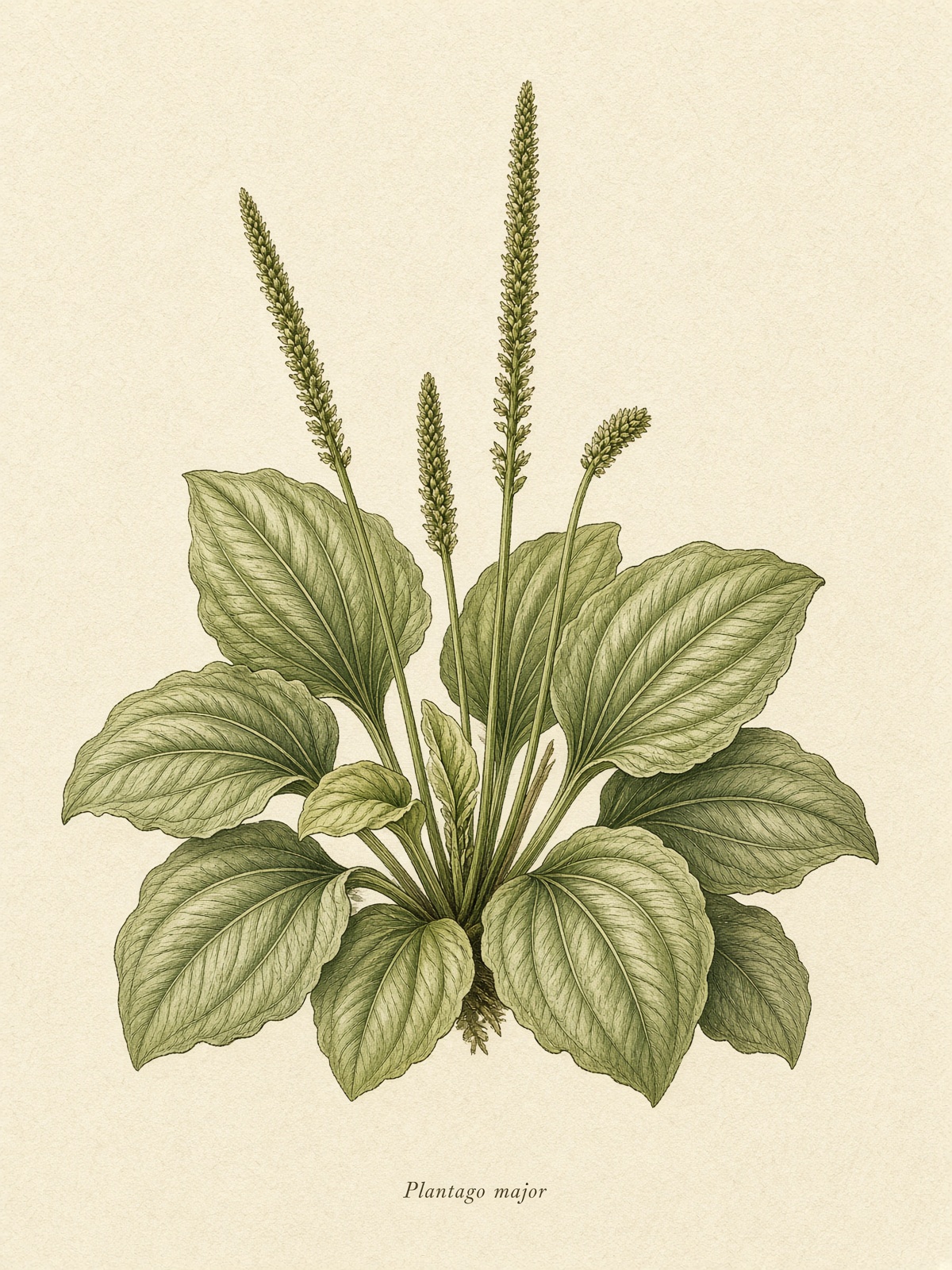 No. 050
Plantain
Plantago major
The ribbed lawn weed you step on — a first-aid leaf for bites and scrapes.
Green, mushroomy, a little salty — a wild salad leaf when young.
Harvest: 40–60 days from sow; wild plants are ready now
White man’s footprint, because the seed followed European shoes around the world. A ribbed rosette in every lawn. The leaf pulled over a bee sting is the oldest first-aid kit that does not require a kit.
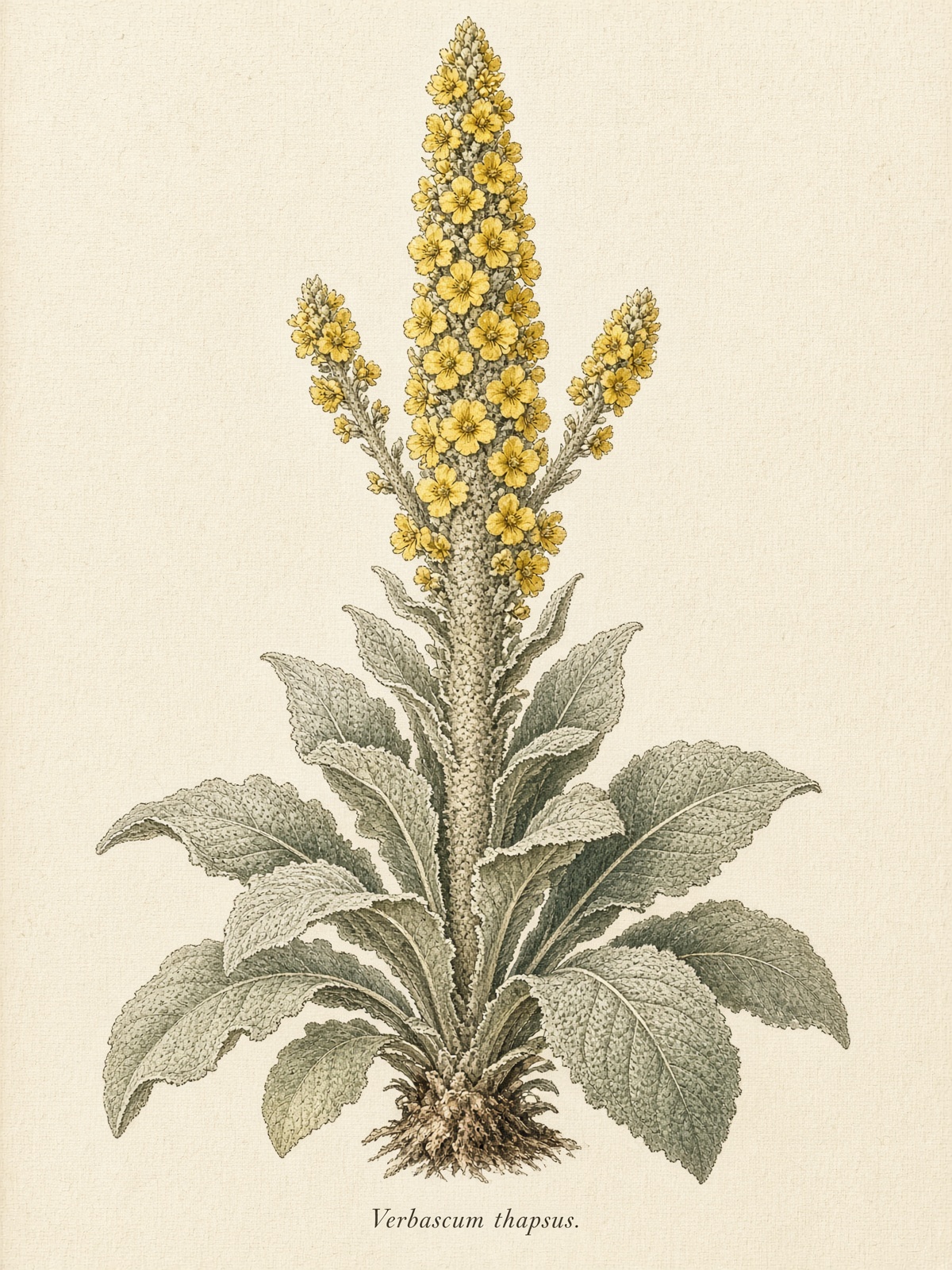 No. 051
Mullein
Verbascum thapsus
A woolly candelabra for the lungs — flowers also oil for the ear in folk practice.
Mild, sweet-tea, a little vanilla if the flowers are in. Hairs make it fuzzy unless strained.
Harvest: Leaf from day 60; flowers in year 2 (~400 days)
Hag’s taper: the dried stalk dipped in tallow was a torch. Roman soldiers are said to have done the same. The felted leaf is a lung tea if you strain the hairs, and a shoe-liner in a pinch of folklore.
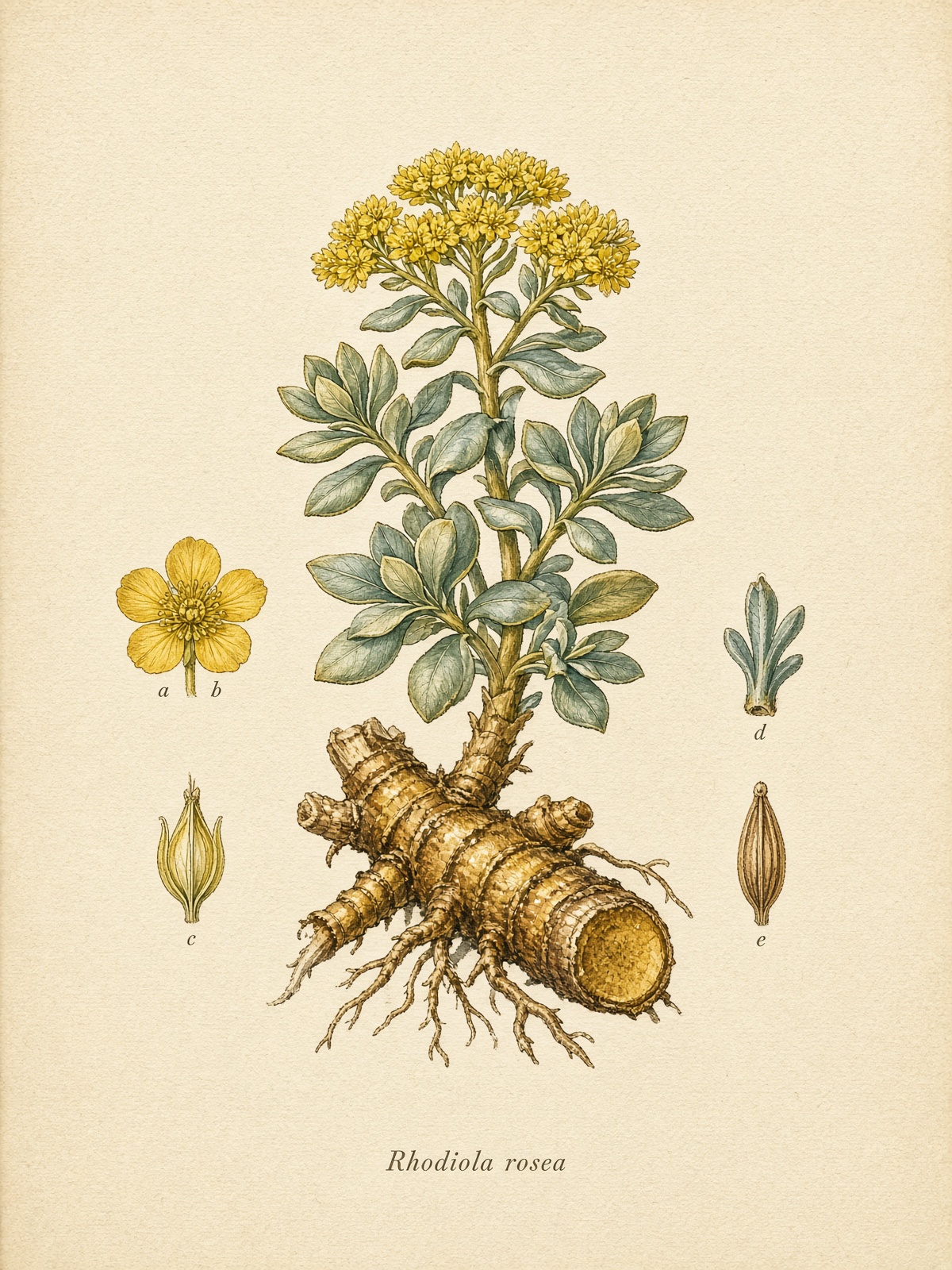 No. 052
Rhodiola
Rhodiola rosea
Rose-root of the Arctic — an adaptogen for fatigue that can also overstimulate.
Rosewater, astringent tannin, and a cold-earth bitterness.
Harvest: 1,000–1,400 days (year 3–4)
Golden root of the Arctic. Vikings and Soviet sport scientists both claimed it, centuries apart. It likes scree and cold and does not like a humid Georgia summer.
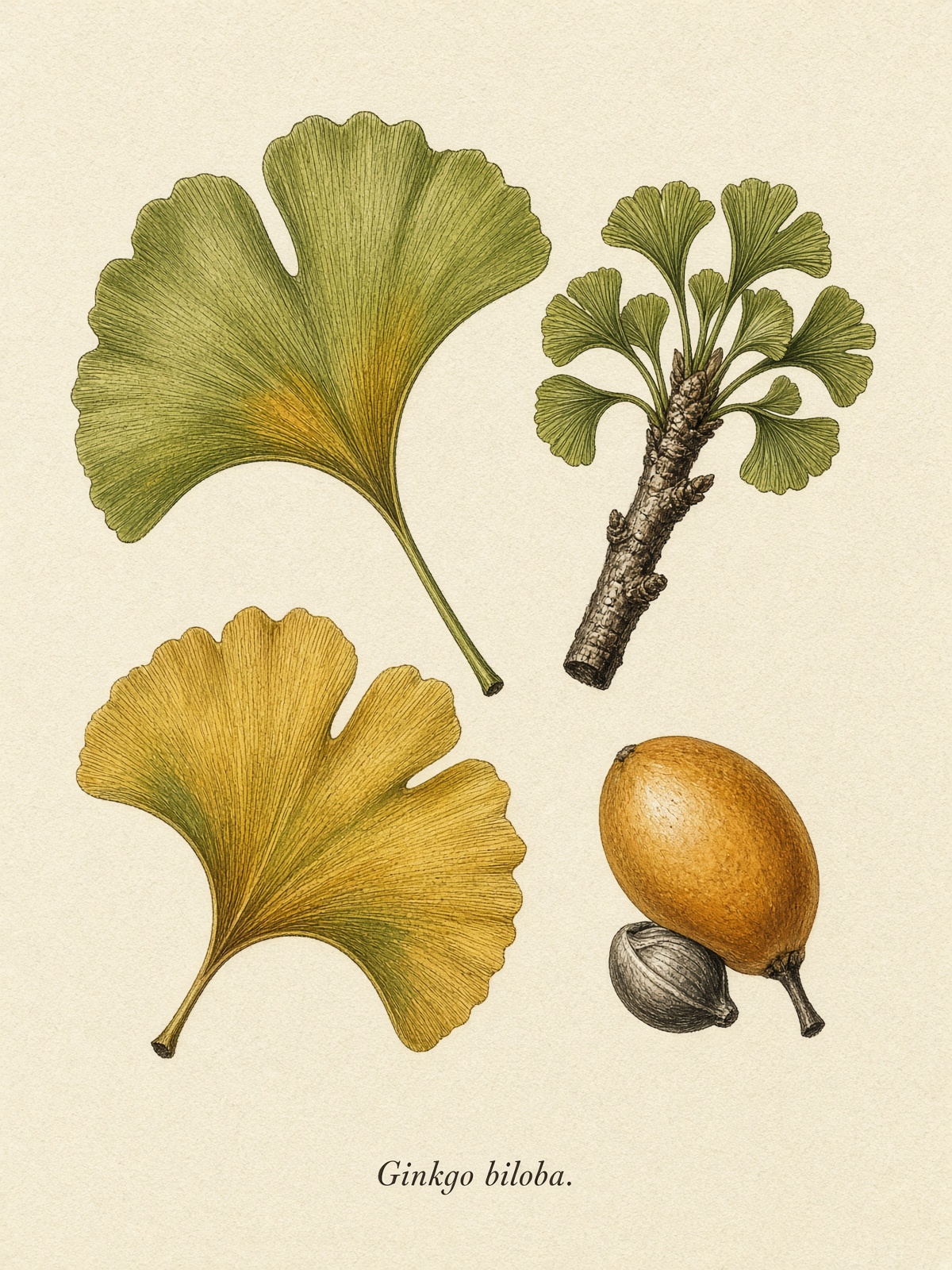 No. 053
Ginkgo
Ginkgo biloba
The living-fossil tree whose leaf is taken for circulation and memory — slowly, and with bleeding in mind.
Dried leaf tea is green-tea astringent and faintly nutty. Extracts are nearly tasteless.
Harvest: Leaf from a young tree in 2–3 years; a specimen tree is a decade
A living fossil with no close relatives, planted as a temple tree in China, then as a street tree that drops foul fruit on sidewalks. The medicinal leaf is a standardized extract story more than a garden tea story.
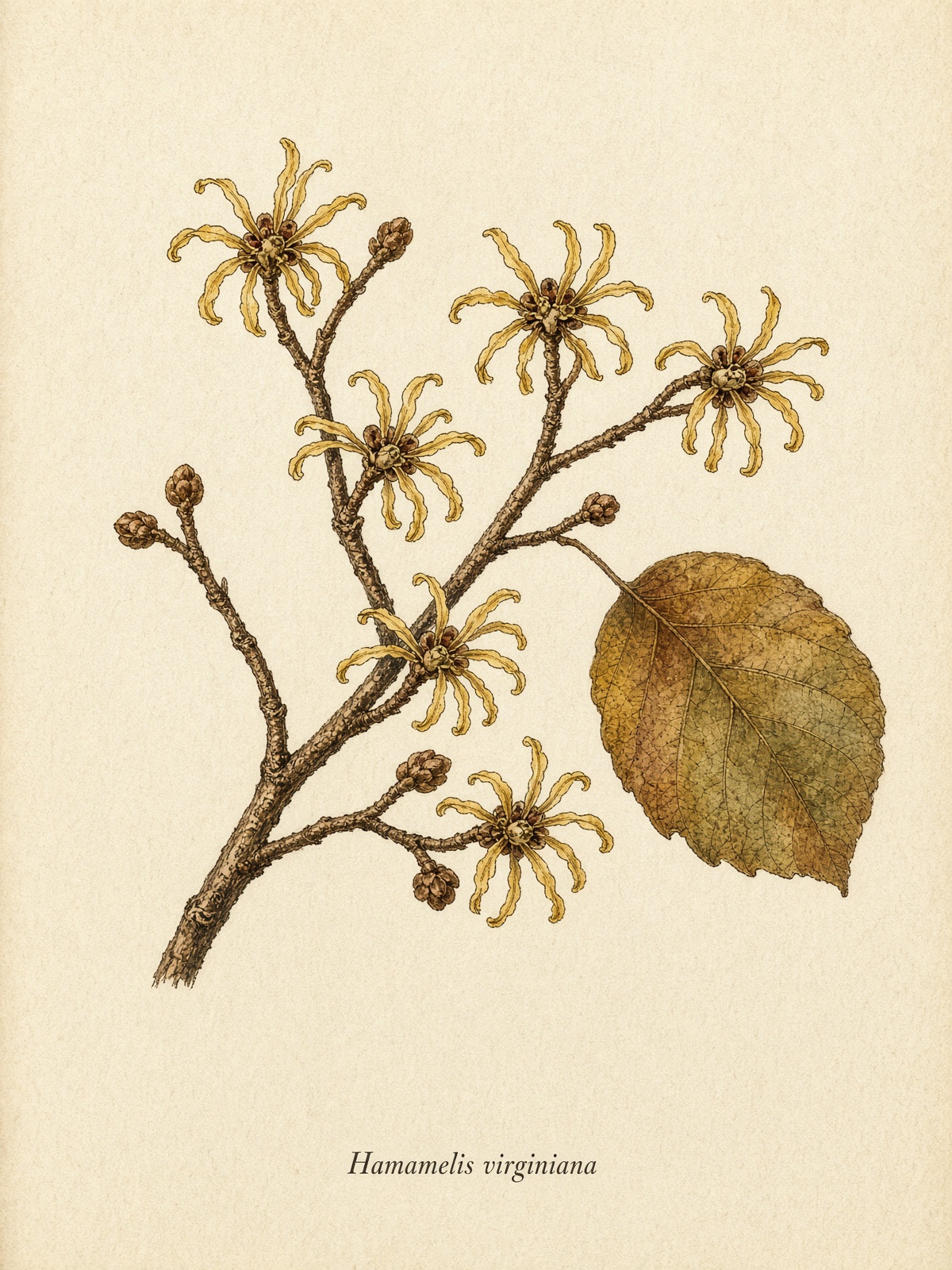 No. 054
Witch hazel
Hamamelis virginiana
A winter-blooming shrub whose bark and leaf make the classic cooling astringent.
Astringent, tea-like, and woody — more a wash than a beverage.
Harvest: Leaf in year 2–3; a flowering shrub in 4–5 years
Hamamelis blooms in winter, petals like scraps of yellow paper. Native nations of the east used the bark; drugstore astringent is steam-distilled and still smells of the woods behind the pharmacy.
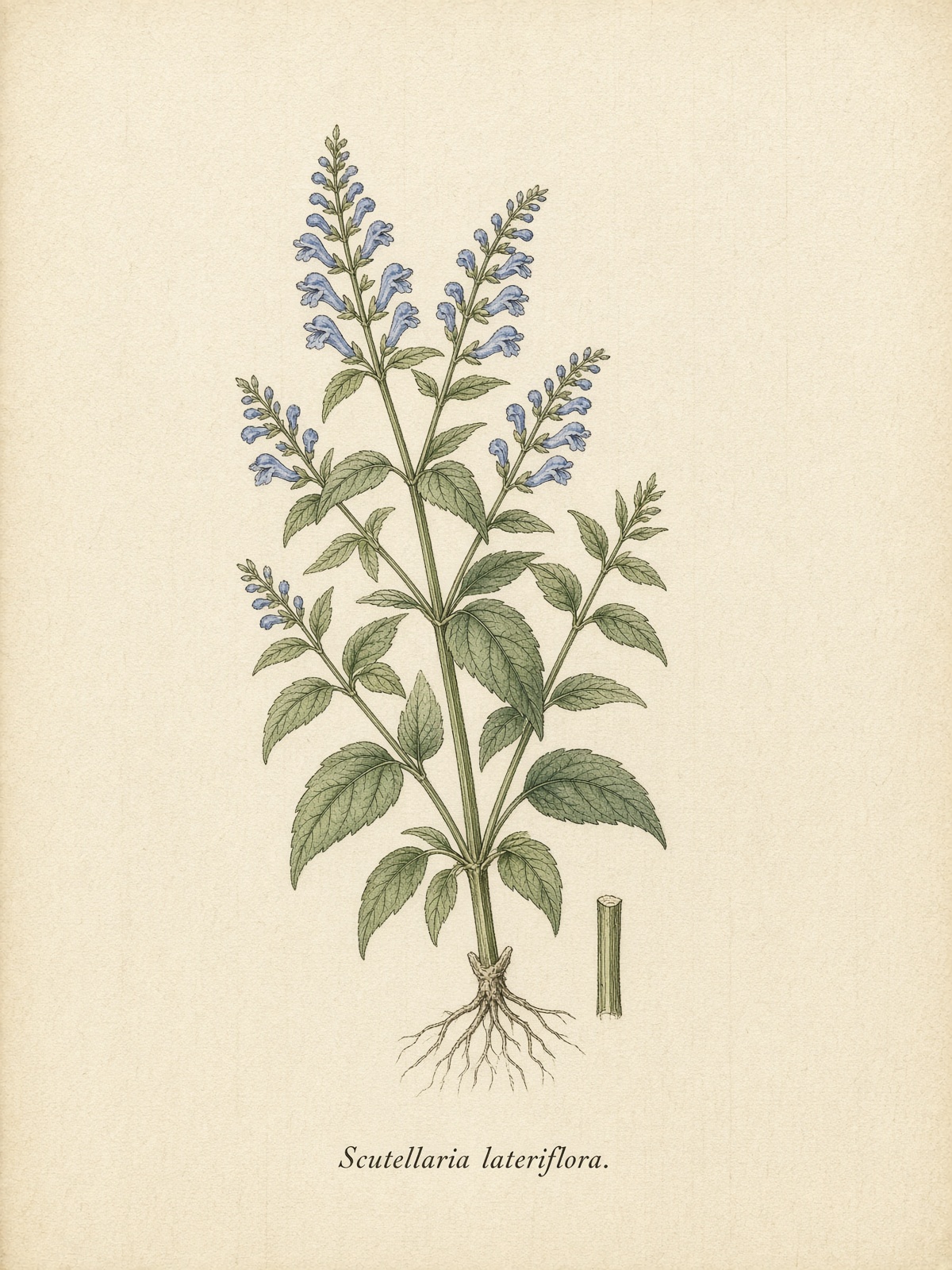 No. 055
Skullcap
Scutellaria lateriflora
A wetland mint for circular thinking — a nervine that wants the right species.
Green, slightly bitter mint. Fresh herb is grassier than dried.
Harvest: 80–100 days to a flowering cut
The calyx looks like a tiny helmet, hence Scutellaria. Mad-dog skullcap was a 19th-century rabies claim that did not hold. The plant that remains is a quiet American nervine of wet ground.
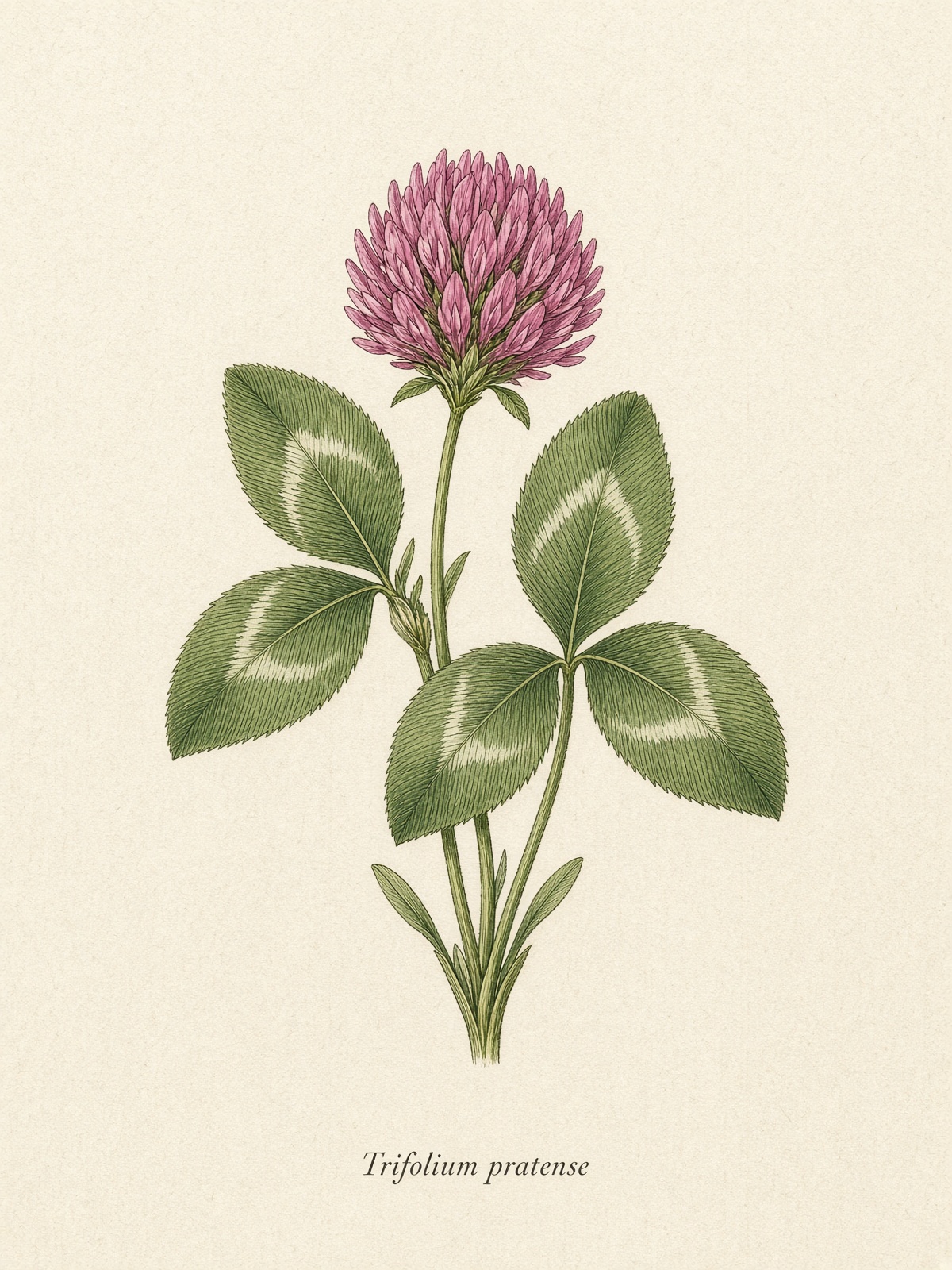 No. 056
Red clover
Trifolium pratense
A magenta meadow blossom used as a gentle blood-and-skin tea.
Honey, hay, and a faint bean sweetness. One of the pleasantest herbal teas.
Harvest: 60–80 days from sow to first blossoms
A farmer’s forage that wandered into the infirmaries as a ‘blood cleanser,’ which is not a medical term. The magenta heads smell of honey. Isoflavones are why it shows up in menopause aisles.
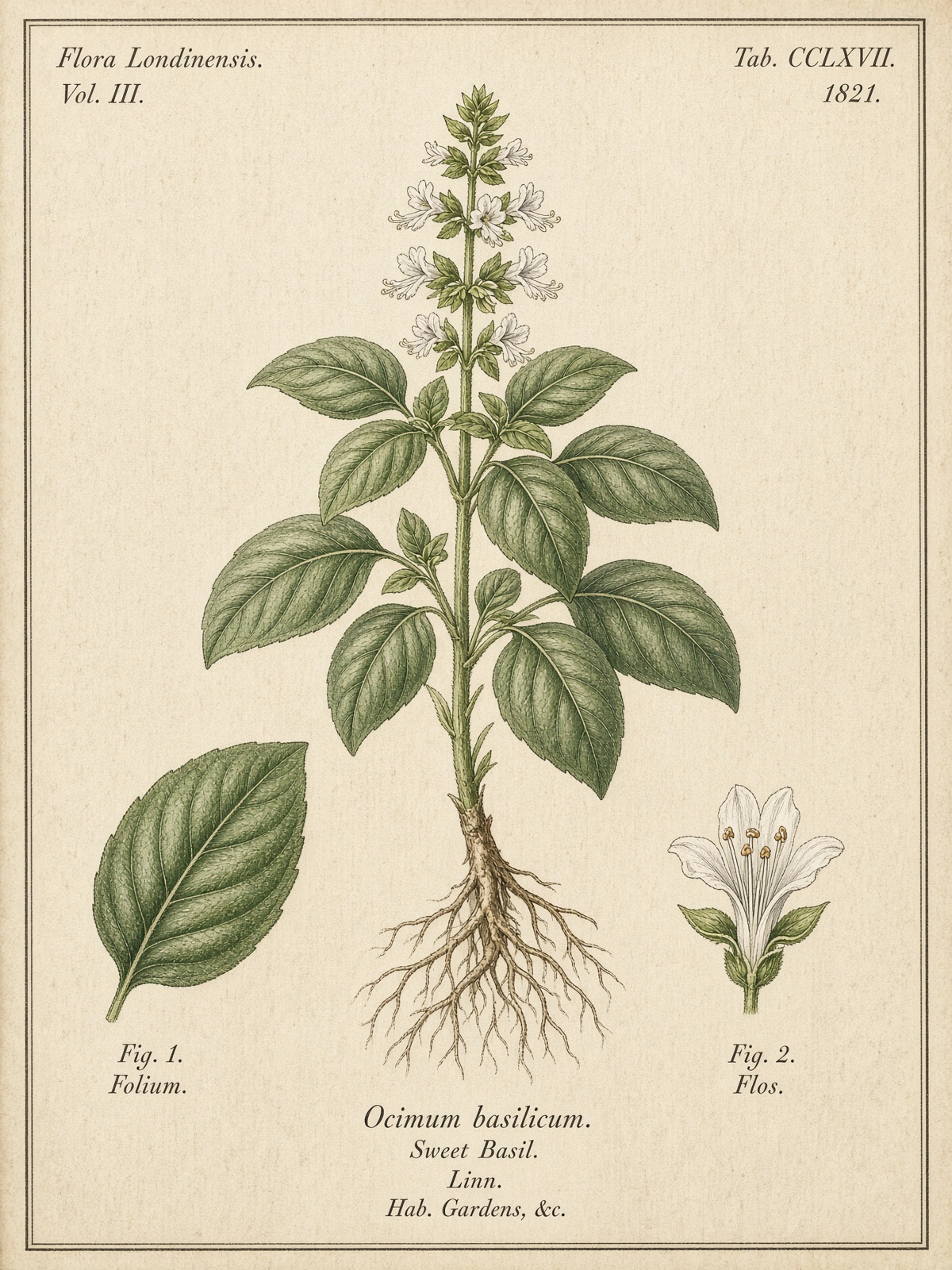 No. 064
Sweet basil
Ocimum basilicum
The pesto leaf — a cooling kitchen mint for digestion and summer nerves.
Clove-anise sweetness over green leaf, brighter when torn than when cooked.
Harvest: 40–60 days from transplant to a useful bush
In some Greek villages it is still a royal plant; in India a close cousin is a goddess. Genovese pesto is a Ligurian invention that made Ocimum basilicum a summer annual in every temperate garden. Cold nights blacken it for spite.
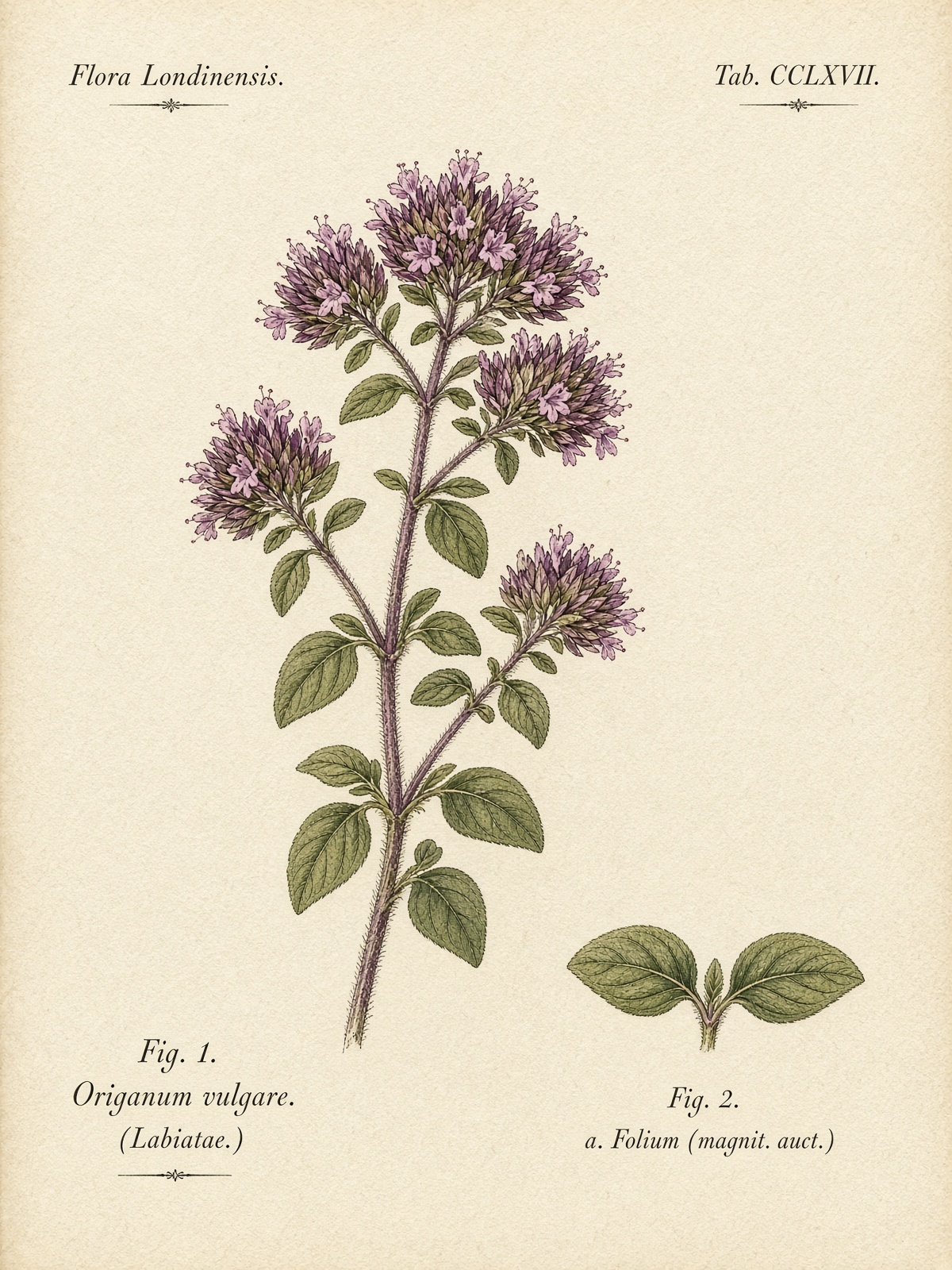 No. 065
Oregano
Origanum vulgare
A hot Mediterranean mint — pizza leaf, and a traditional winter antimicrobial tea.
Peppery, warm, a little bitter — dried is toastier than the garden sprig.
Harvest: 60–80 days from a small plant
The joy of the mountain — oros ganos. Pizza is a delivery system for carvacrol. Oil of oregano is a caustic extract, not a pinch from the jar, and the two should not be confused at 2 a.m.
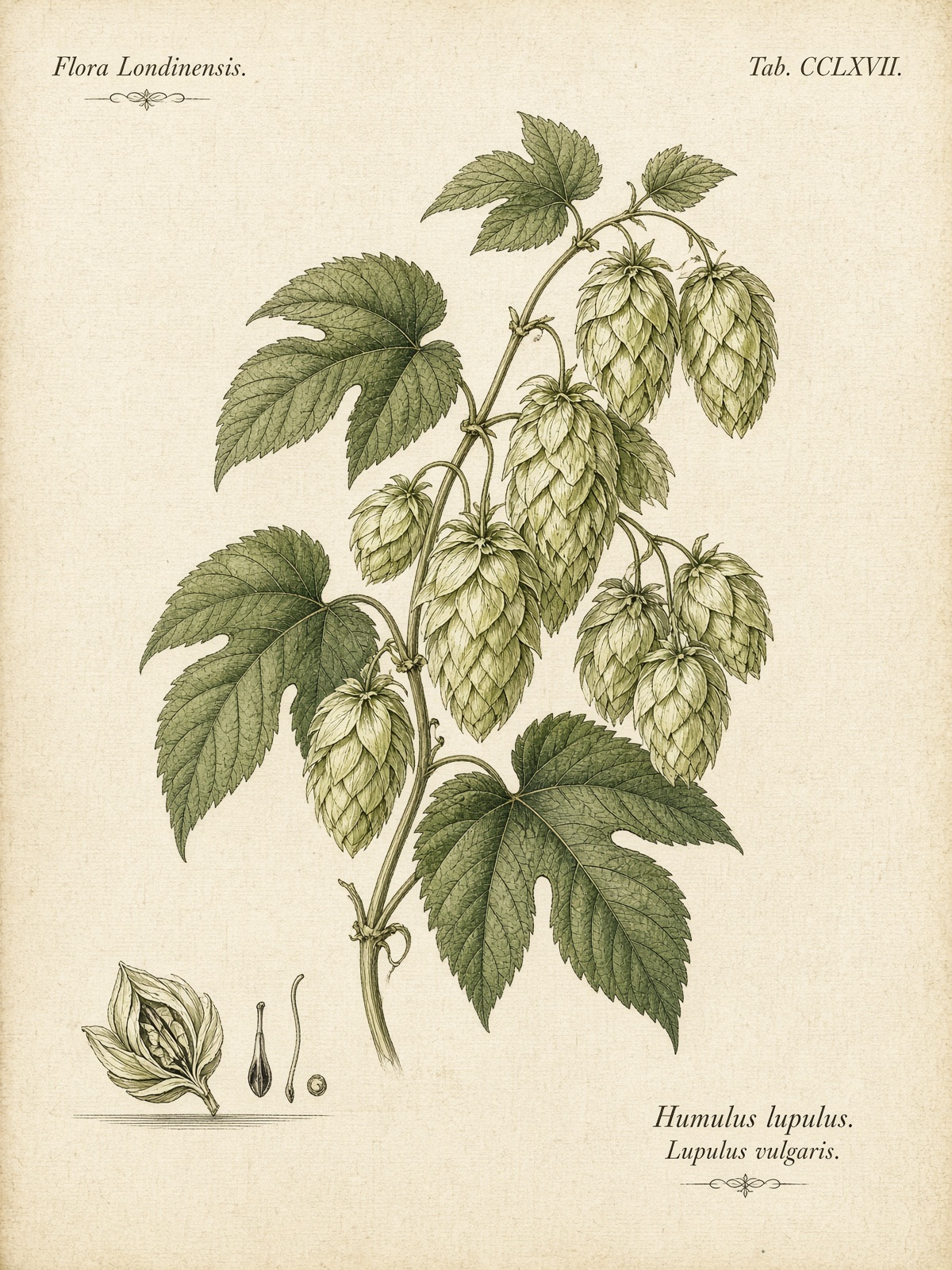 No. 066
Hops
Humulus lupulus
The beer flower — a bitter, estrogenic sedative that also climbs the shed.
Green-resin bitterness, grapefruit pith, and a grassy perfume.
Harvest: First useful cones in year 2 (~400 days); year-one bines are practice
Monasteries added the bitter cone to beer to keep it, then the beer kept people. A hop pillow is an old sleep trick that smells like a brewery. The bine always climbs clockwise.
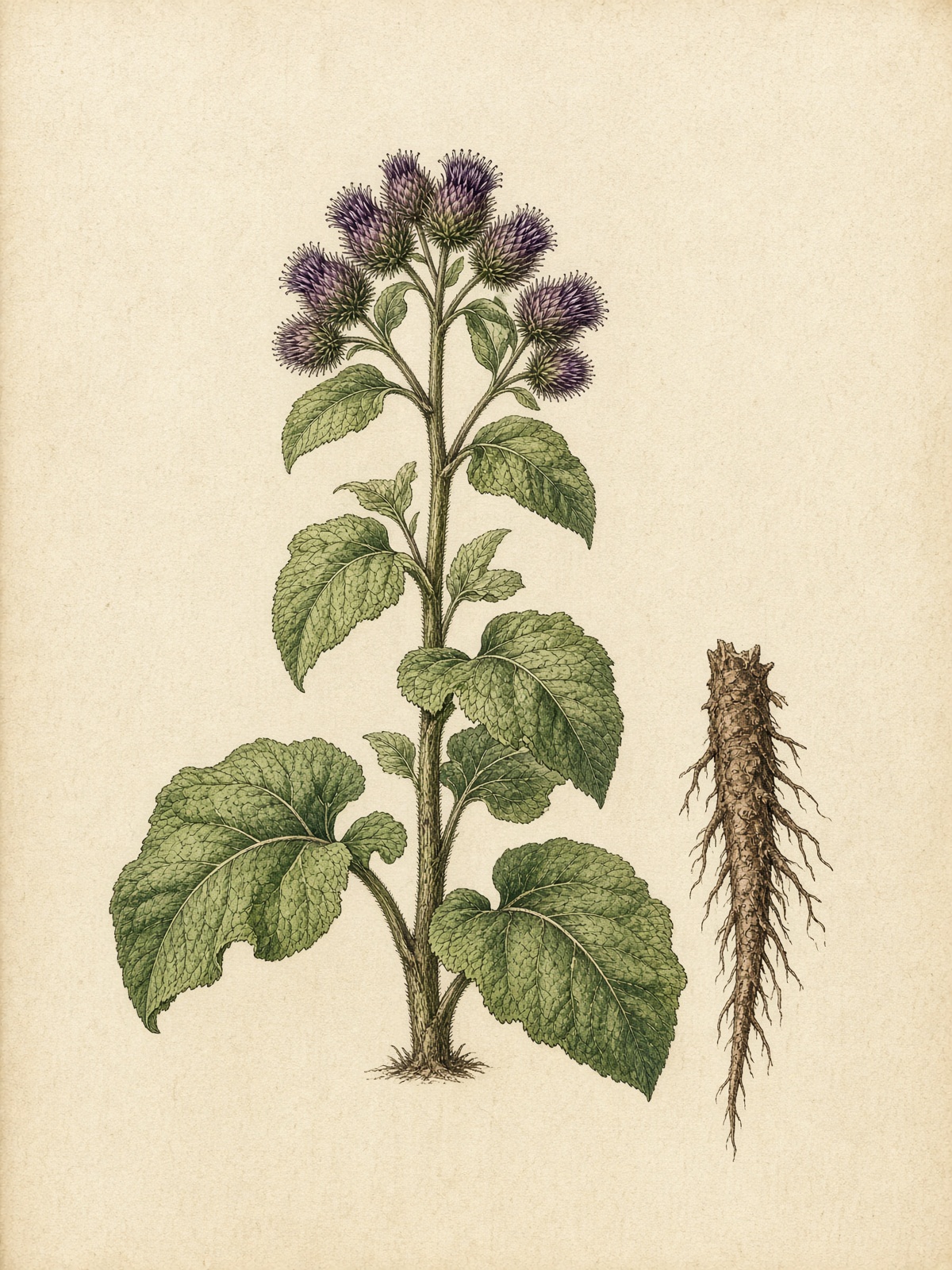 No. 067
Burdock
Arctium lappa
The burr that invented Velcro — a deep bitter root for skin and sluggish digestion.
Earthy, artichoke-bitter, a little sweet when roasted — like a wild salsify.
Harvest: 120–180 days to a first-year kitchen root
Gobo in the Japanese pot, beggar’s buttons in the English lane. Velcro was inspired by the burs. The root is a long, muddy harvest and a traditional ‘blood’ bitter.
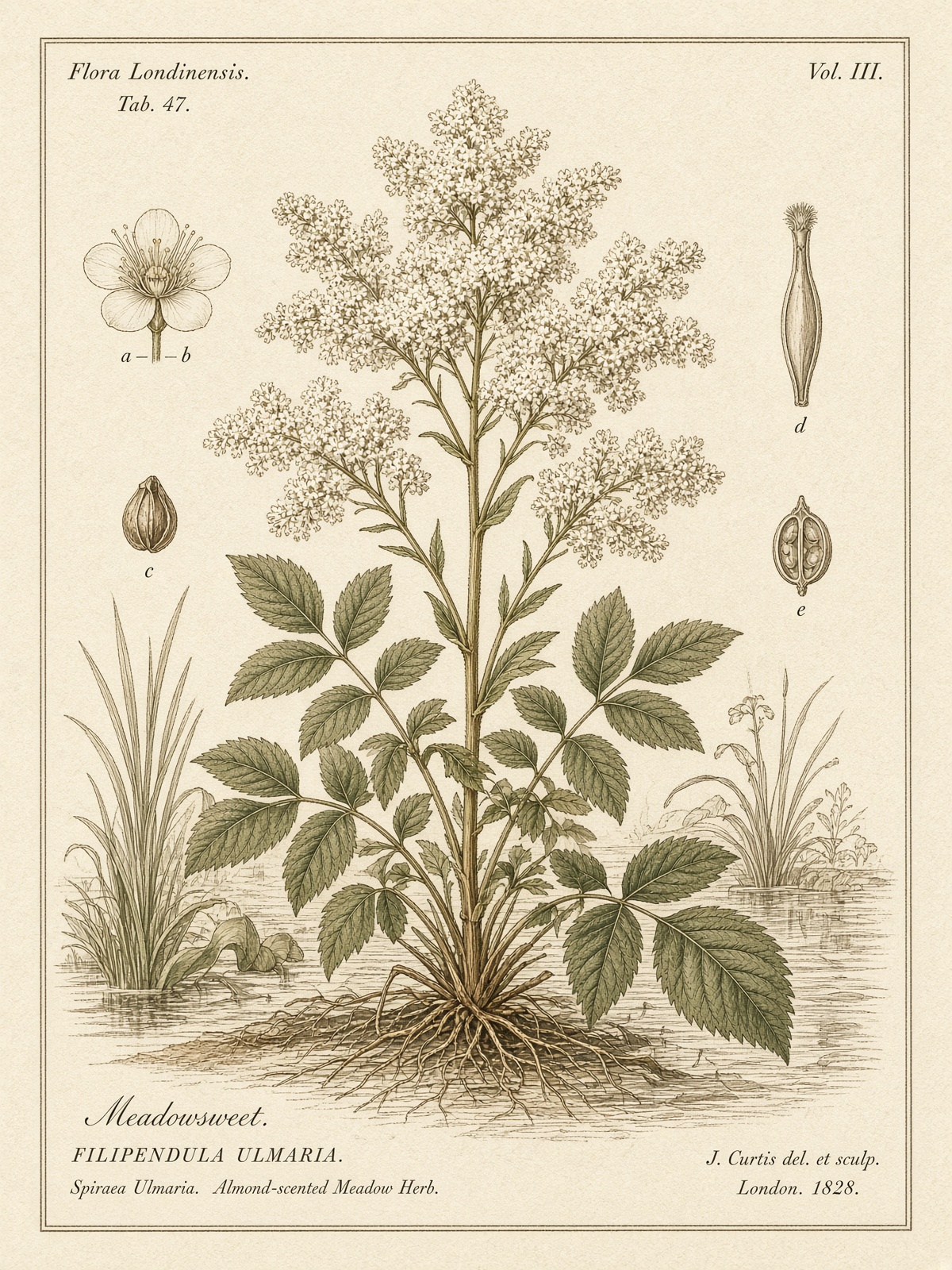 No. 068
Meadowsweet
Filipendula ulmaria
Creamy meadow plumes that smell of almond and aspirin — a stomach-kinder willow analog.
Almond, hay, and wintergreen honey — one of the finest meadow teas.
Harvest: 90–120 days to first bloom from a young plant; established clumps yearly
Queen of the meadow, and the plant from which salicylic acid was named — Spiraea, hence aspirin. It smells of hay and almonds when you pass a ditch in July.
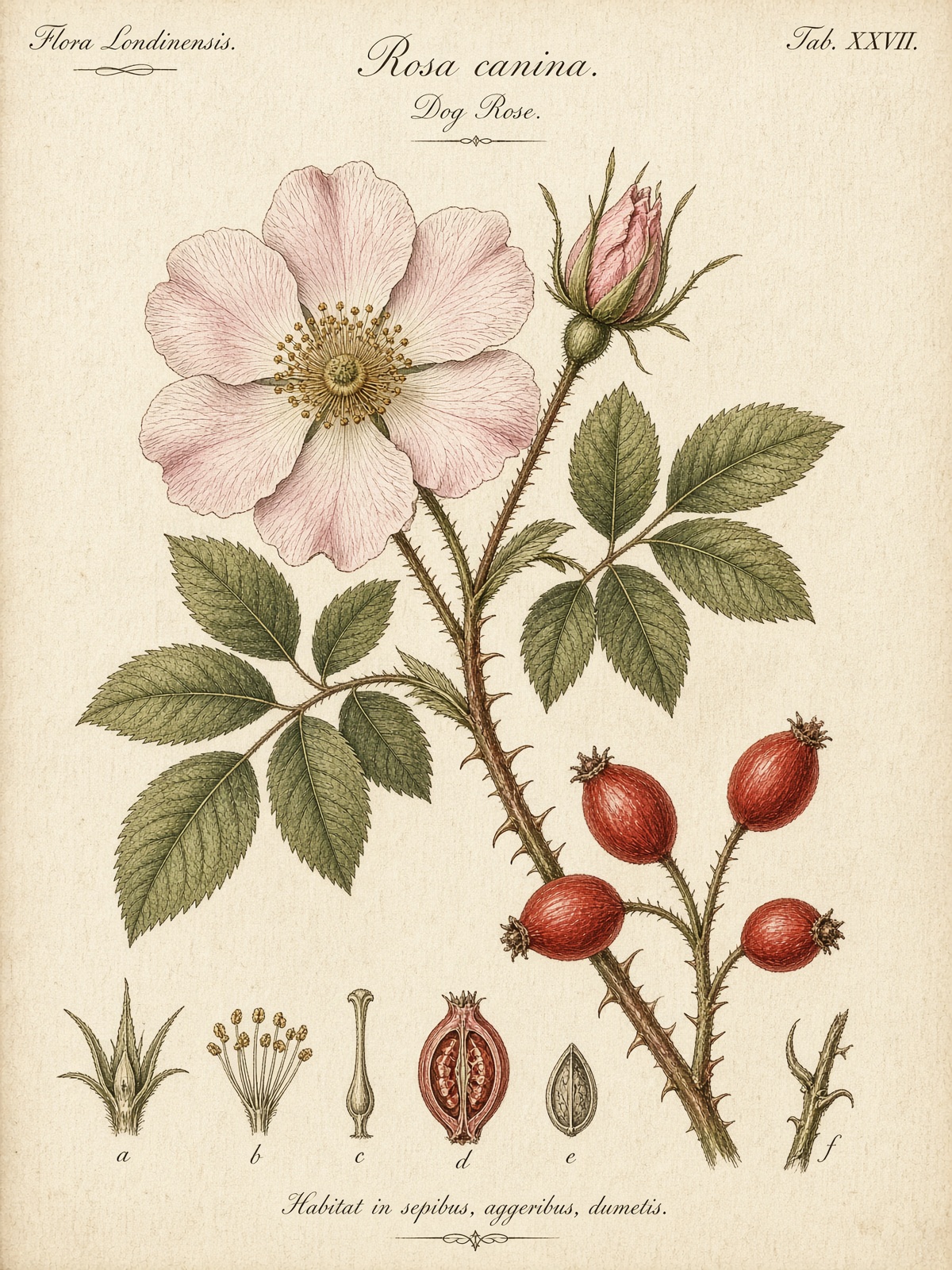 No. 069
Dog rose
Rosa canina
The hedgerow rose — hips for winter vitamin C, petals for a cooling, fragrant cup.
Hips are tart apple-tomato; petals are perfume and green tea, faintly honeyed.
Harvest: Petals year 2; hips 500–700 days from a young shrub
Attar, hips, and the War of the Roses were all this genus. The tea is usually the hip after frost, strained of its itchy hairs. A garden rose sprayed for beetles is not a medicine.
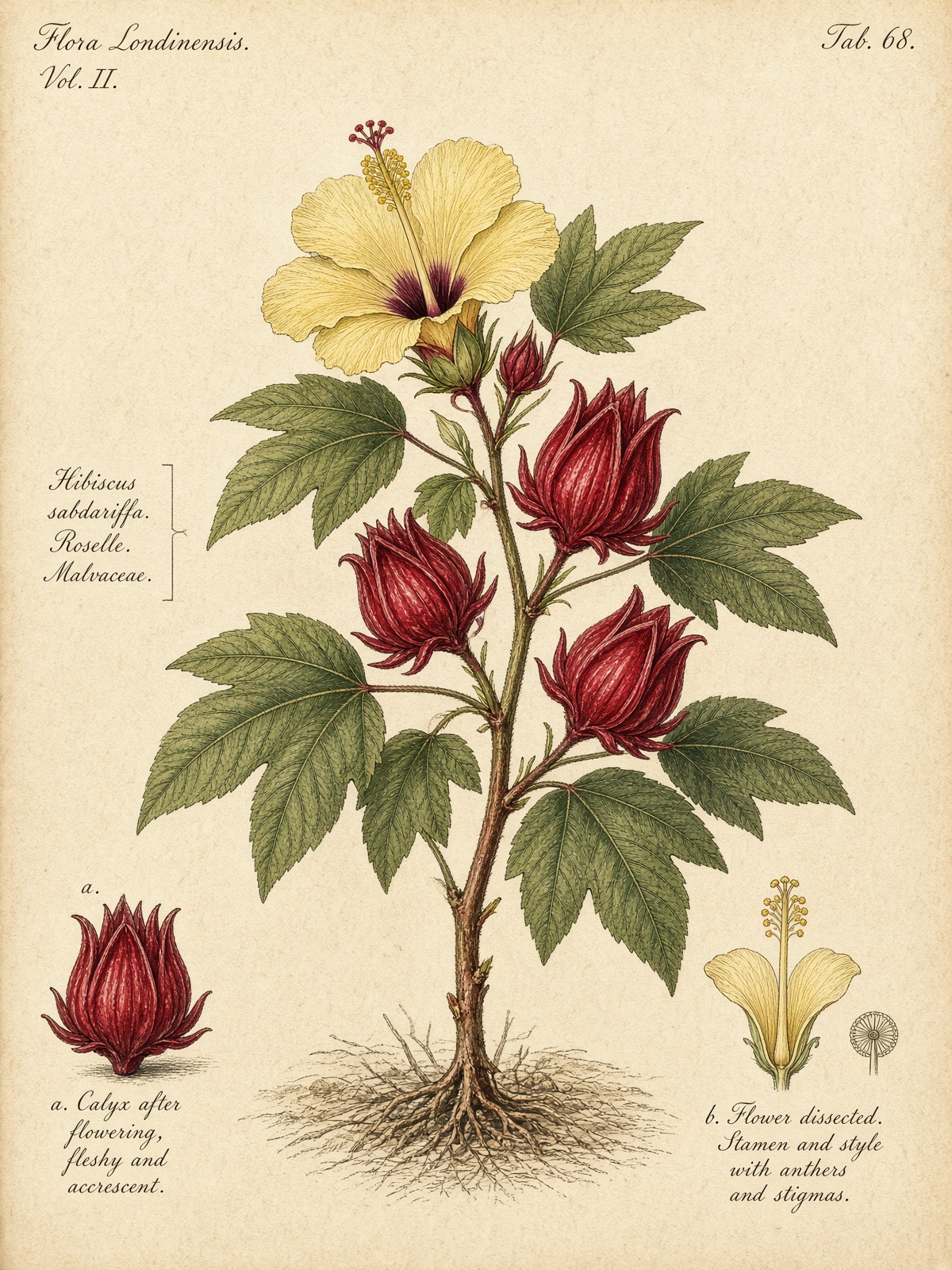 No. 070
Roselle
Hibiscus sabdariffa
The crimson sour calyx behind agua de jamaica — a cooling, tart drink for heat and blood pressure folklore.
Bright cranberry-sorrel sourness, floral and clean, staining the cup red.
Harvest: 90–120 days from transplant to first calyces
Roselle, karkadé, agua de jamaica — the same calyx in different heat. The red is the plant, not a dye pack. Pharaohs drank a version; Caribbean groceries still sell the bags.
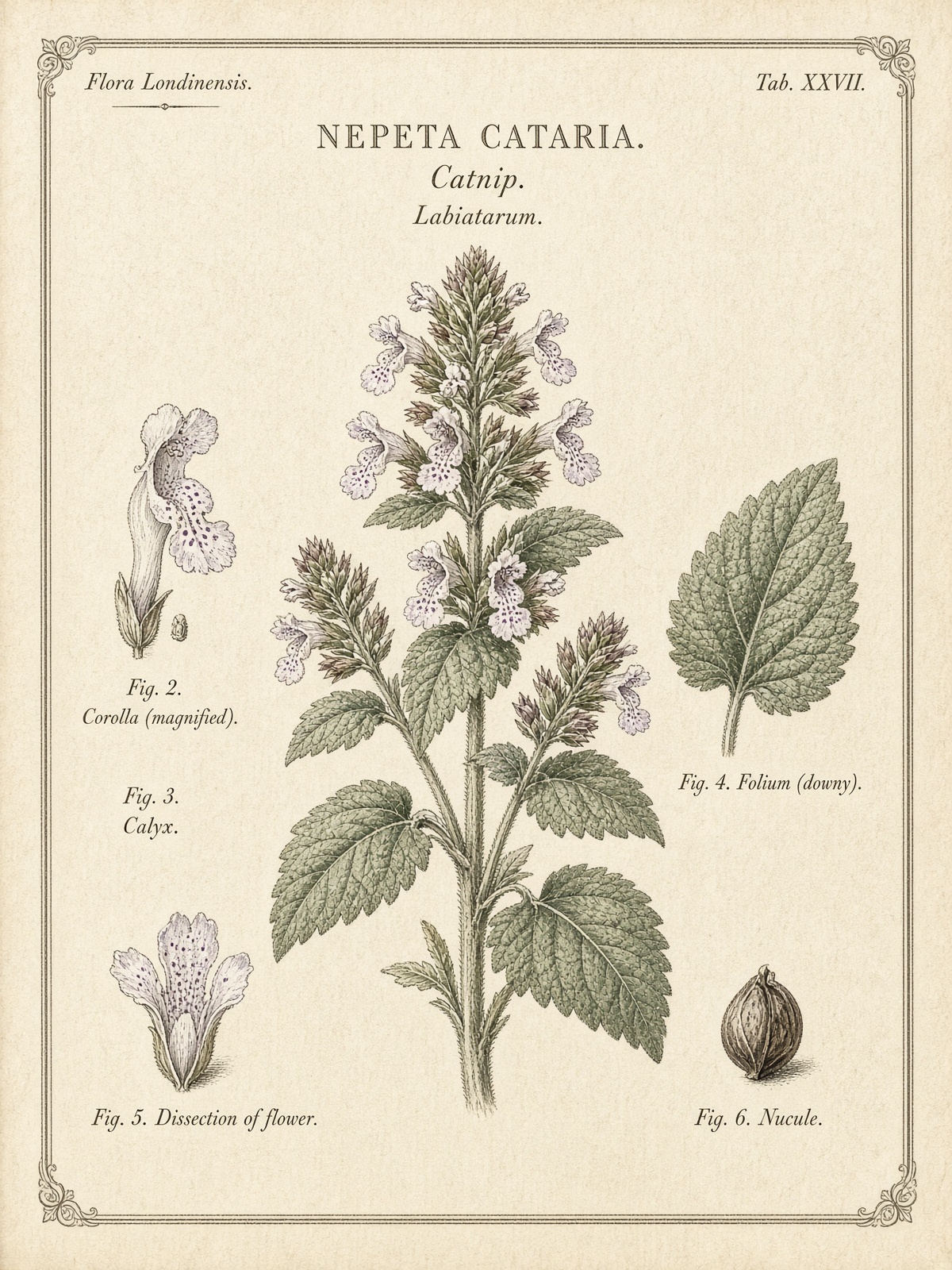 No. 071
Catnip
Nepeta cataria
A grey mint that sends cats sideways and, as a mild tea, settles people the other direction.
Dusty mint, lemon, and a faint bitter hay. Better with honey than alone.
Harvest: 60–80 days from sow to a first cut
Nepeta, named for the Etrurian town of Nepete. Cats who have the gene will wreck a plant for the iridoids; cats who don’t will walk past. The tea is a mild lemon-mint for people, and a riot for everyone else.
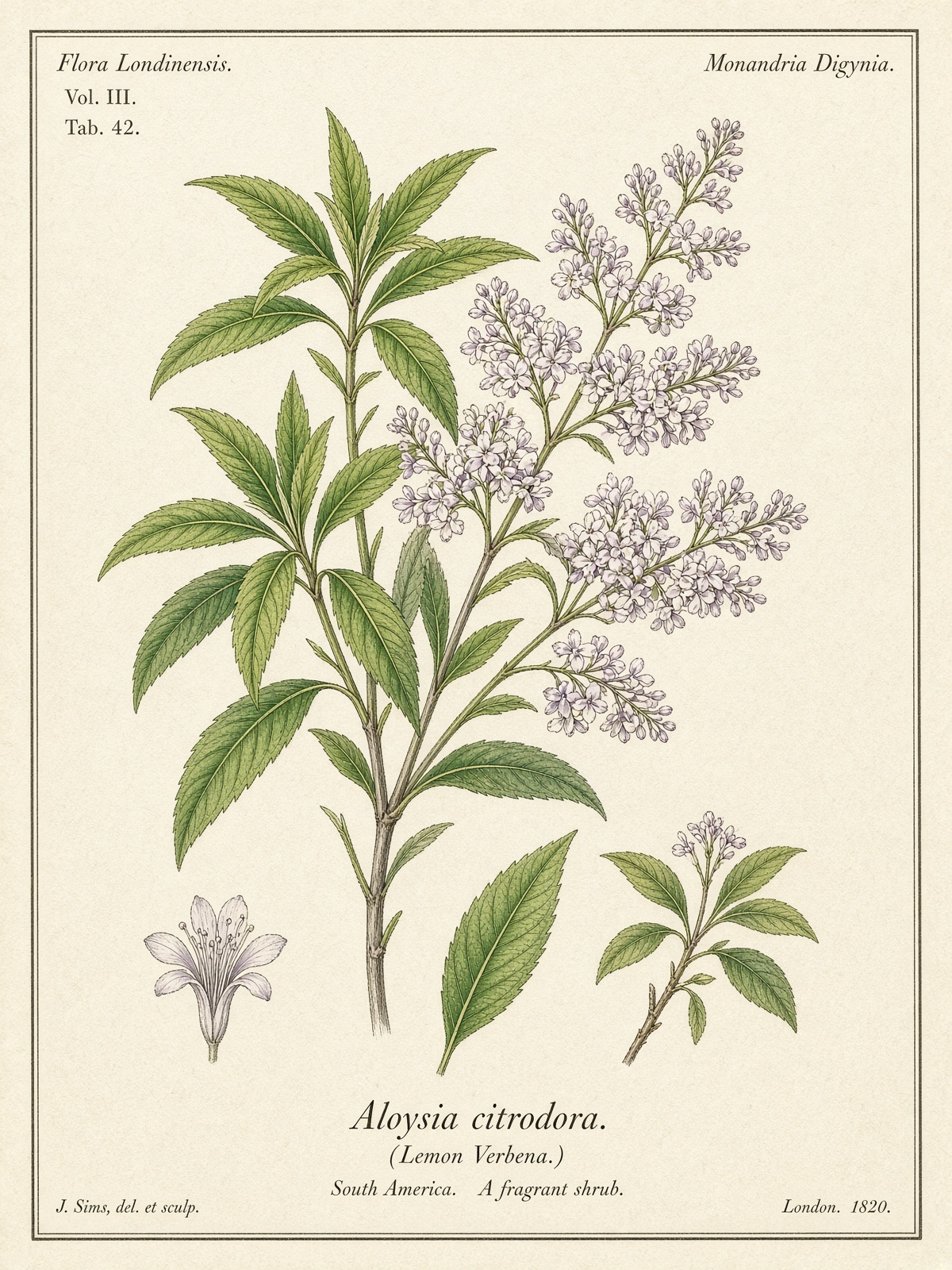 No. 080
Lemon verbena
Aloysia citrodora
An Andean shrub that smells more of lemon than lemon does — a digestive and evening leaf.
Bright lemon peel and sweet herb, cleaner than lemongrass, no pith bitterness.
Harvest: 60–90 days from a cutting to a useful bush
Brought from South America to Europe in the 1700s and immediately planted where a door could bruise it. Aloysia citrodora is almost pure citral. The tea is what people mean when they say lemon but do not want lemon.
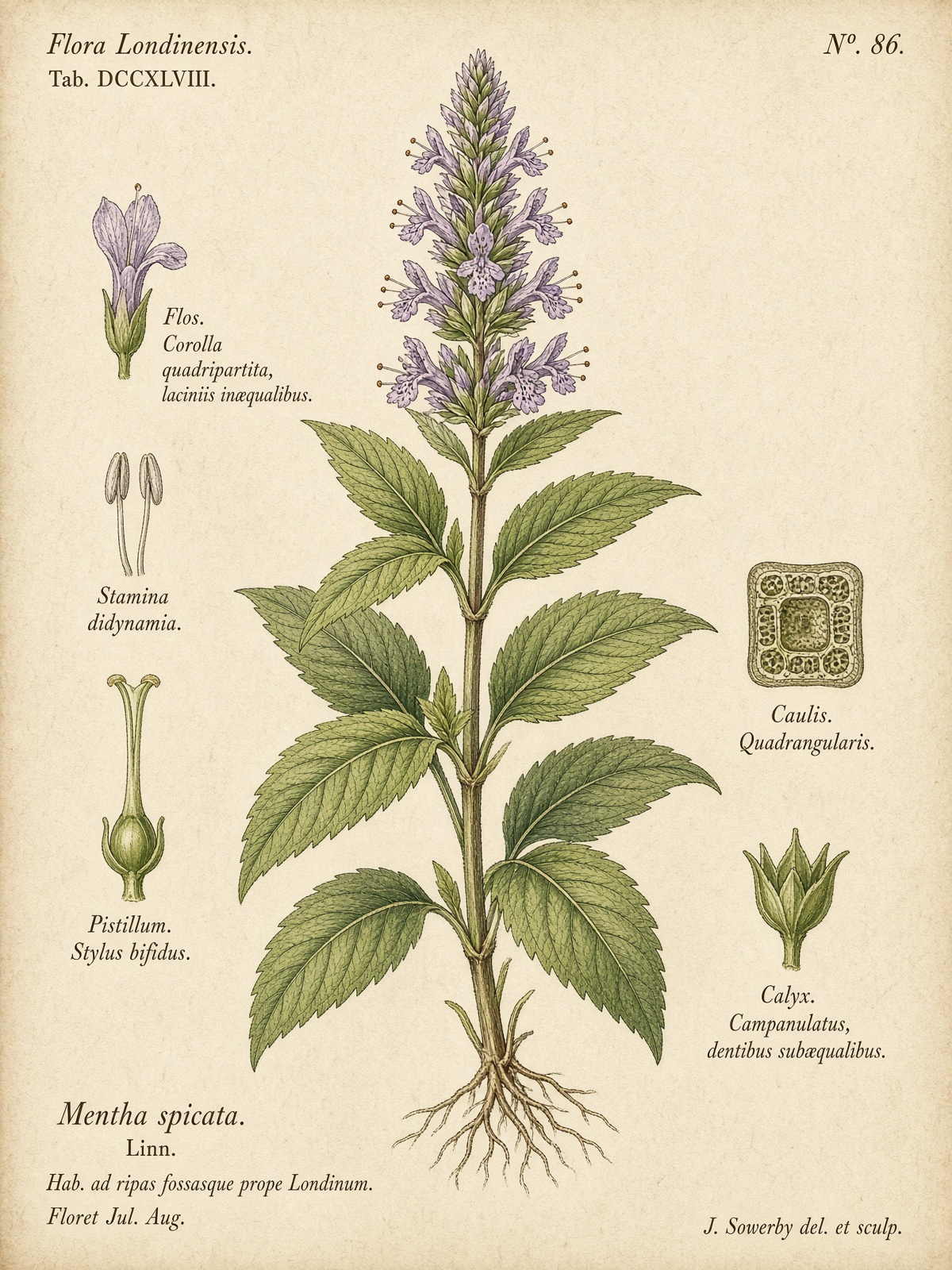 No. 081
Spearmint
Mentha spicata
The sweeter garden mint — less menthol fire, more green candy. A children’s and after-dinner leaf.
Sweet green mint, cooler than basil, milder than peppermint — chewing-gum without the burn.
Harvest: 30–45 days from a planted runner
The gentler mint, the one in Moroccan tea and in American gum. Mentha spicata does not have peppermint’s reflux reputation to the same degree. A lawn of it is a decision.
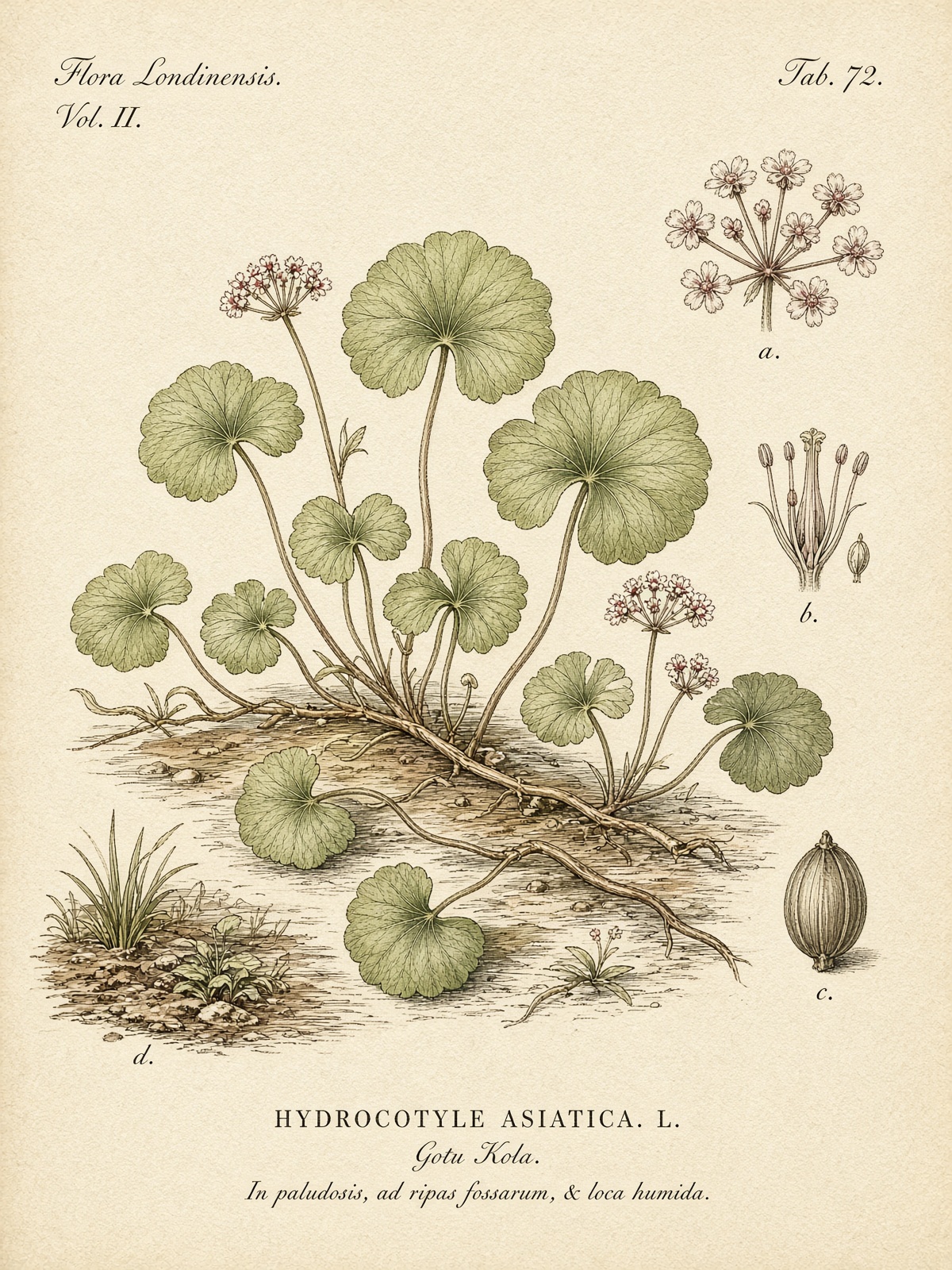 No. 082
Gotu kola
Centella asiatica
A marsh pennywort eaten for skin, memory folklore, and circulation — a salad herb in the tropics.
Green, marshy, a little bitter-carrot — a wild salad, not a dessert tea.
Harvest: 40–60 days from a division
The pond-edge pennywort of South Asia. A Sinhalese proverb says eat it and you will live long enough to see a jungle grow. Elephants, the story goes, graze it. The leaf is a small green kidney.
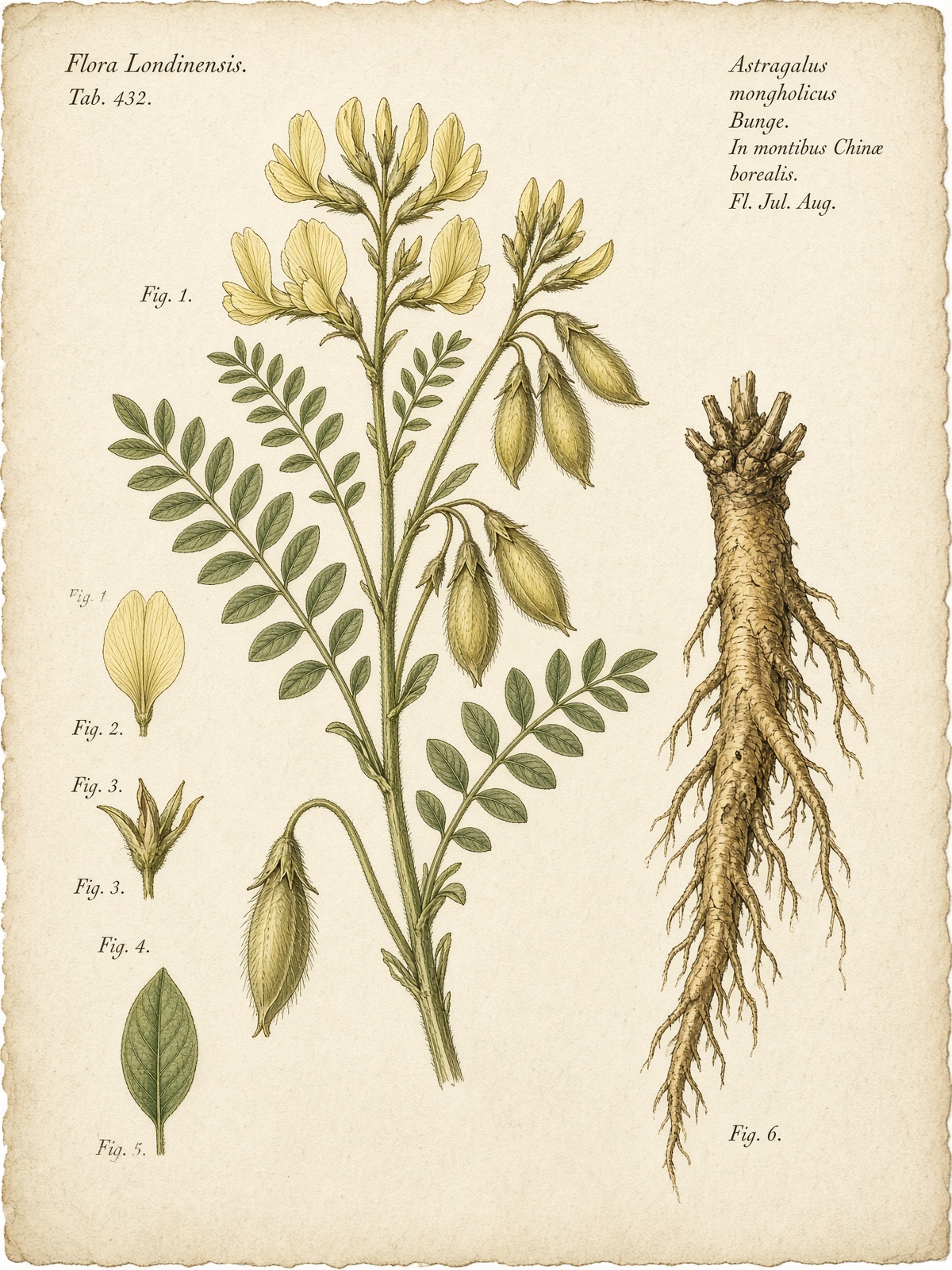 No. 083
Astragalus
Astragalus mongholicus
A northern Chinese milkvetch root simmered for months of recovery — not an acute cold rescue.
Sweet, beany, faintly licorice — a soup bone of a root, not a tea flower.
Harvest: 1,000–1,400 days (year 3–4)
Huáng qí, yellow leader, a Chinese tonic root that looks like a tongue depressor. It is a legume of dry north China, now a farm crop. The sweet, fibrous chew is the old quality test.
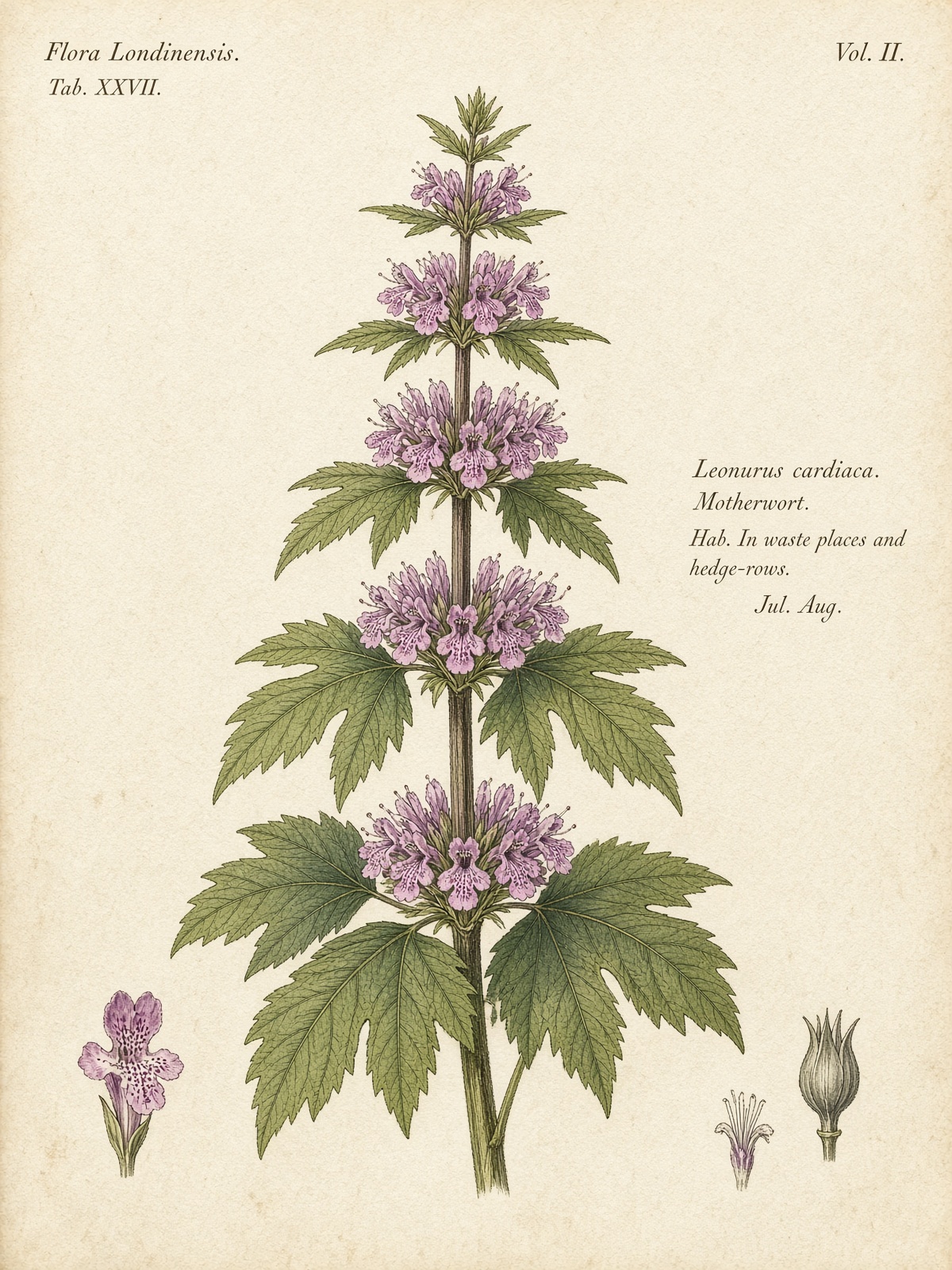 No. 084
Motherwort
Leonurus cardiaca
A bitter mint for a racing heart and a spinning mind — not a culinary leaf.
Harsh, bitter mint. A tincture or a short infusion, not a pleasant cup.
Harvest: 80–100 days from sow to a flowering cut
Leonurus, lion’s tail. A bitter mint for palpitations and the ‘mother’s herb’ of European midwives. It self-sows in a way that suggests it has opinions about your garden.
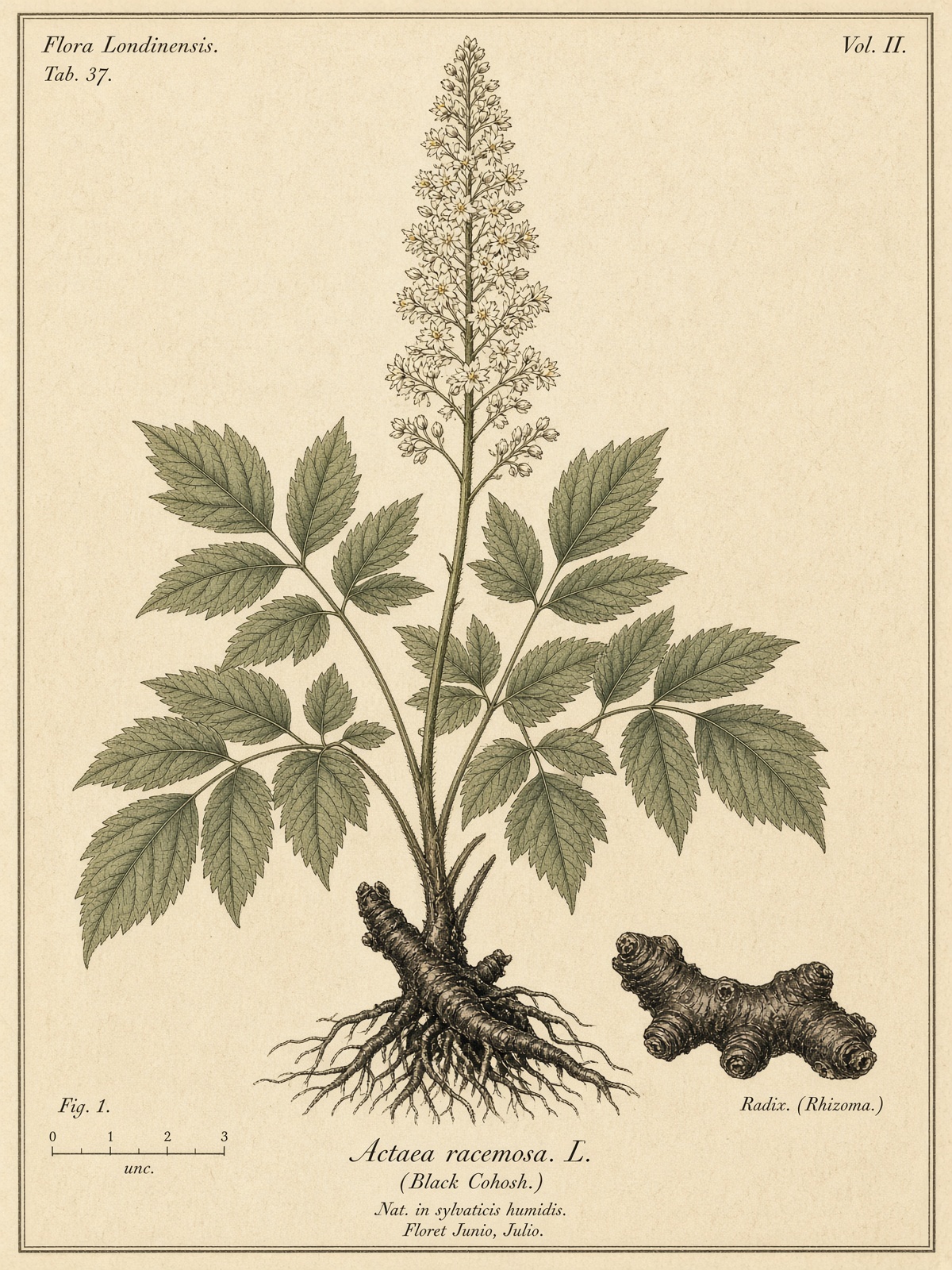 No. 085
Black cohosh
Actaea racemosa
A woodland candle whose rhizome is a menopause herb with a real liver signal on extracts.
Bitter, earthy, slightly acrid. Not a tea you drink for pleasure.
Harvest: 1,000–1,400 days (year 3–4)
A woodland bugbane of eastern North America. Eclectic physicians used the root for women’s complaints; modern extracts are a menopause aisle. The name cohosh is Algonquian.
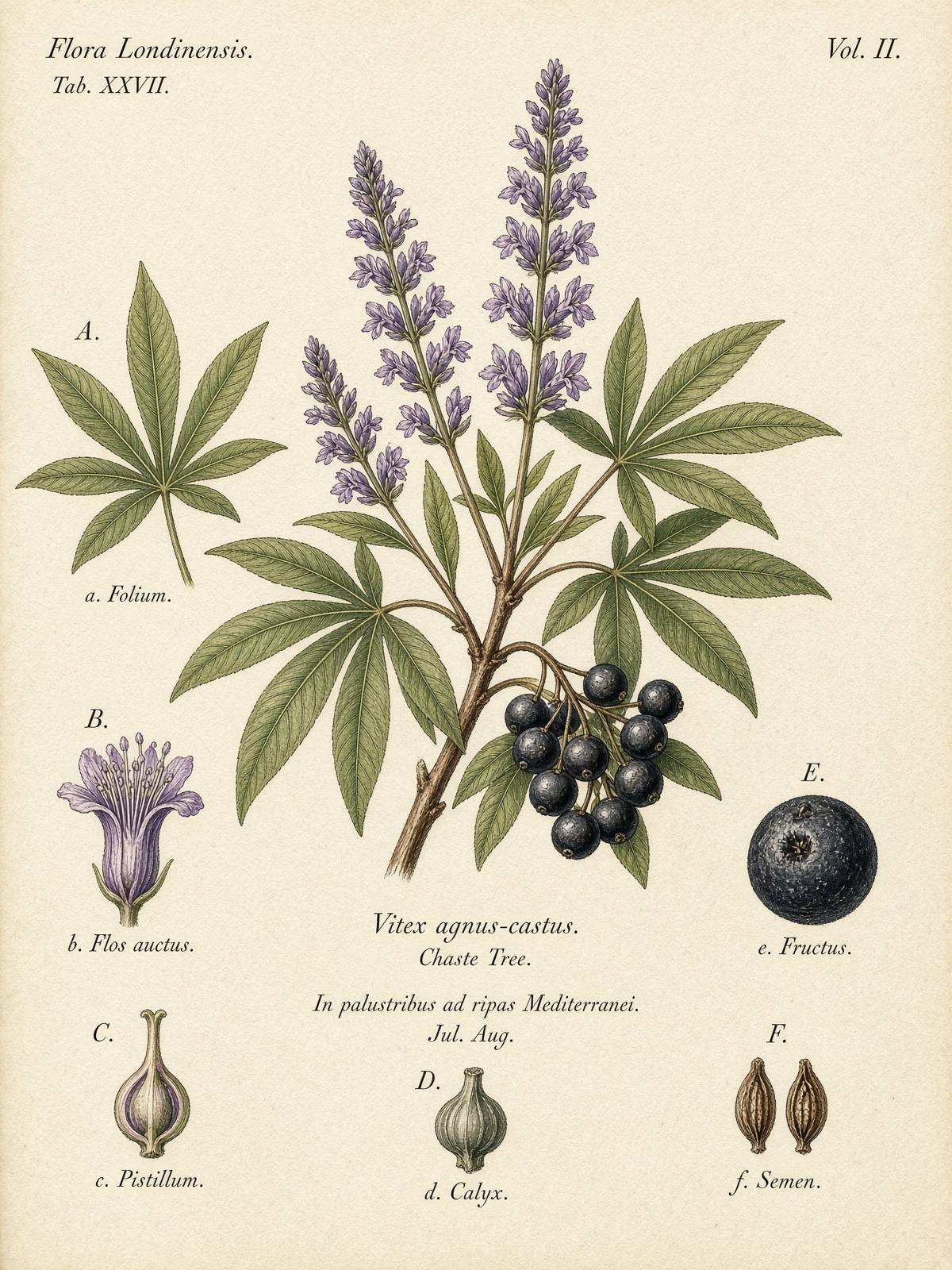 No. 086
Chaste tree
Vitex agnus-castus
A lilac-like Mediterranean shrub whose peppercorn berries are a cycle herb with a hormone reputation.
Pungent, peppery, slightly bitter — a spice more than a tea.
Harvest: First useful berries in year 2–3
Chaste tree. Medieval monks were said to chew the seeds for the obvious reason. Mediterranean vitex is a purple-spiked shrub whose berry is a hormone-folklore spice, not a culinary one.
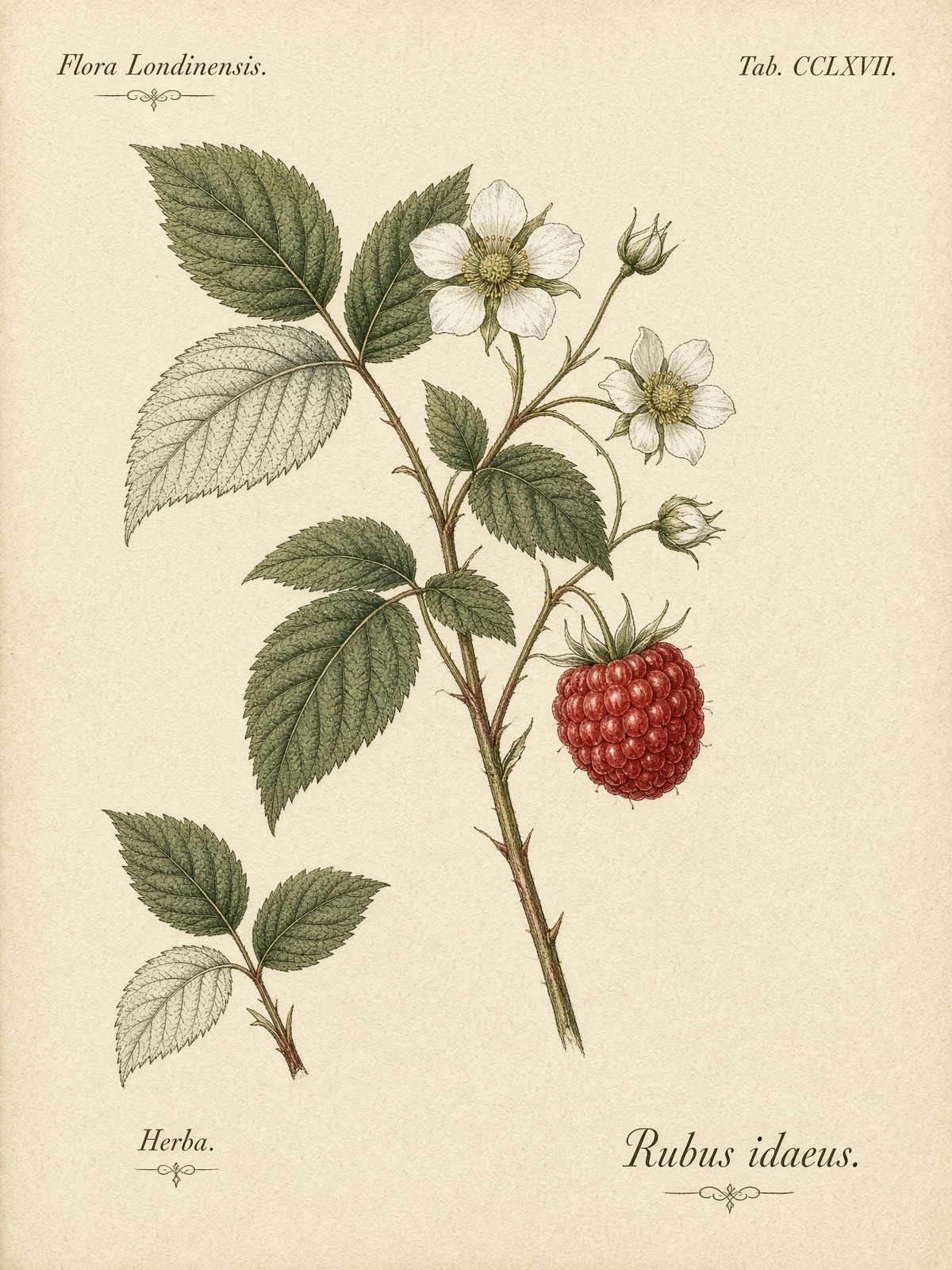 No. 087
Raspberry leaf
Rubus idaeus
The cane you grow for fruit — the leaf is an astringent tea with a long midwifery folklore.
Green tea, faint berry, a pleasant astringency — one of the easier herbal cups.
Harvest: Leaf 40–60 days in spring; fruit the following summer on floricanes
The leaf, not the fruit, is the midwife’s tea. The fruit is a bonus the birds invoice. Canes are biennial: green this year, berries next, then they die and the plant starts again.
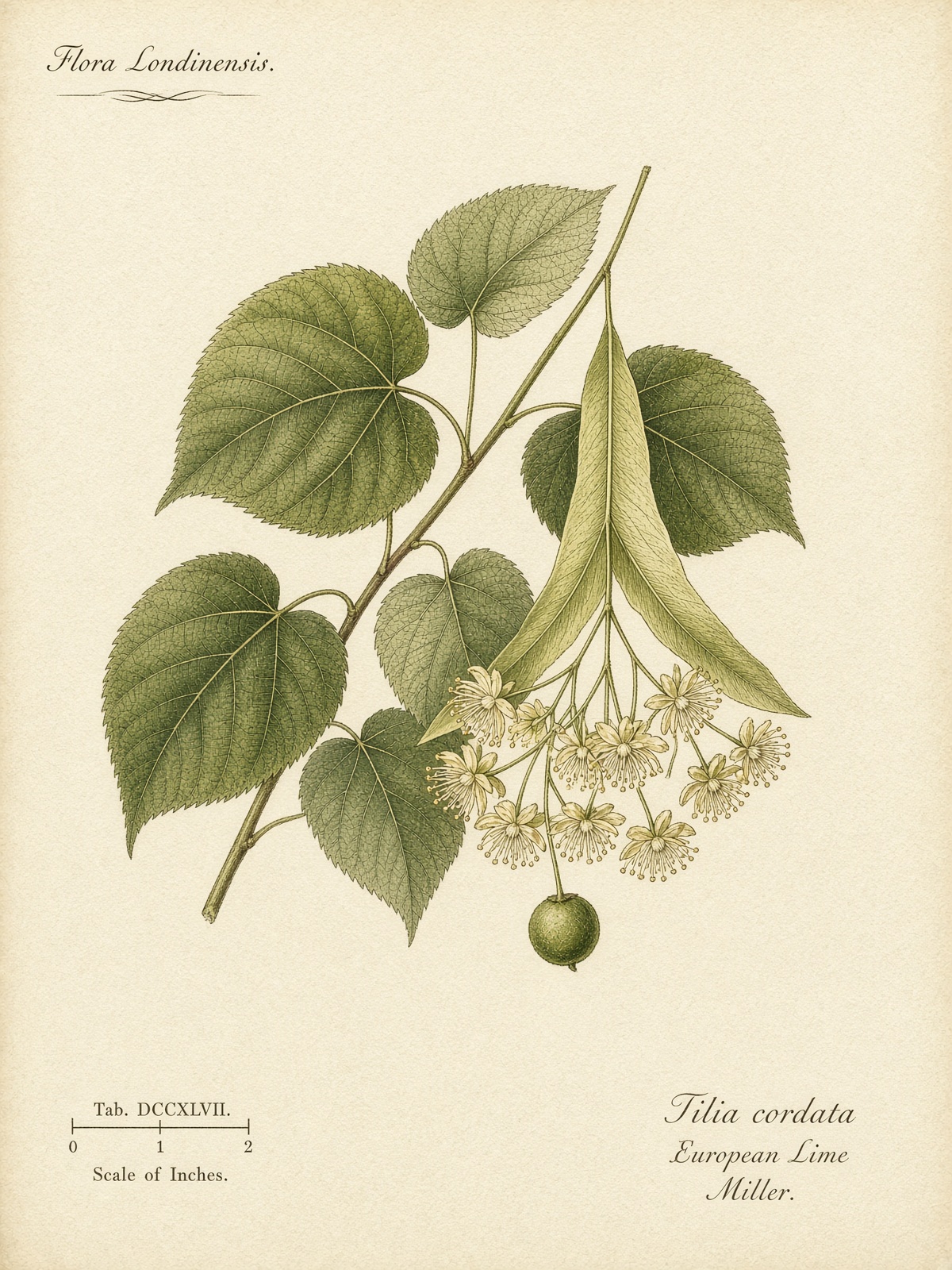 No. 088
Linden
Tilia cordata
Heart-shaped leaves and a honey-bract blossom — the classic European calm-and-cold tea.
Honey, linden, a faint mucilage — the smell of June streets in Europe.
Harvest: First pickable blossom in 6–10 years from a whip; sooner from a large nursery tree
Tilleul is the smell of June in a French railway station. The heart-wood tree of European streets is also a nervine blossom. Bees work it until the pavement is sticky. Street trees may be sprayed; the tea wants a tree you can name as clean.
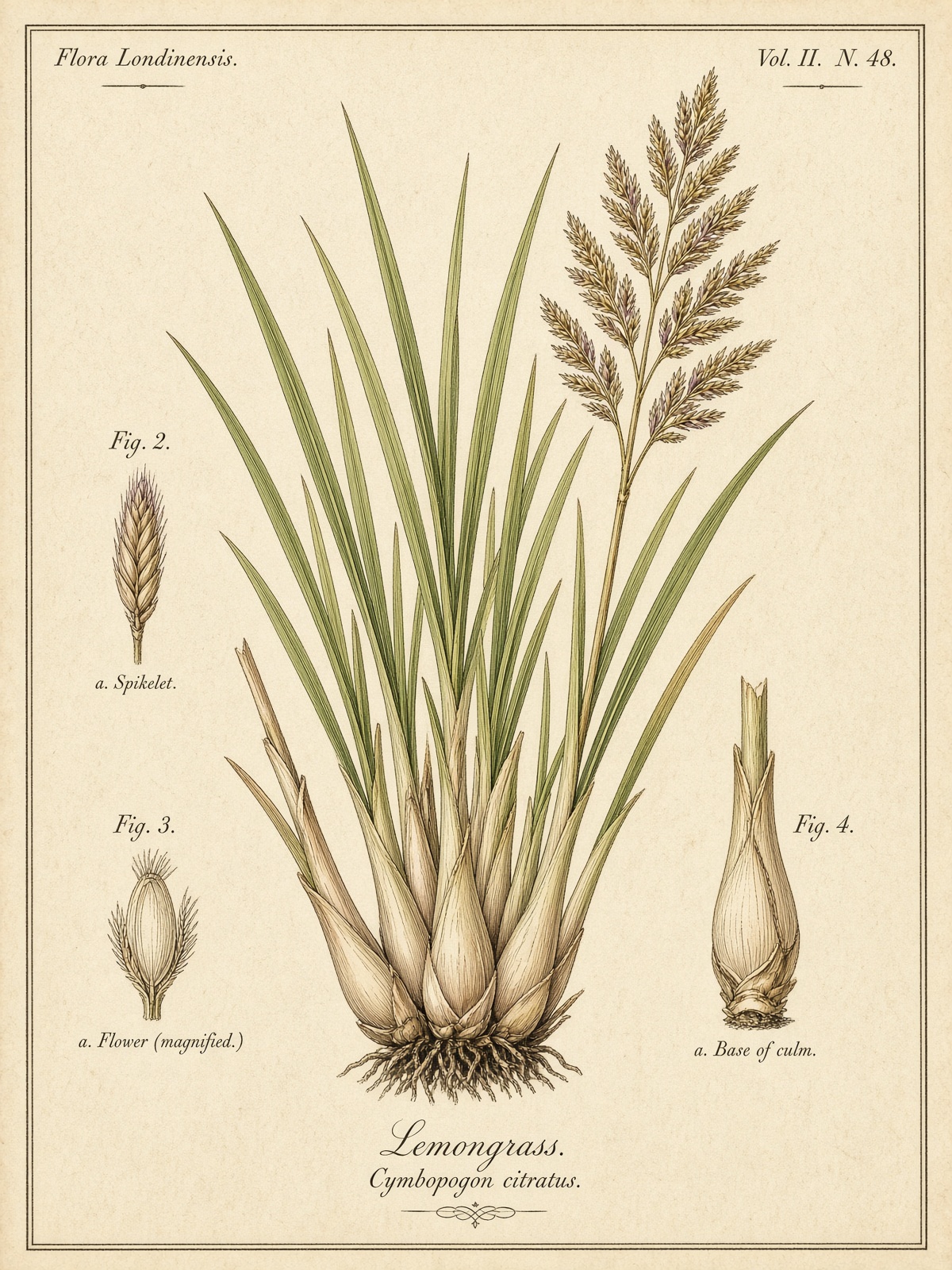 No. 089
Lemongrass
Cymbopogon citratus
A tropical clump that puts lemon in soup — fever-and-digestion folklore with a wok pedigree.
Lemon zest, ginger-grass, a little fat when you bruise the bulb — soup, not candy.
Harvest: 90–120 days from a rooted stalk to a cookable clump
A tropical grass that cooks as if it were lemon peel and ginger had a child. Ayurveda and Thai kitchens got there first. The essential oil is citronella’s cousin and not a drink.
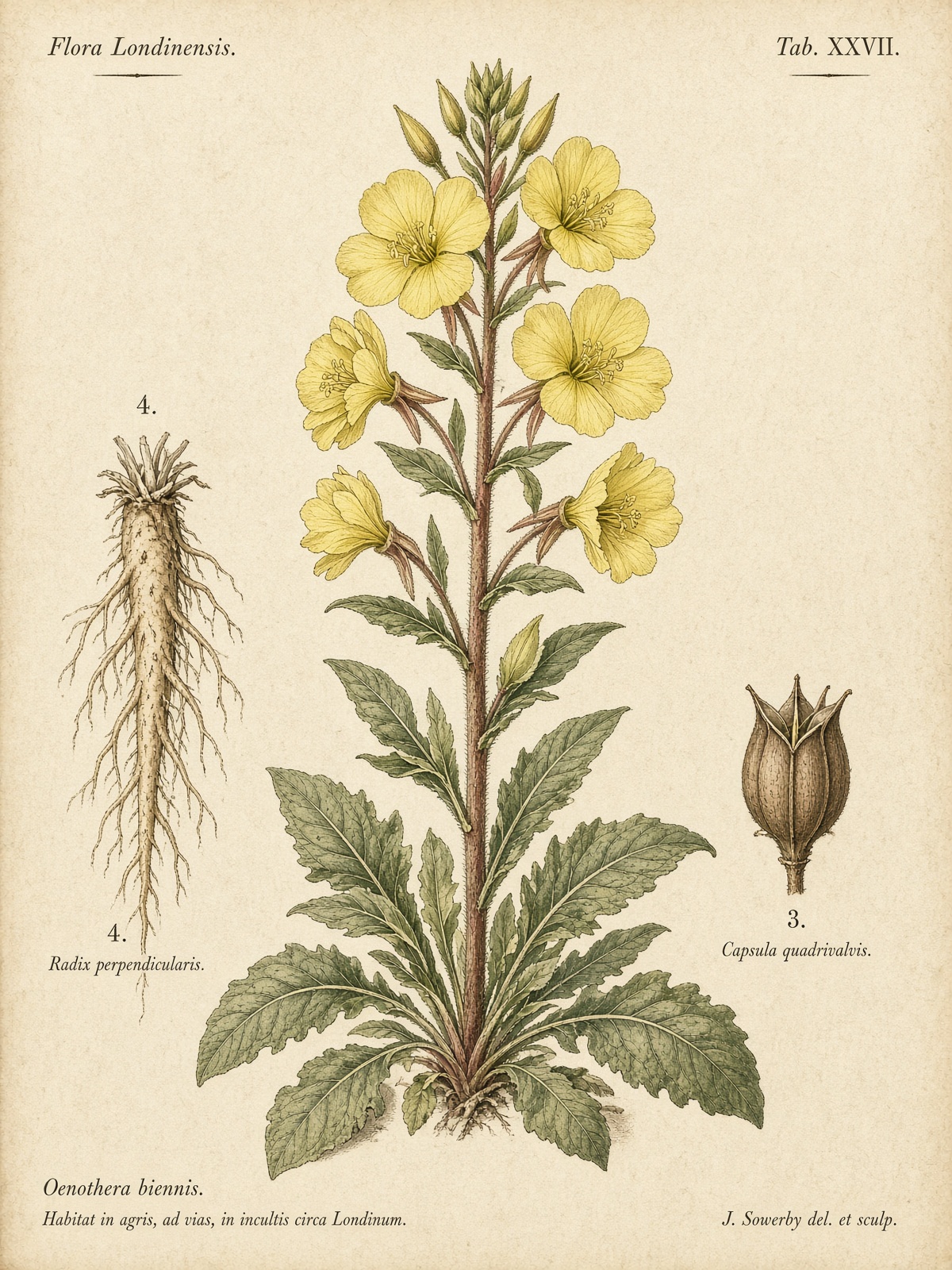 No. 090
Evening primrose
Oenothera biennis
A dusk-opening yellow native whose seed oil is taken for skin and cycle folklore.
Root is peppery-sweet when young; seed oil is oily and faintly nutty. Flowers are not a tea crop.
Harvest: Root ~120 days year 1; seed ~400 days
The yellow flowers open at dusk as if they had an appointment. Native to eastern North America; the seed oil became a 1980s supplement. Moths do the pollinating while you are indoors.
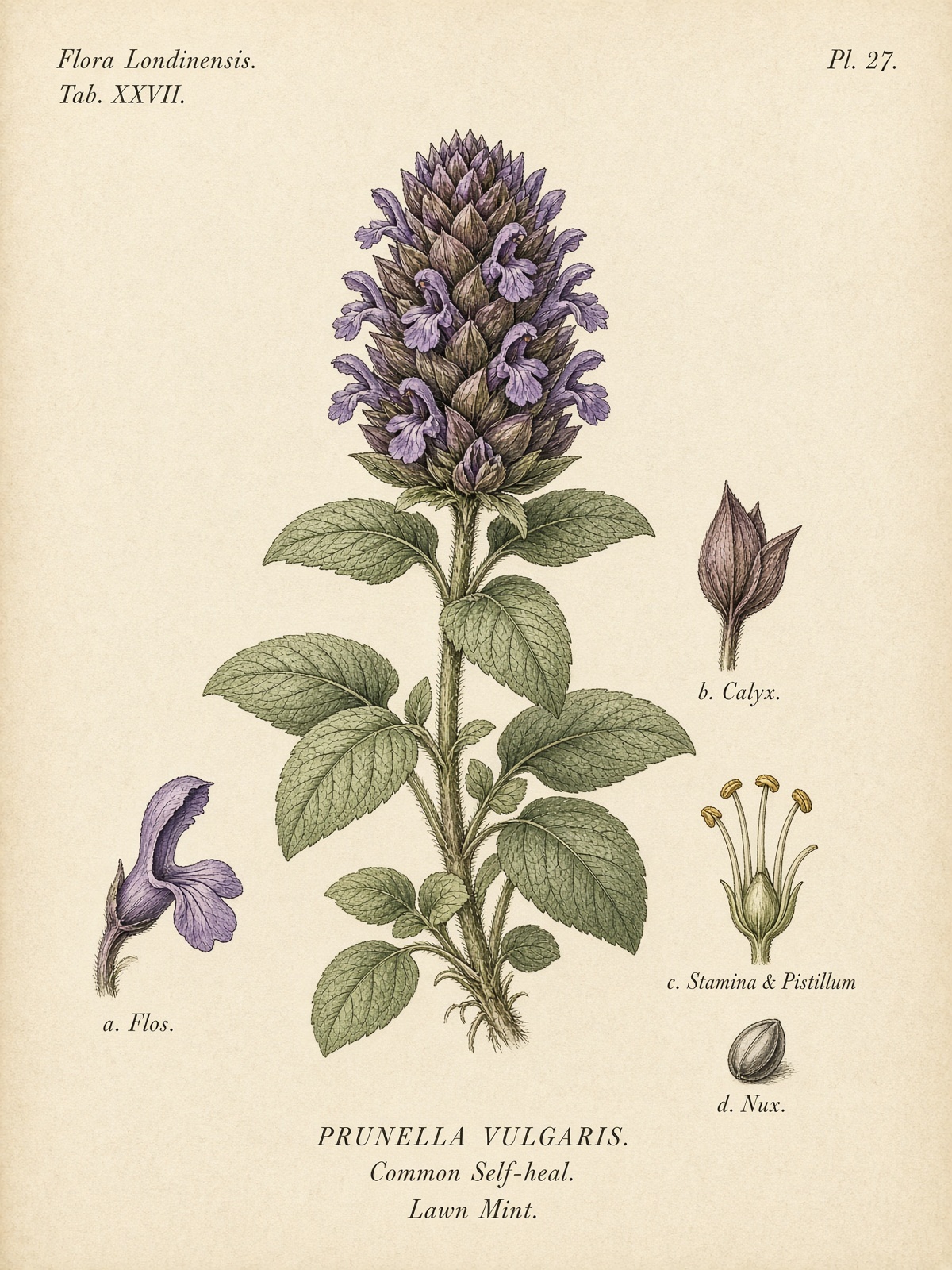 No. 091
Self-heal
Prunella vulgaris
The purple lawn mint you already step on — a traditional throat gargle and wound wash.
Mild, green, slightly bitter mint. A gargle as much as a cup.
Harvest: 60–80 days from sow; lawn plants are ready in season
Prunella vulgaris, heal-all, a lawn mint with a purple poker. Culpeper said it needed no instruction because its name was the instruction. Modern herbalists use it as a gargle more than a miracle.
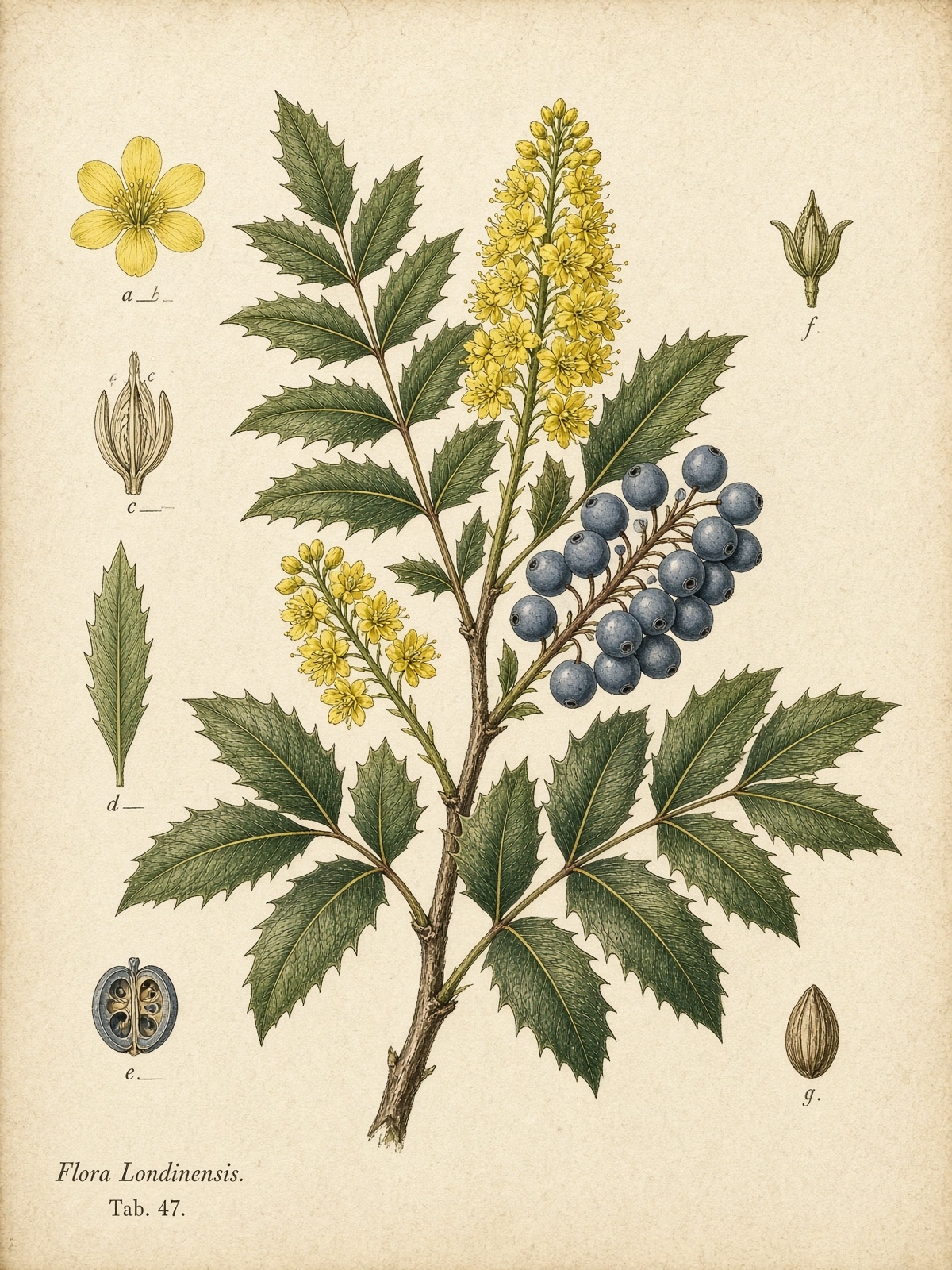 No. 092
Oregon grape
Mahonia aquifolium
A holly-leaved west-coast shrub whose yellow root is a bitter berberine cousin of goldenseal.
Root is shockingly bitter and yellowing. Berry is grape-sour once cooked.
Harvest: Root after year 4–5; berries sooner
Mahonia of the Pacific Northwest, yellow berberine in the root like goldenseal’s cousin. The dusty blue berries make a tart jelly. Landscapers planted it far beyond Oregon.
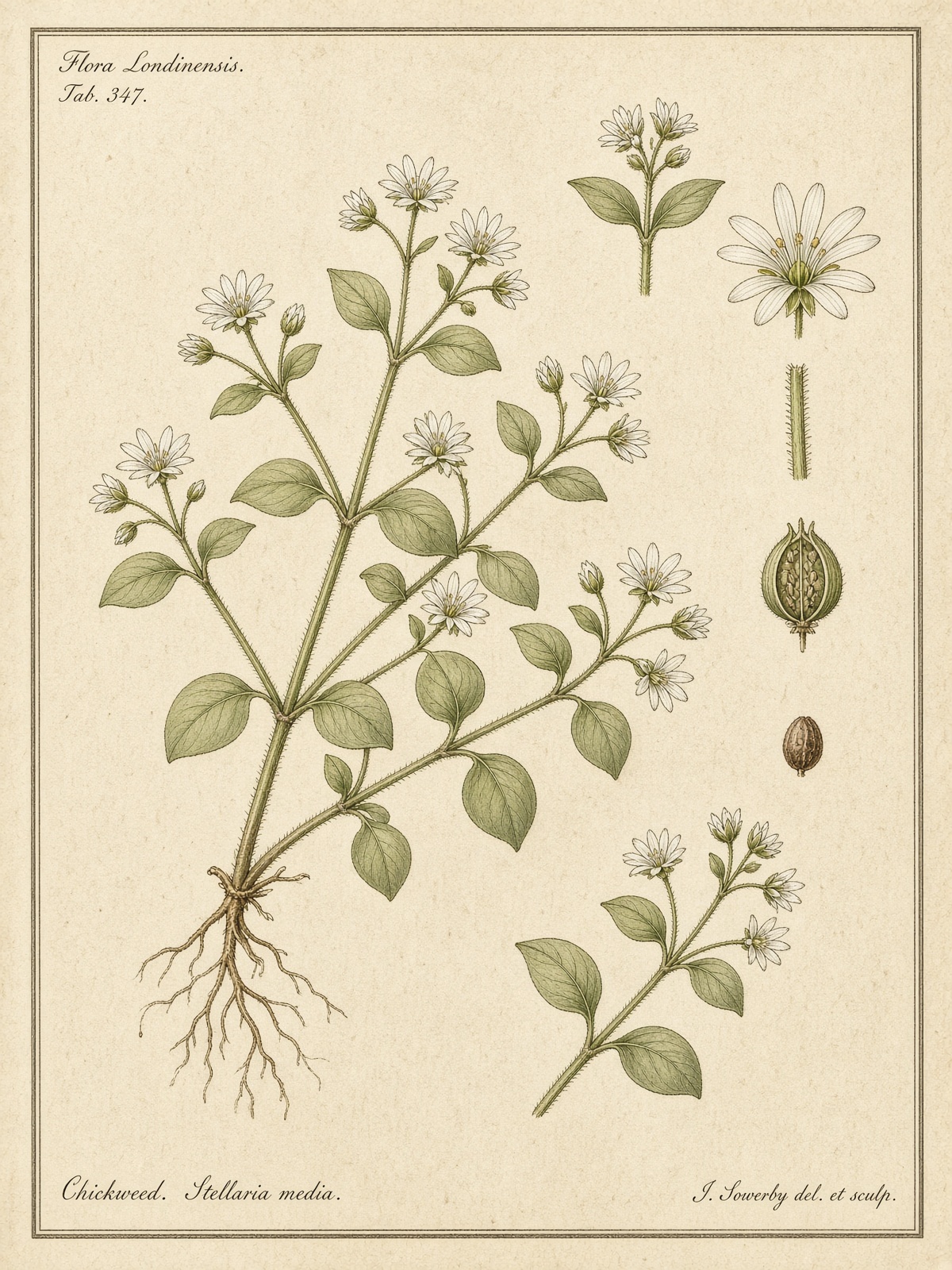 No. 093
Chickweed
Stellaria media
A tender star-flowered green for cooling itchy skin and a spring salad.
Corn-salad green, mild, slightly succulent. The garden’s mildest wild salad.
Harvest: 20–35 days from sow in cool weather
Stellaria, little star. A cool-season stitchwort that herbalists used for itch and that foragers put in salad. It closes when rain is coming. The mouse-taste of the stem is how you know you have it.
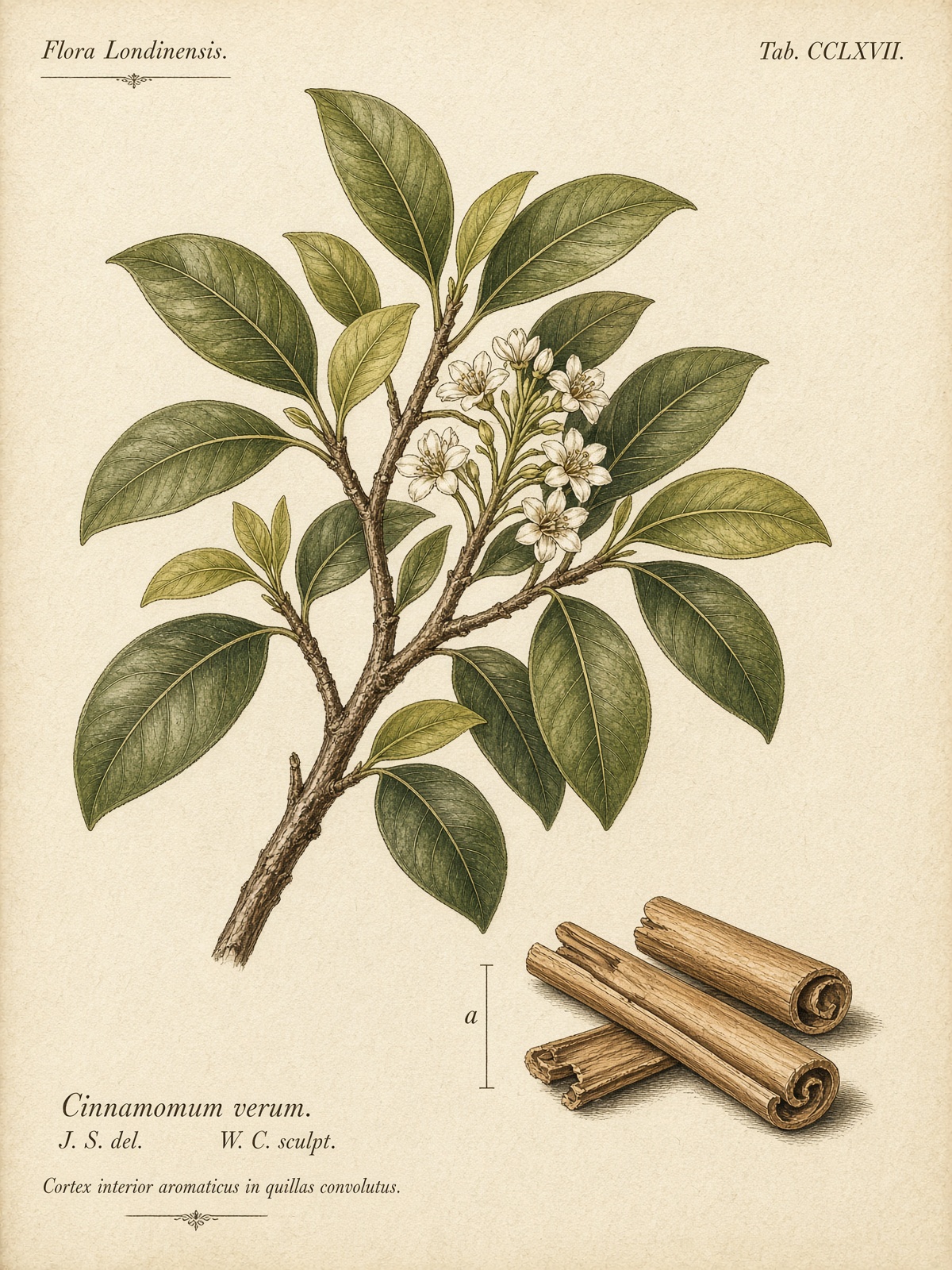 No. 094
Cinnamon
Cinnamomum verum
The inner bark that built a trade — blood-sugar folklore, a kitchen spice, and a tropical tree.
True cinnamon is sweet, floral, and delicate. Cassia is hotter, woodier, and louder.
Harvest: Bark in commercial culture after 2–3 years of coppice; a pot tree is for leaves and perfume
True cinnamon is Sri Lankan C. verum, thin and sweet; cassia is the supermarket bark with more coumarin. Wars were fought for both. A stick in a pot is food; a tablespoon of cassia a day is a liver conversation.
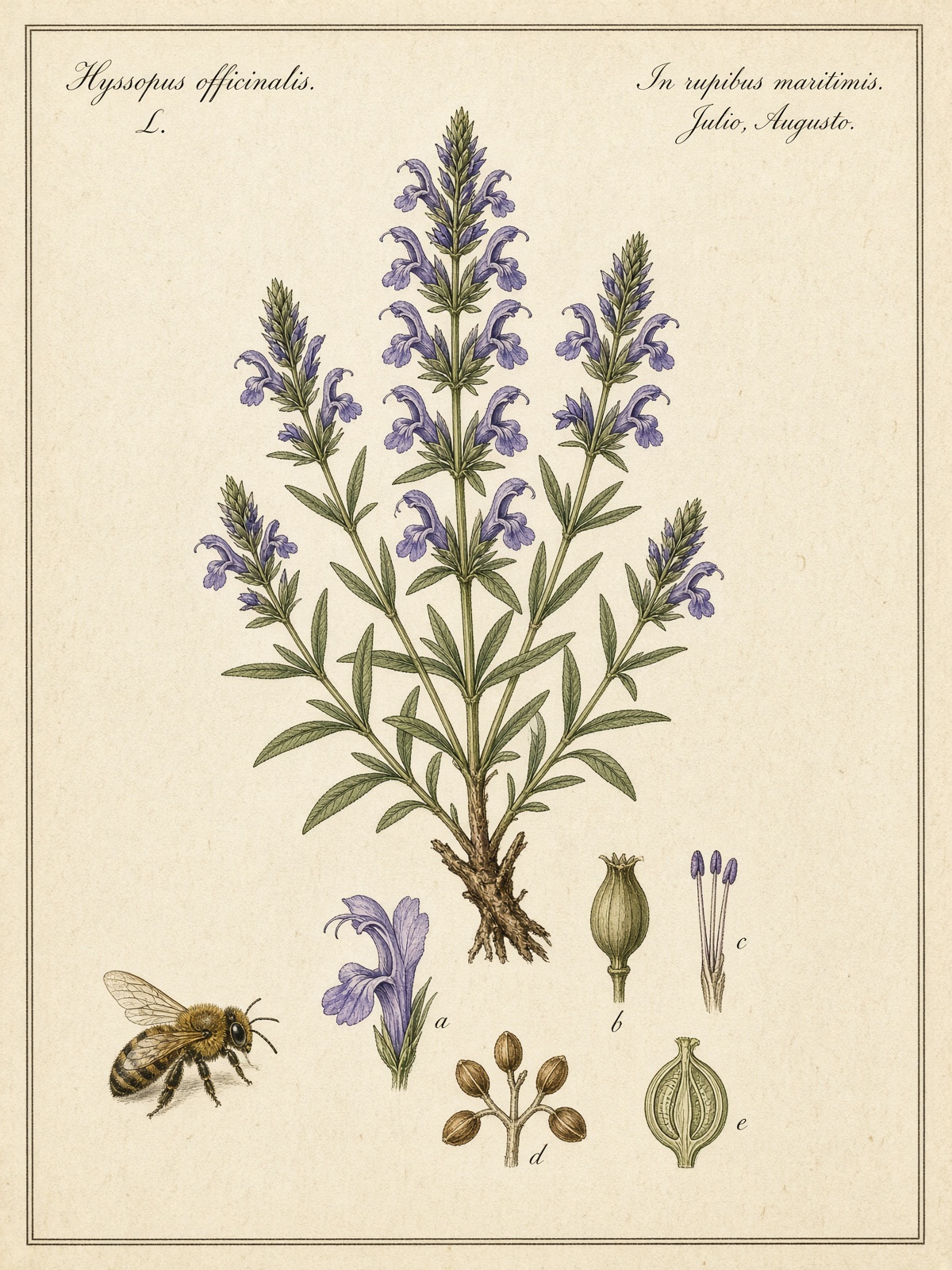 No. 095
Hyssop
Hyssopus officinalis
A blue-spike Mediterranean bitter for the chest — a bee plant with a camphor edge.
Camphor, mint, and a clean bitterness — medieval sauce more than dessert.
Harvest: 70–90 days from a young plant
Purge me with hyssop, says the psalm, which may have been a different plant. Garden hyssop is a Mediterranean blue spike, a bee plant, and a bitter for the chest in the old books.
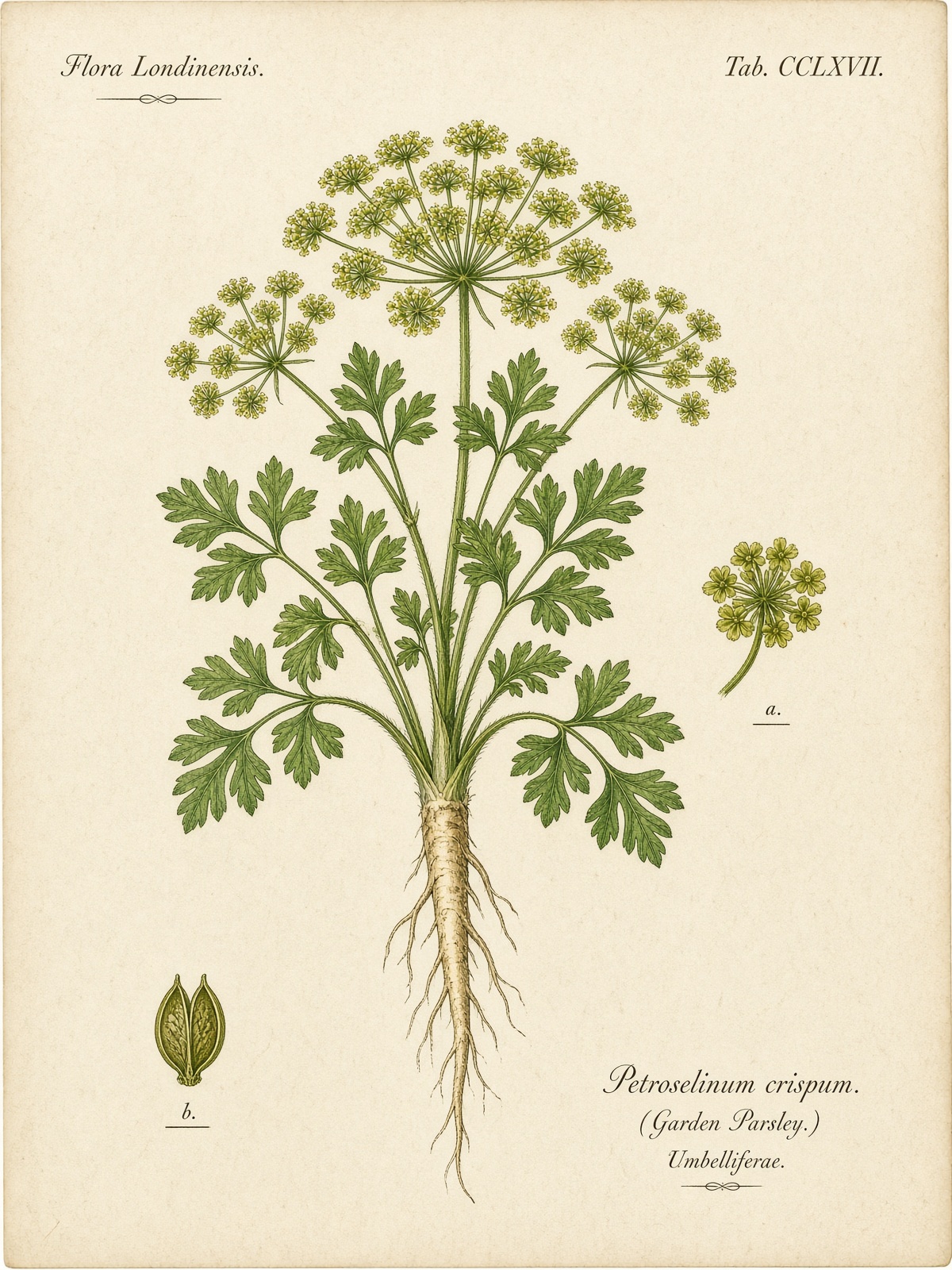 No. 100
Parsley
Petroselinum crispum
The garnish that is actually a mineral-green — a kitchen herb with a traditional kidney-and-breath record.
Green, mineral, a little peppery — curly is milder, flat-leaf is louder.
Harvest: 70–90 days from sow to a useful bunch
The Greeks wove it into graves; the Romans put it on tables. Charlemagne ordered it planted. The garnish that got left on the plate was, for most of history, the point of the plate.
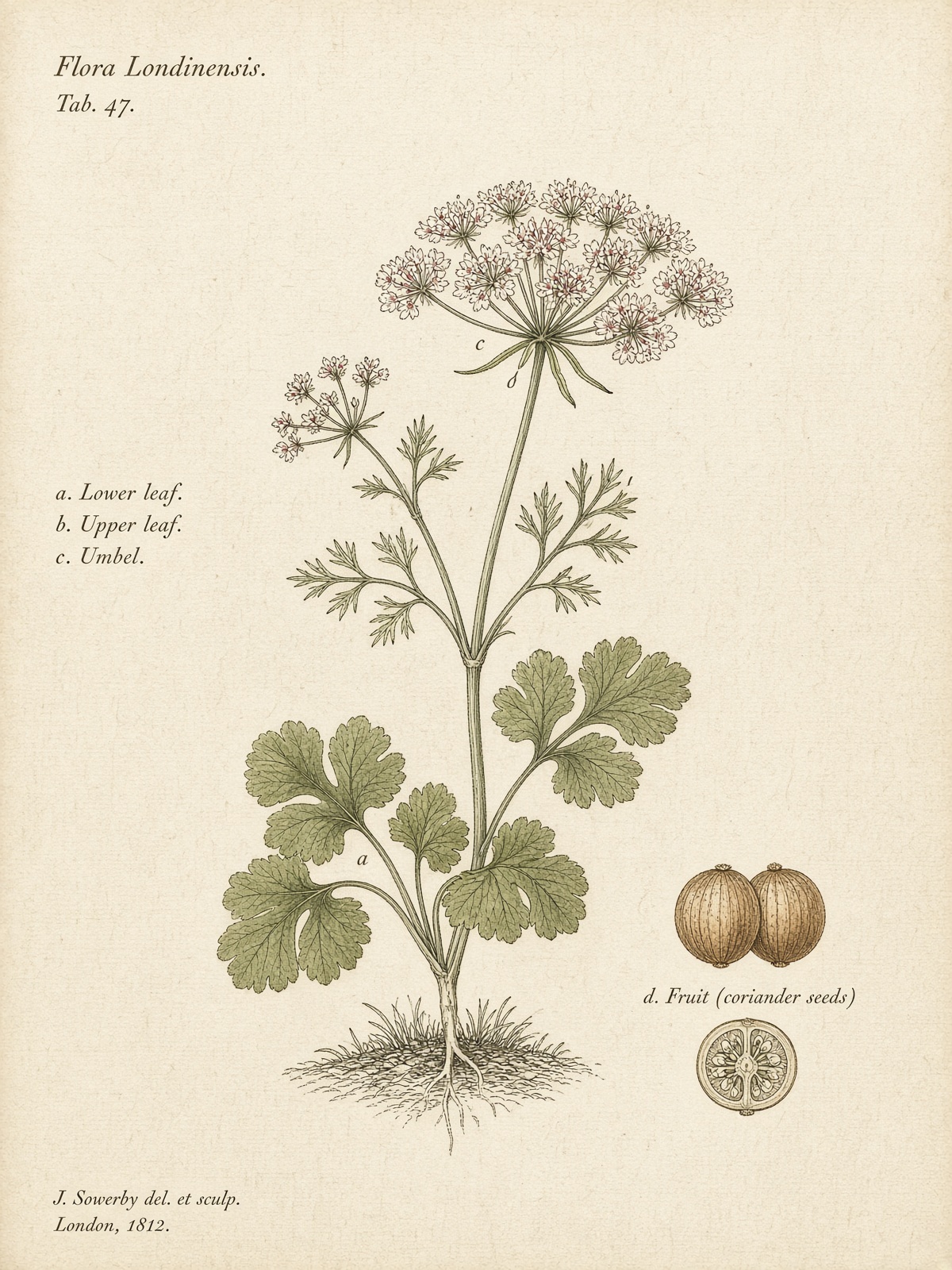 No. 101
Cilantro
Coriandrum sativum
The herb people argue about — leaf for salsa, seed for digestion. A two-crop kitchen annual.
Leaf is polarizing: citrus-green or soap. Seed is warm, orange-peel, and sweet-spice.
Harvest: 30–45 days for leaf; 90–110 days for ripe seed
Coriander is in the Tutankhamun cache. The leaf splits humanity by a gene, OR6A2, into soap people and salsa people. Neither camp is wrong. The seed is the same plant after it has had a think.
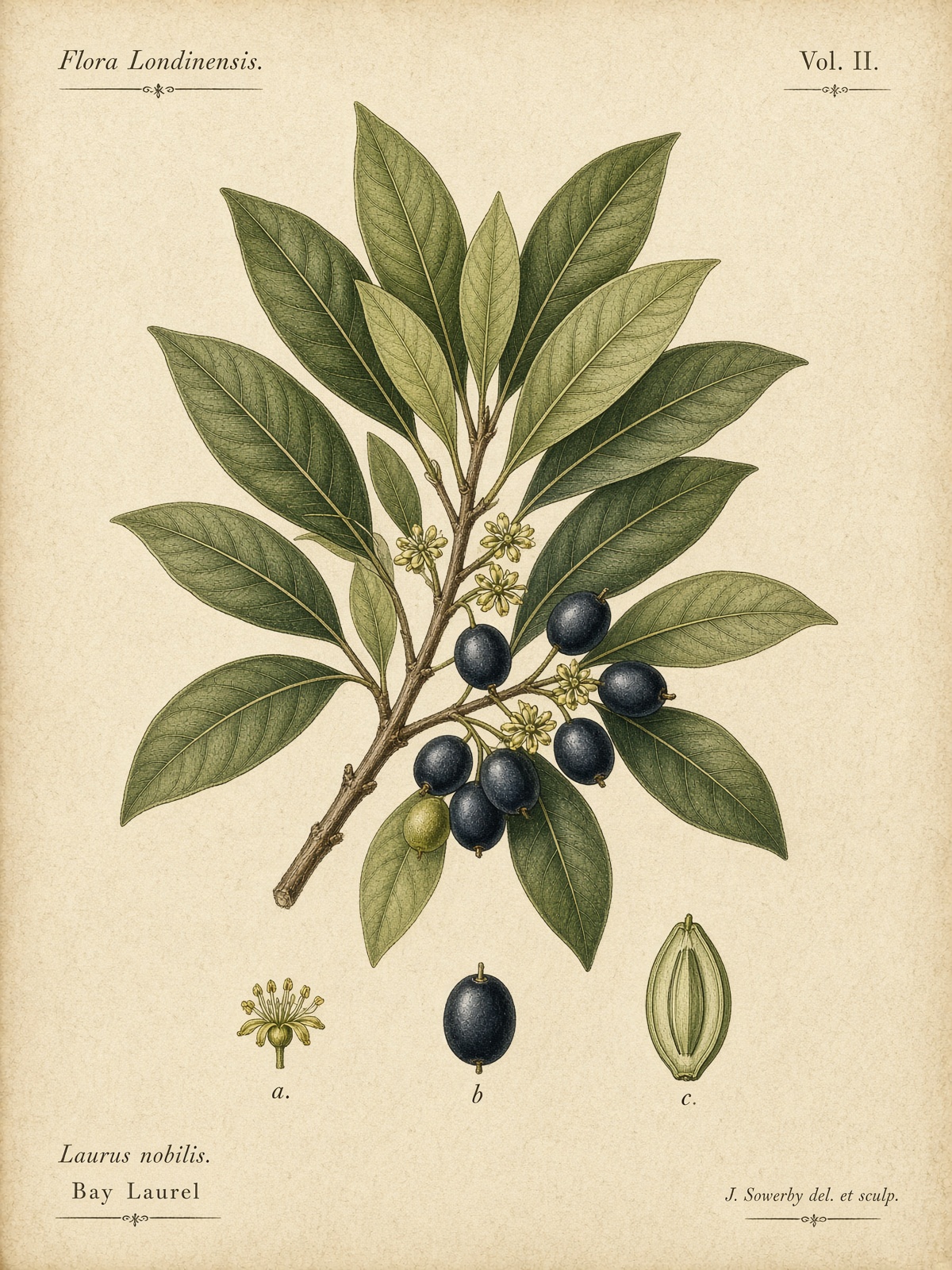 No. 102
Bay laurel
Laurus nobilis
The soup leaf of the Mediterranean — a pot shrub whose dried blade flavors broth and beans.
Warm, resinous, clove-pine. One leaf is a meal; five is a pine forest.
Harvest: Leaf from a young plant in 90–120 days; a bush in 2–3 years
The wreath of poets and generals is Laurus nobilis, not the toxic mountain laurel. A leaf in a stew is the mildest kind of fame. Delphi’s priestesses may have chewed a different laurel; this one is soup.
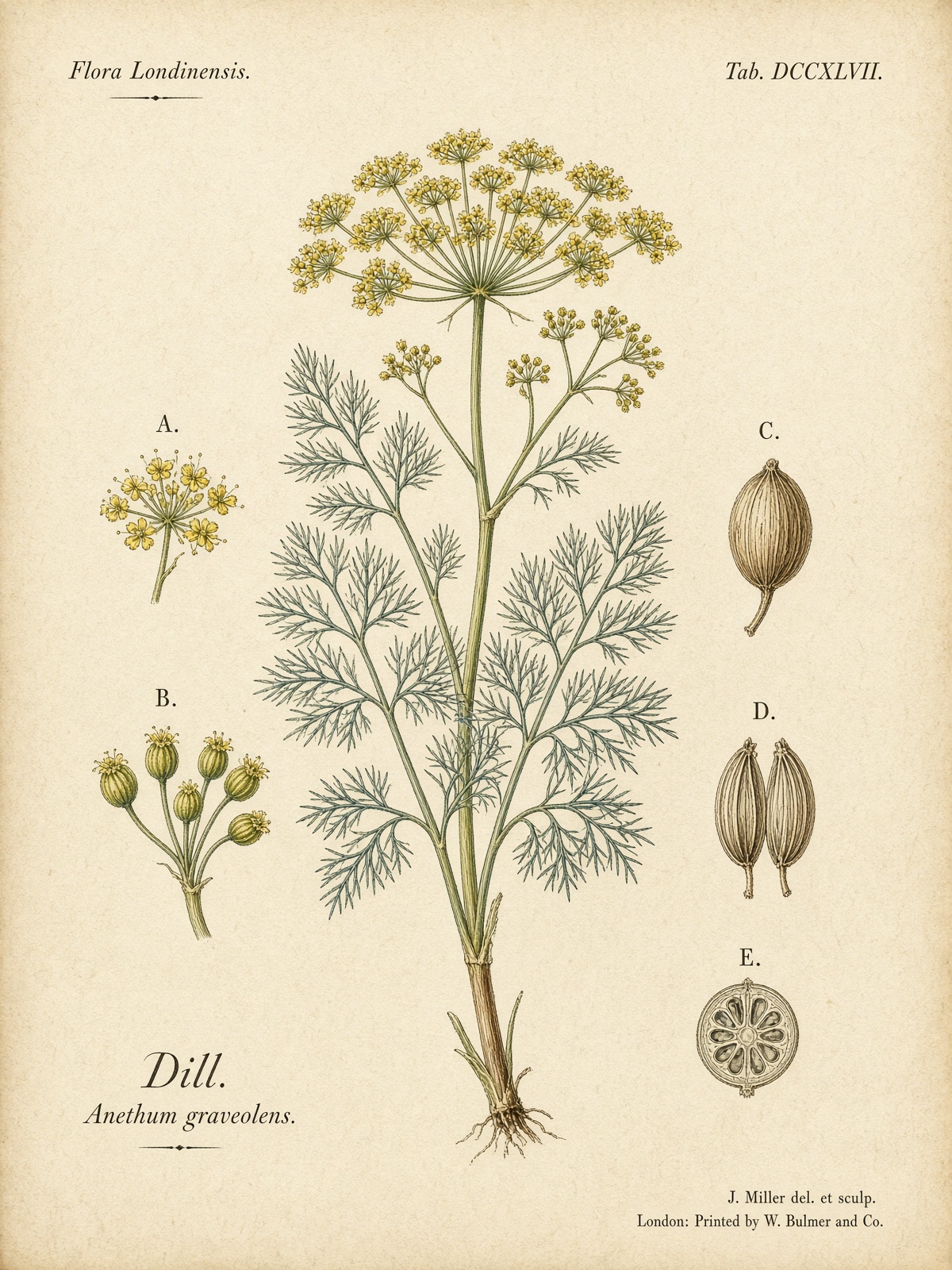 No. 103
Dill
Anethum graveolens
Feathery kitchen green and a caraway-cousin seed — the pickle herb, also an after-dinner chew.
Leaf is green anise and grass; seed is warmer, caraway-adjacent, a little citrus.
Harvest: 40–55 days for leaf; 85–100 days for seed
Dill comes from Old Norse dilla, to lull — a colic name. The feathery weed and the seed are one annual in a hurry. Keep it from fennel if you care about honest grandchildren.
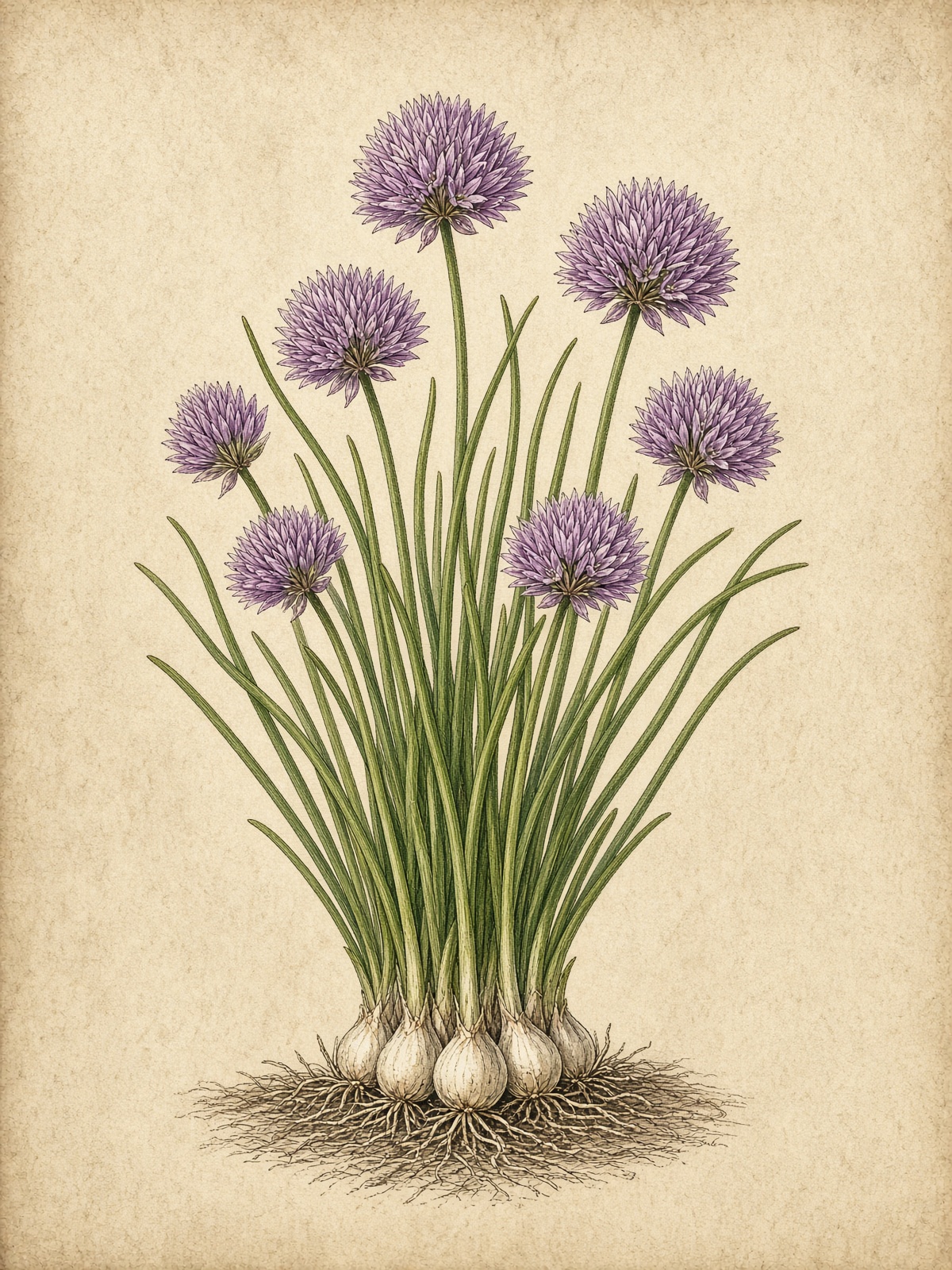 No. 104
Chives
Allium schoenoprasum
The mildest kitchen onion — a perennial snip for eggs, and a gentler cousin of garlic’s folklore.
Green onion, grass, a little garlic on the finish. Flowers are milder and faintly sweet.
Harvest: 60–80 days from seed; 21 days from an established clump
The smallest onion of the temperate world, already in Chinese pots 4,000 years back. The Latin schoenoprasum is ‘rush-leek.’ The purple pompoms are edible, which the bees also know.
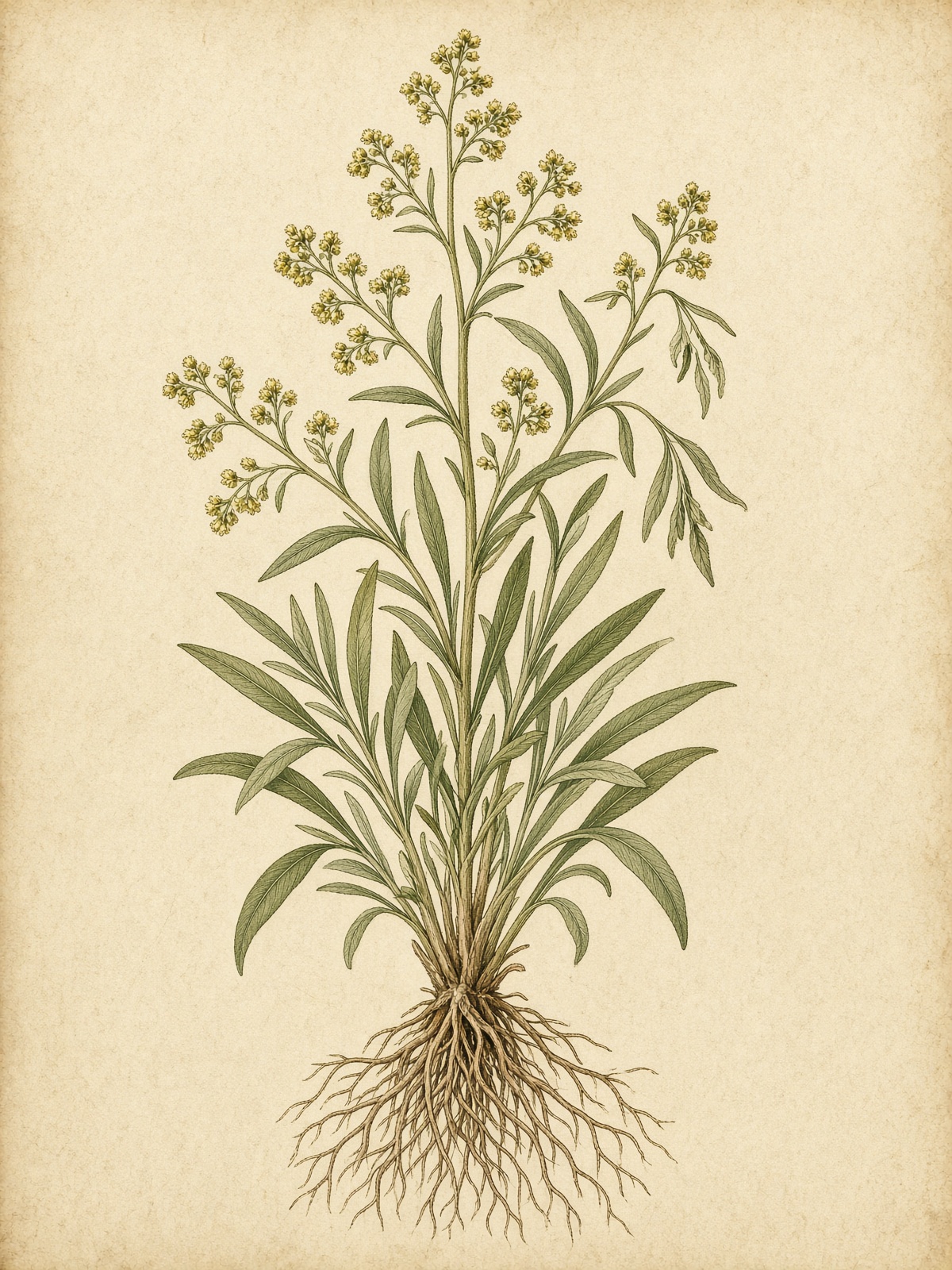 No. 105
French tarragon
Artemisia dracunculus var. sativa
Anise-leaf of French kitchens — a sterile clone you buy as a plant, then tarragon-vinegar the rest of your life.
Sweet anise, faint vanilla, green bite. Dried is a pale shadow of fresh.
Harvest: 40–60 days from a division to a useful snip
French tarragon is a sterile clone of an Artemisia; if it sets seed, you bought the Russian kind and will be disappointed. Béarnaise is a delivery system for the leaf. The name is a little dragon, dracunculus.
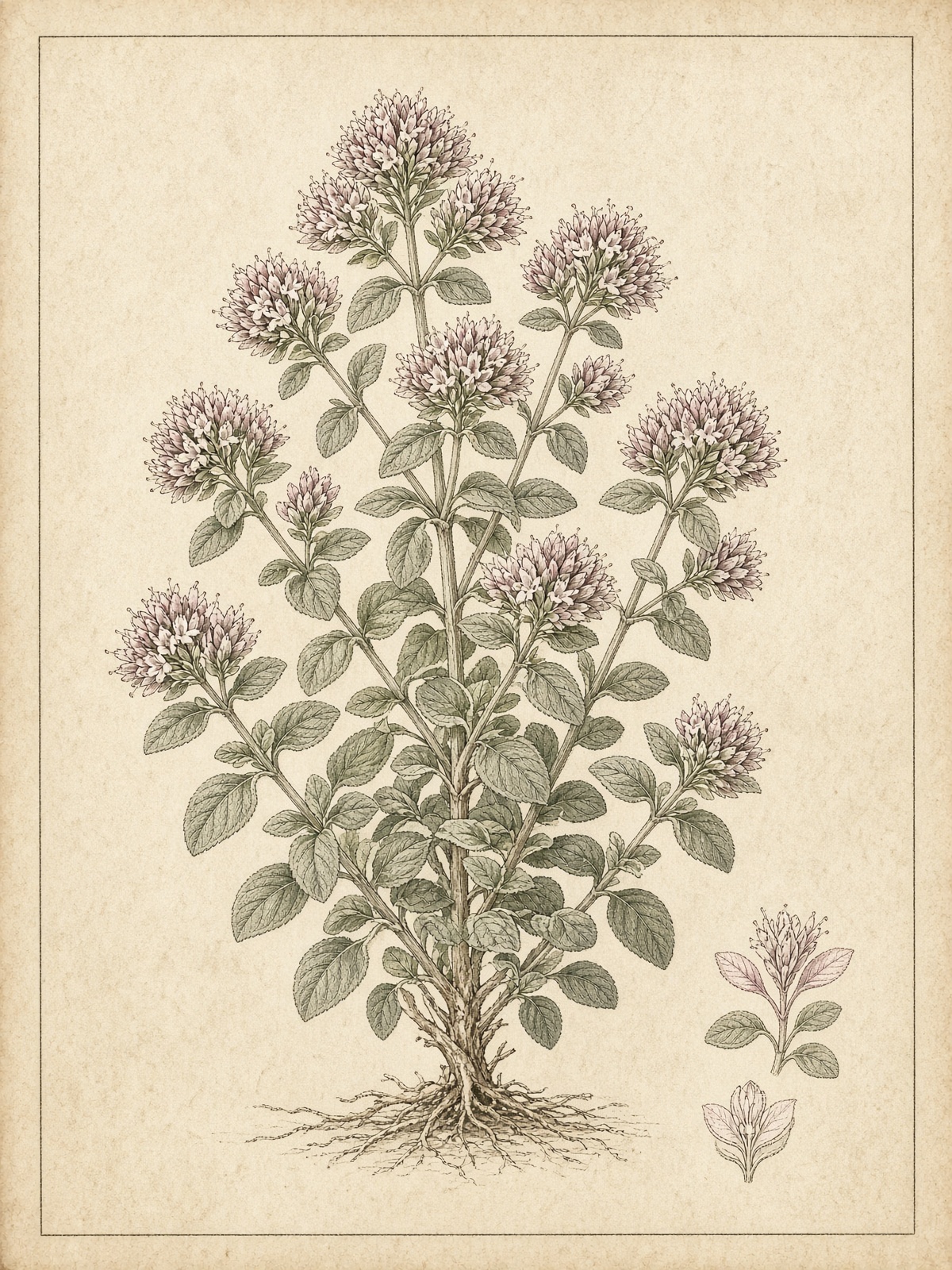 No. 106
Sweet marjoram
Origanum majorana
Oregano’s sweeter kitchen cousin — a tender Mediterranean mint for digestion and a quiet evening cup.
Sweet, floral, pine-camphor without oregano’s heat.
Harvest: 60–80 days from transplant
Sweet marjoram was the plant Aphrodite was said to have grown. It is oregano’s gentler, more floral sibling, and it hates a hard frost. German sausage and a Greek hillside both claim it.
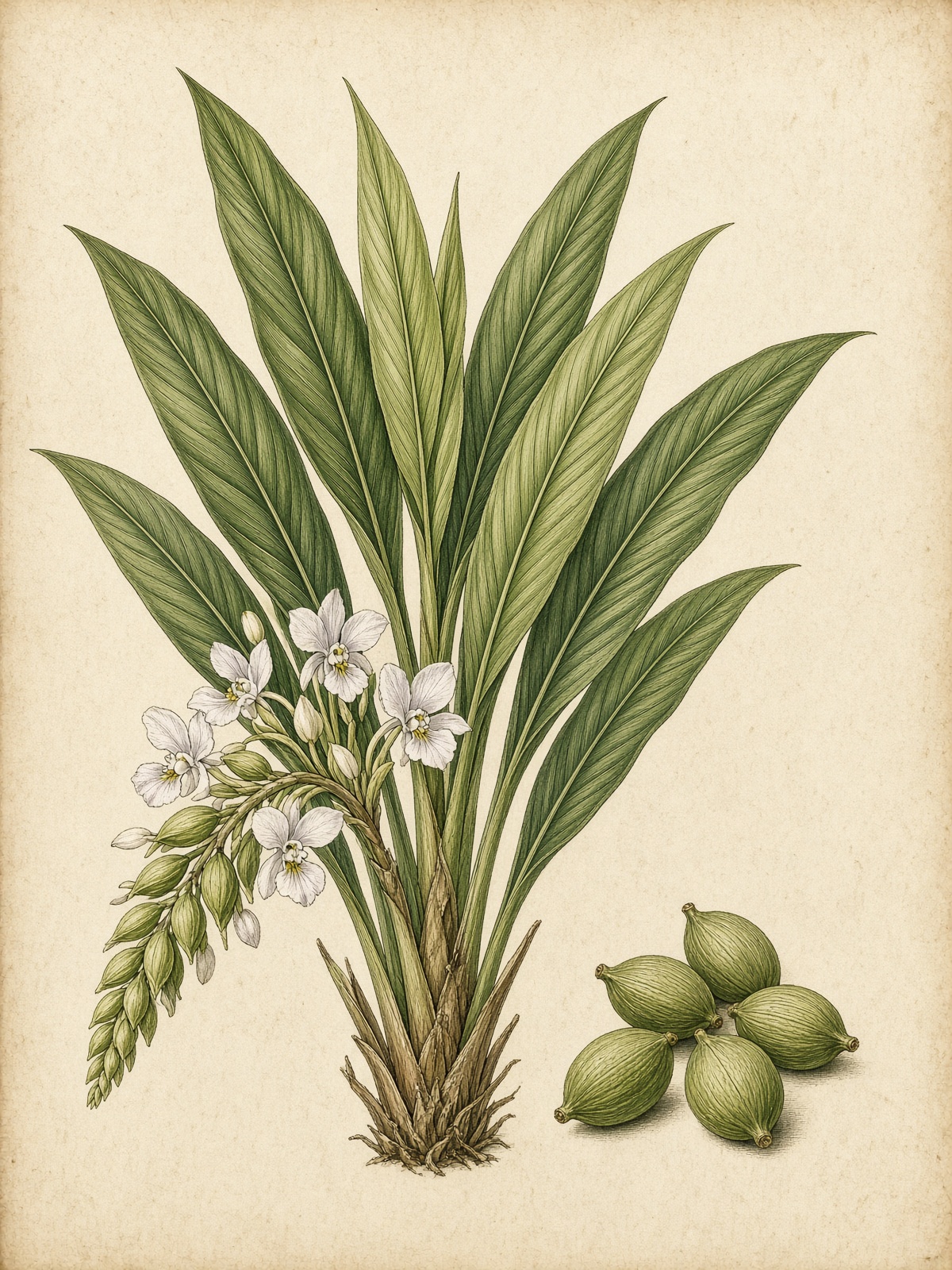 No. 107
Green cardamom
Elettaria cardamomum
The queen of spices — a tropical ginger whose green pods scent chai, coffee, and after-meal folklore.
Camphor, eucalyptus, lemon peel, a little sweetness. Crush the pod; whole it is shy.
Harvest: 2–3 years to a first pod flush in a greenhouse; kitchen use is the dried spice
The queen of spices in the Western Ghats. Vikings somehow got it into Scandinavian buns, a trade-route joke that stuck. Crack a green pod and the kitchen smells like a train through Kerala.
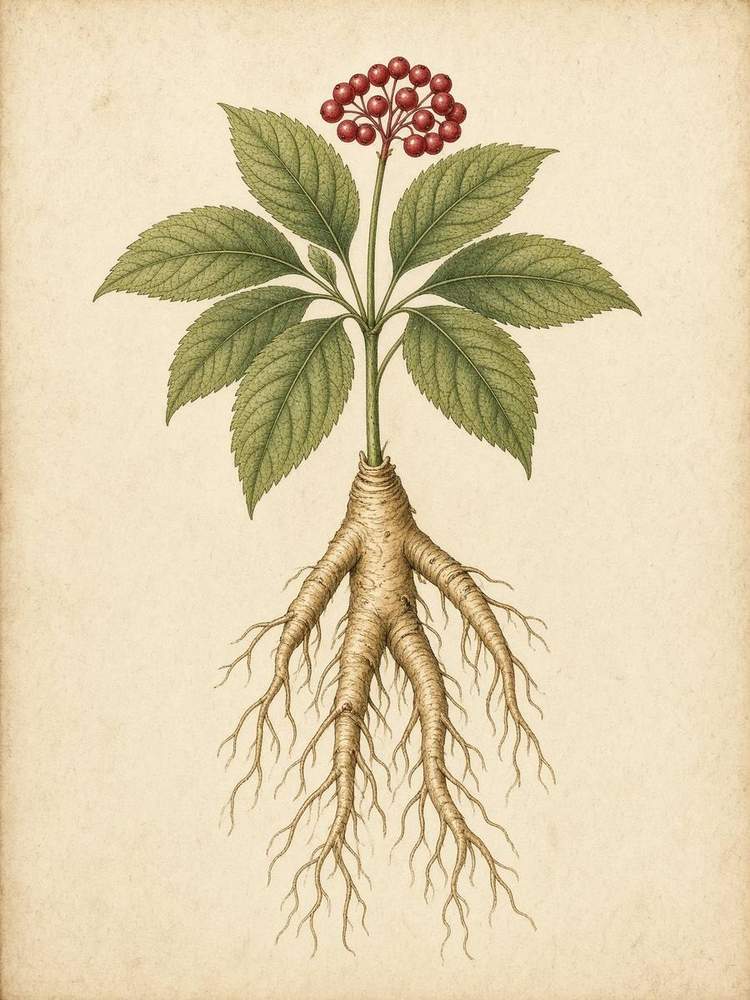 No. 108
Asian ginseng
Panax ginseng
The man-shaped root of East Asian tonic medicine — stamina folklore in a slow, expensive crop.
Bitter-sweet, earth, a little licorice and metal.
Harvest: 1,400–2,200 days (year 4–6) for a first decent root
The forked root was read as a little person — panax, the all-heal — and Korean and Chinese courts paid in silver for old wild specimens. The word ginseng is Chinese rénshēn, ‘man root.’ Most of what you can buy now is a farmed shade crop; the wild plant was loved nearly to disappearance.
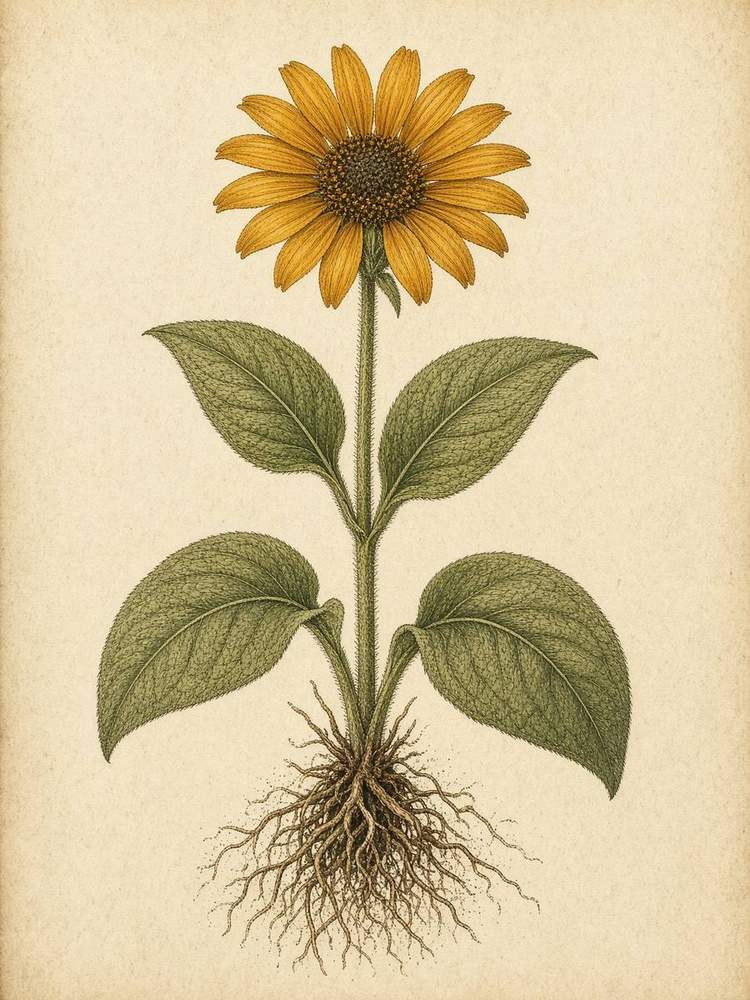 No. 109
Arnica
Arnica montana
A mountain daisy for bruises — a skin plant, never a tea.
Not a flavor. Resinous, bitter, and not for the mouth.
Harvest: 365–450 days to a first flowering
Goethe kept arnica in his travel kit. Alpine shepherds used the daisy on kicks and falls; German pharmacies still sell it as a bruise gel. The same plant in a teacup has sent people to the clinic — a reminder that ‘natural’ and ‘edible’ are not synonyms.
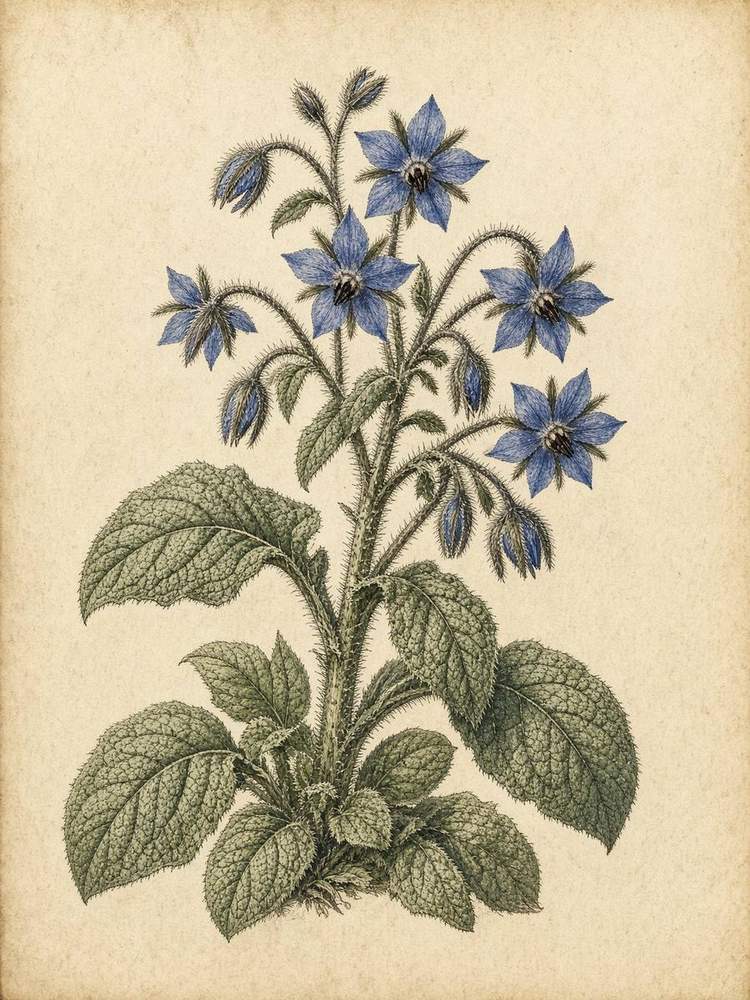 No. 110
Borage
Borago officinalis
Cucumber-leaf and a blue star flower — a kitchen curiosity with a liver caveat if you make a habit of it.
Cucumber, oyster, a little salt. The flower is milder than the leaf.
Harvest: 50–70 days from sow to first stars
Medieval cups were floated with borage ‘for courage’ — ego borago, gaudia semper, ‘I, borage, bring always courage.’ The blue stars still turn up in Pimm’s. The plant’s other gift is less festive: pyrrolizidine alkaloids, which is why this plate stays a garnish.
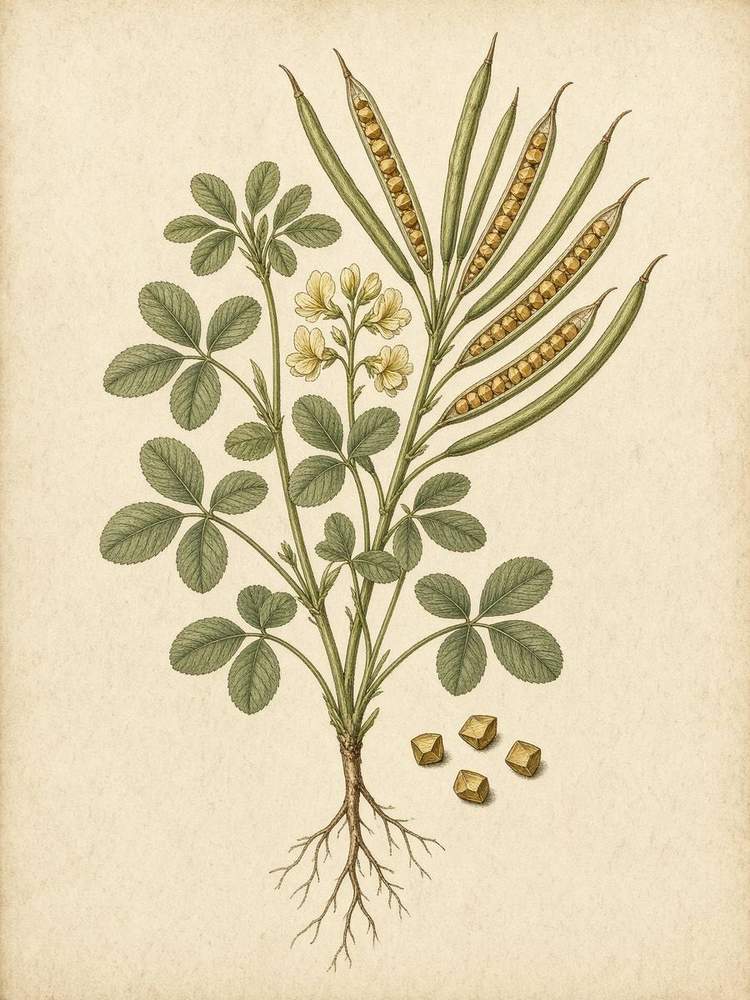 No. 111
Fenugreek
Trigonella foenum-graecum
Maple-scented methi — a curry seed, a sprout, and a traditional milk-and-glucose folklore.
Seed is maple, bitter celery, and warm spice. Leaf is bitter-green.
Harvest: 30–40 days for leaf; 90–110 days for seed
The Latin foenum-graecum means ‘Greek hay’ — it was cattle fodder that escaped into the spice box. Indian kitchens know it as methi; a heavy hand makes sweat and milk smell of maple. That is the seed, not a candle.
 No. 112
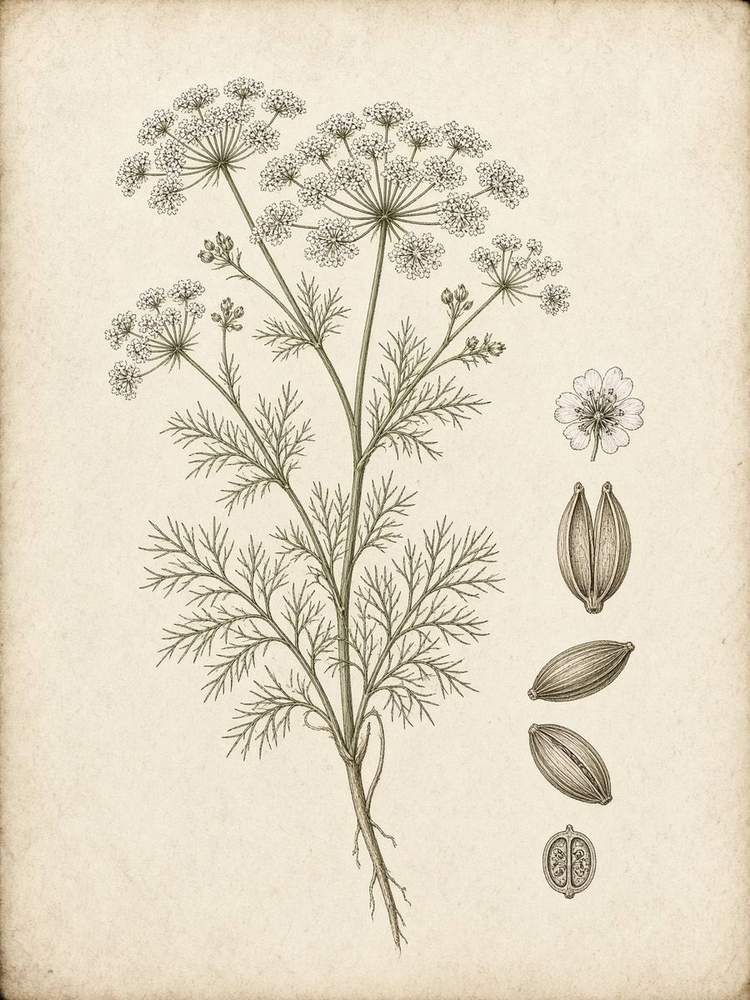
Cumin
Cuminum cyminum
The warm, earthy seed of every chili and curry — a carminative kitchen spice with a long gut record.
Warm earth, bitter citrus, a little sweat-spice. Toast wakes it.
Harvest: 100–120 days from sow to ripe seed
Cumin was so valued in antiquity that the Romans kept it on the table like pepper. The name is Akkadian kamūnu by way of Greek. A medieval European ‘cumin oath’ was sworn over the seed because it was thought to keep lovers — and chickens — from wandering.
 No. 113
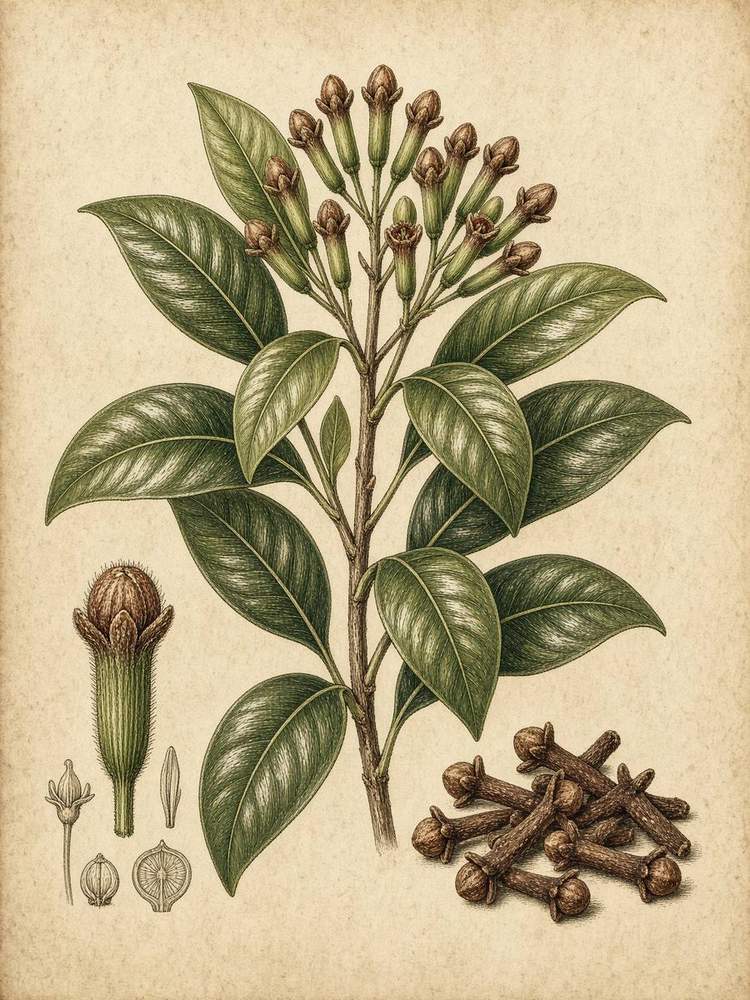
Clove
Syzygium aromaticum
The nail-shaped flower bud that built a monopoly — a kitchen spice and a traditional toothache clove.
Hot, sweet, eugenol-numb. One bud perfumes a pot; five is a dentist’s office.
Harvest: Several years to first buds in the tropics; the kitchen crop is purchased
The Dutch East India Company burned clove trees on every island but one to keep the price. The ‘nail’ in the name is the Latin clavus — the dried bud looks like a tack. Dentists still meet eugenol, the same warmth that makes Christmas ham smell like a clinic.
 No. 114
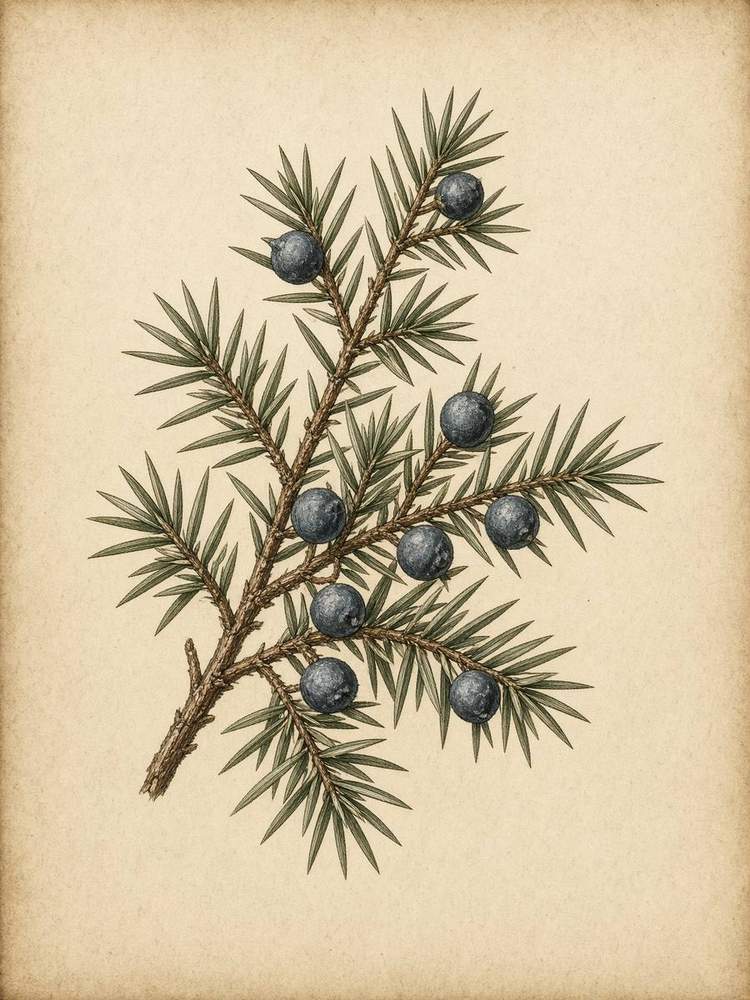
Juniper
Juniperus communis
The blue berry that makes gin smell like a northern wood — a roasting spice with a kidney caveat in quantity.
Pine, gin, citrus-resin. Crush a berry and the kitchen becomes a forest.
Harvest: Berries ripen over 18–24 months on an established shrub
Gin is simply genever — the Dutch for juniper — and the berry was a plague-era fumigant as much as a drink. Medieval kitchens used it the way we use pepper. Sailors chewed the cones against scurvy with mixed success; the pine-citrus smell was the point as much as the vitamin.
 No. 115
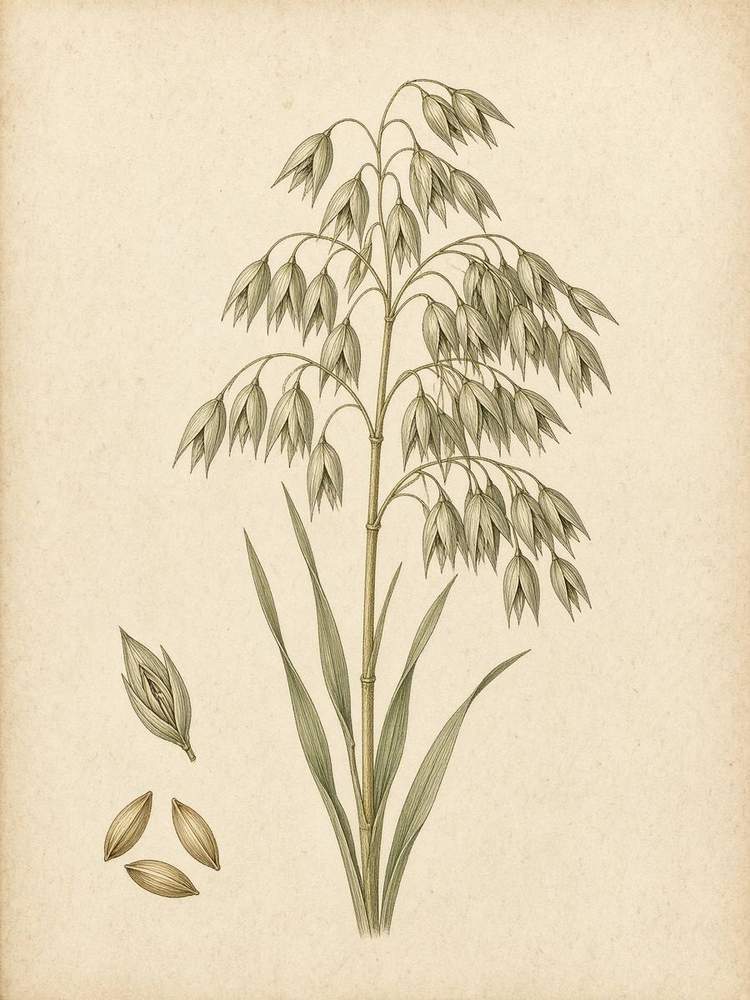
Oatstraw
Avena sativa
The same plant as breakfast — milky tops and straw as a traditional nervine food-tea.
Green hay, milk, a little sweetness. Straw tea is quieter than the grain.
Harvest: 60–70 days to milky tops; 90–110 days to ripe grain
Oats fed northern horses and northern people when wheat would not ripen. ‘Sowing wild oats’ was a weed of the wheat field — Avena fatua — before it was a proverb. The milky-oat herbalists of the 19th century were taking the same plant your breakfast came from and catching it a month earlier.
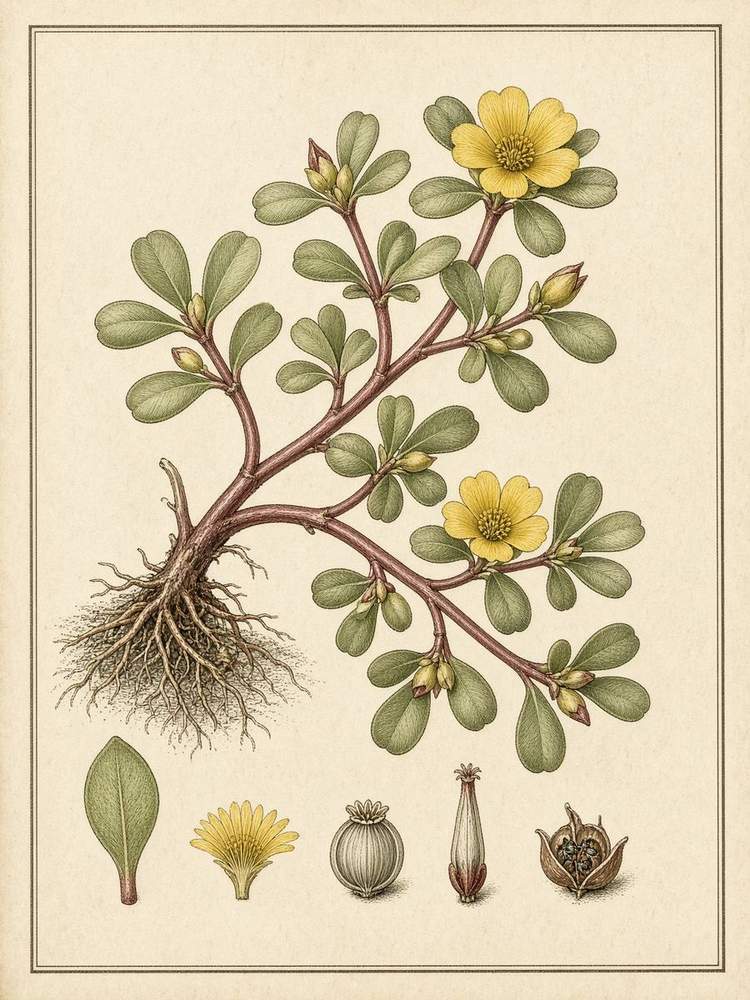 No. 116
Purslane
Portulaca oleracea
The lemony succulent in the cracks of the driveway — a salad weed richer in omega-3 than most garden greens.
Lemon, cucumber, a little okra-slime. Pleasant cold, dull if overcooked.
Harvest: 30–45 days from sow; volunteers are ready when you notice them
Pliny already called it a pot-herb. Thoreau ate it at Walden and wrote that he made a satisfactory dinner of it. Modern nutritionists rediscovered what village kitchens never forgot: this ‘weed’ carries more alpha-linolenic acid than most greens we plant on purpose.
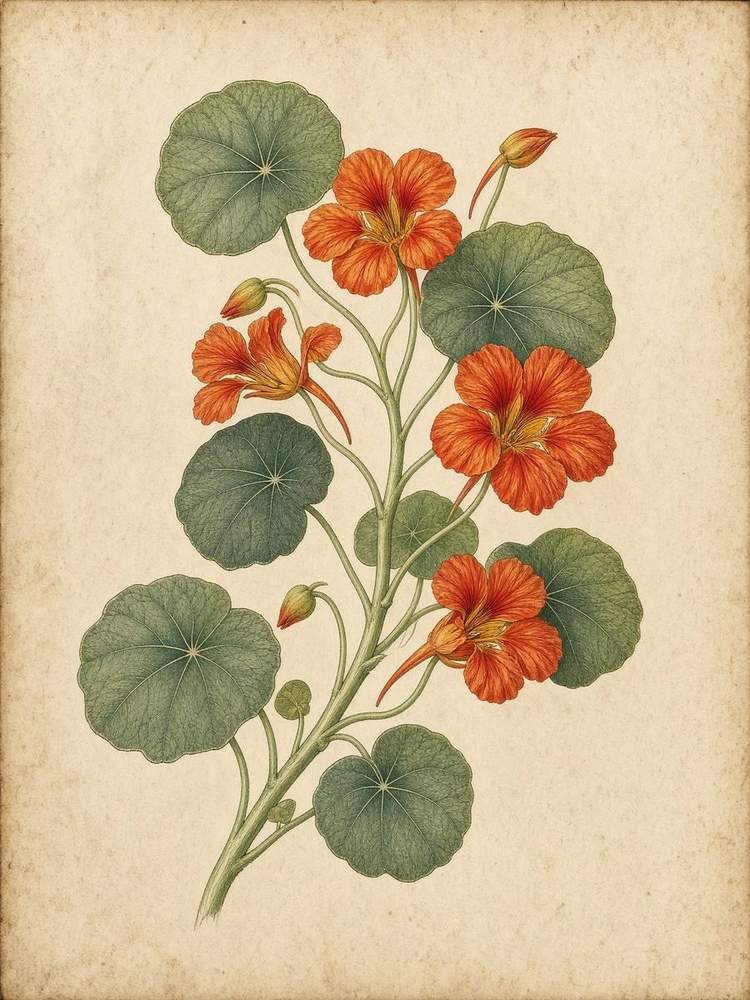 No. 117
Nasturtium
Tropaeolum majus
Peppery lily-pad leaves and a spurred flower — a salad plant whose pickled seeds stand in for capers.
Watercress, mustard, a little honey in the flower. Seed is hotter.
Harvest: 35–50 days to leaf and flower
Linnaeus named it Tropaeolum from tropaeum, a trophy — the round leaves and flowers looked to him like shields and helmets on a battlefield pole. Victorian salads were not complete without it. The pickled seeds fooled no one as capers, and fooled everyone as a good idea.
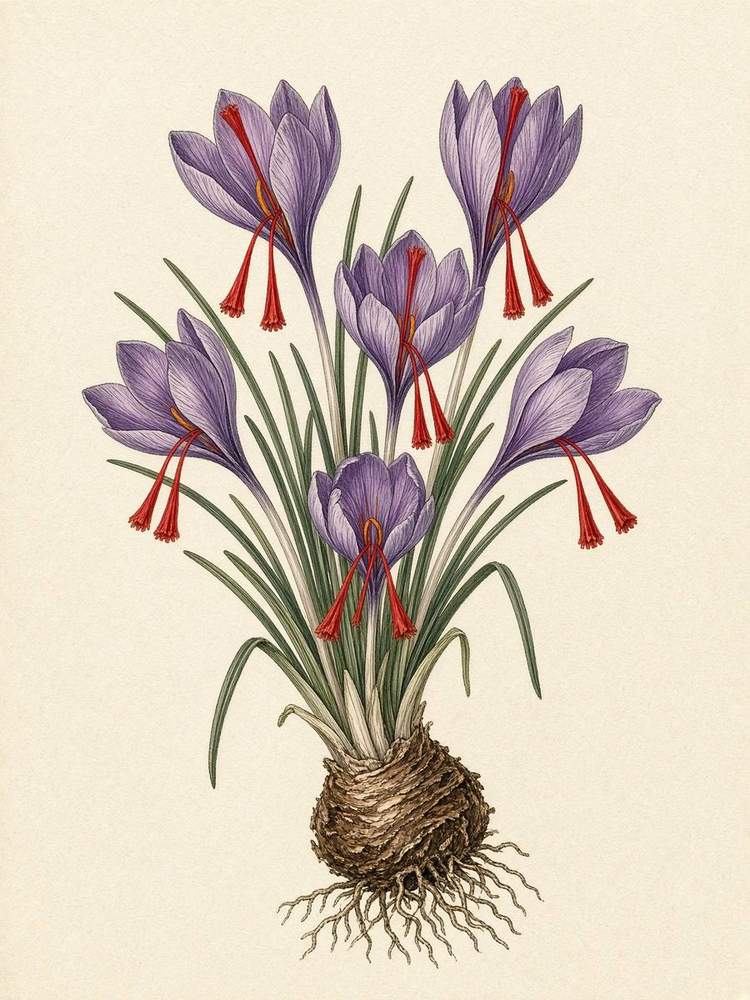 No. 120
Saffron
Crocus sativus
Three red threads from a sterile autumn crocus — the dearest spice on earth, and a traditional mood-and-digestion pinch.
Honey, hay, and a faint metallic bitterness. A pinch perfumes a pot; a teaspoon is a dye vat.
Harvest: 60–90 days from a late-summer planting to first threads
Cleopatra was said to bathe in it; the Phoenicians dyed wedding veils the same red-gold. Medieval Venetian merchants were hanged for cutting saffron with marigold. The word is Arabic zaʿfarān by way of Persian. Each flower offers three threads and no more, which is why a gram still costs like a small jewel.
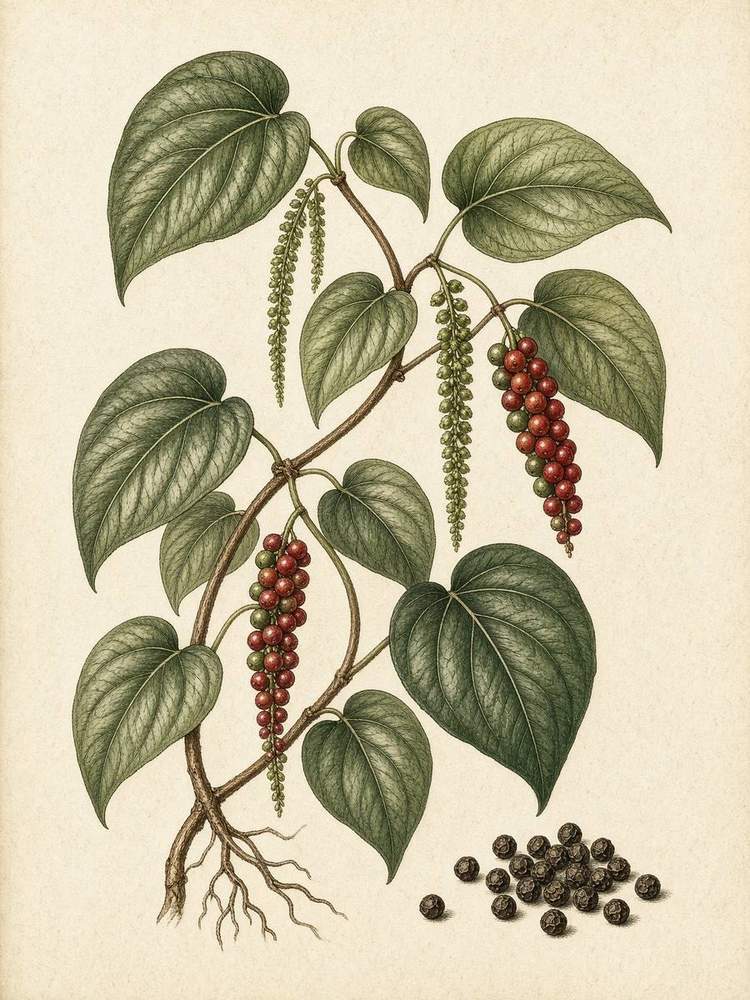 No. 121
Black pepper
Piper nigrum
The berry that made the spice routes — a tropical vine whose dried fruit is still the world’s default heat.
Hot, piney, citrus-wood. Fresh-cracked is a different spice from the pre-ground dust.
Harvest: Several years to first spikes in the tropics; the kitchen crop is purchased
Rome paid in gold for Malabar pepper; Alaric the Visigoth took a ton of it as ransom in 408. Medieval Europe used it the way we use salt — as wealth you could taste. The phrase ‘peppercorn rent’ is a joke about a contract that costs almost nothing, which only works if you have forgotten what a peppercorn used to cost.
 No. 122
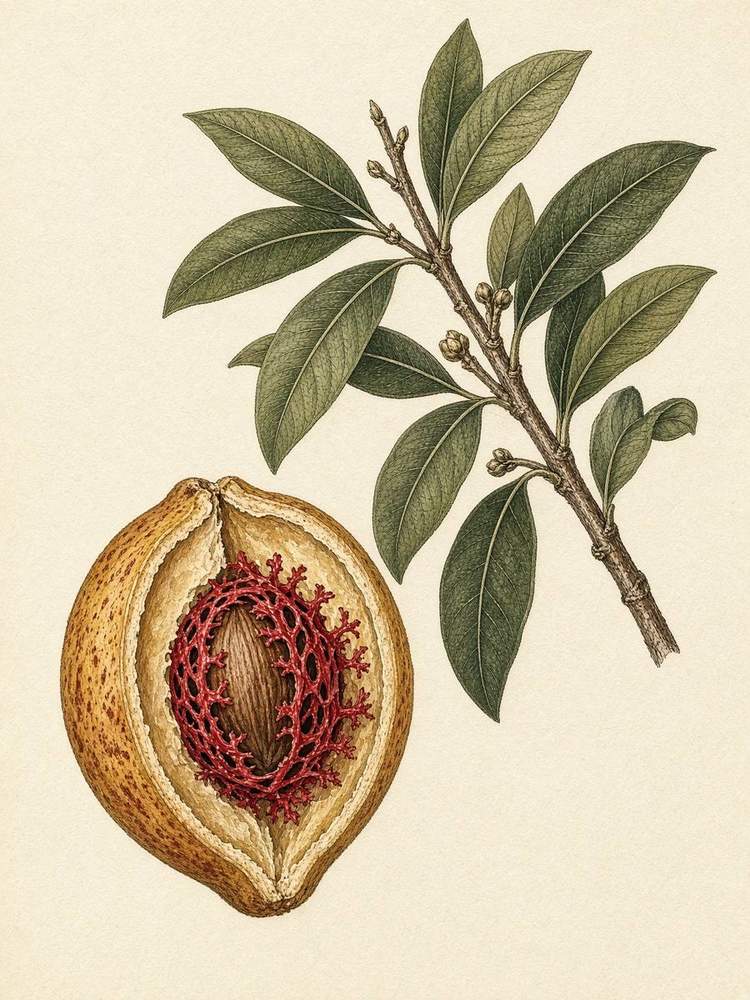
Nutmeg
Myristica fragrans
One fruit, two spices — the brown seed and the lacy red mace — a kitchen warm with a hard stop at the teaspoon.
Warm, woody, a little camphor and pine. Mace is brighter, more citrus-floral; nutmeg is deeper.
Harvest: Several years to first fruit in the tropics; the kitchen crop is purchased
The Dutch East India Company waged a war for these islands and, for a time, kept the whole world’s nutmeg on one chain of rocks. A 17th-century Londoner might pay more for a nutmeg than for a sheep. The lacy red aril was sold separately as mace — two spices, one murderous monopoly.
 No. 123
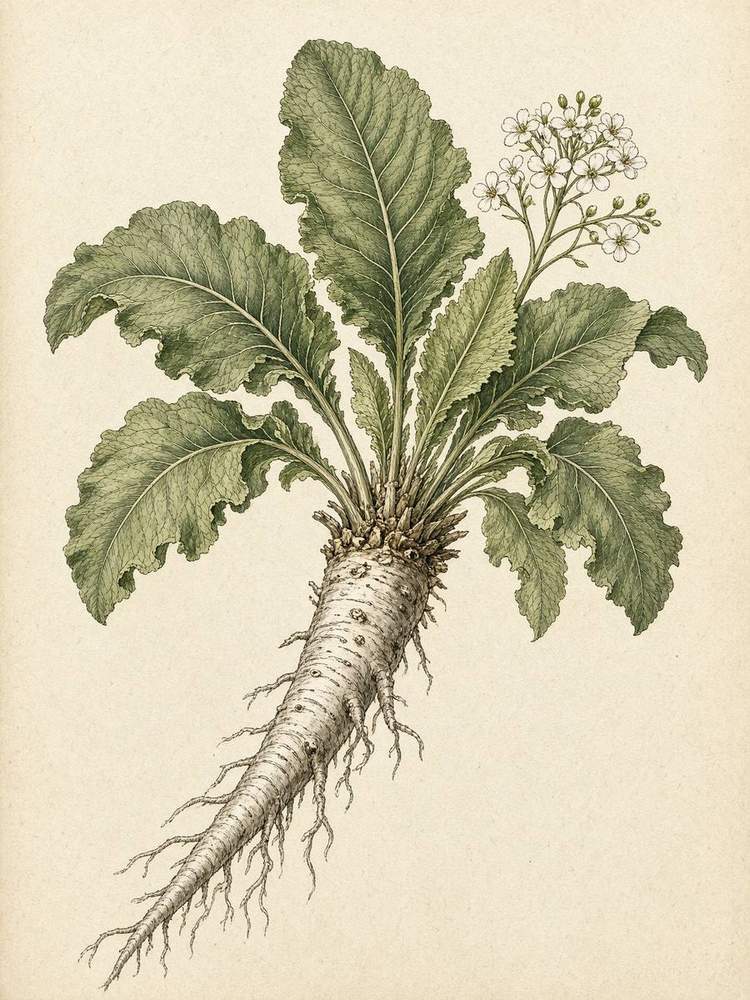
Horseradish
Armoracia rusticana
The sinus-clearing white root of spring — a prepared-sauce plant with a traditional wet-cough folklore.
Clean, hot, tear-jerking, then gone. Vinegar catches it; cream softens it.
Harvest: 150–180 days from a planted thong to a first decent root
The Germans called it Meerrettich, sea radish; English ears heard ‘mare’ and then ‘horse.’ Passover’s bitter herb in some Ashkenazi houses is this root, not lettuce. A 16th-century German herbal already has it as a sauce — the sinus joke is older than the bottled cream.
 No. 124
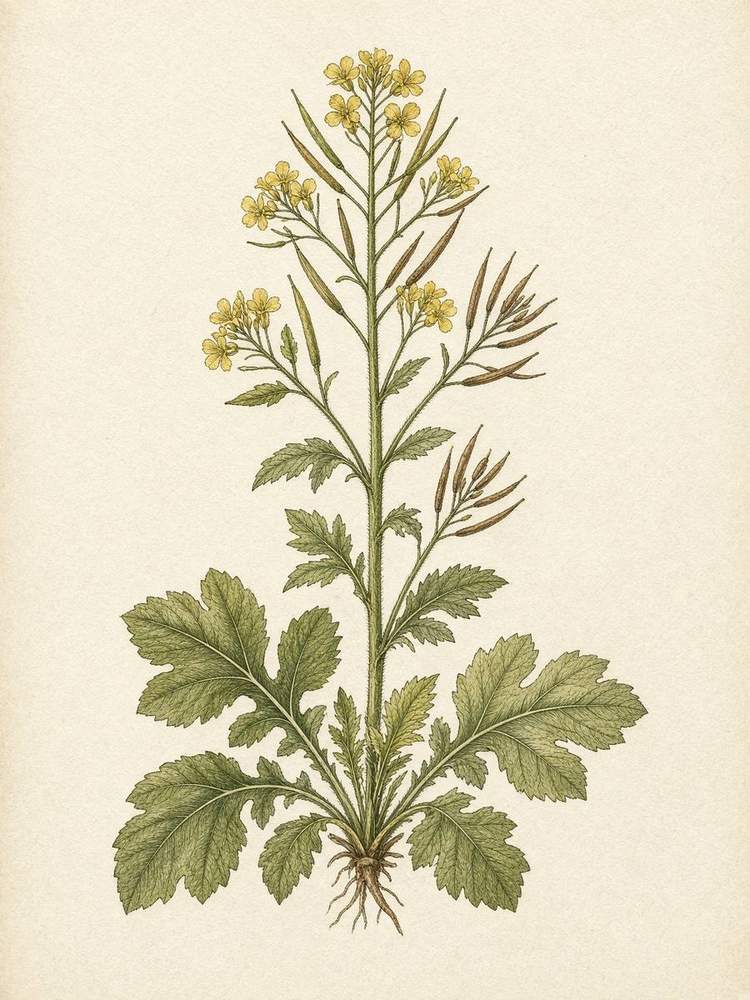
Brown mustard
Brassica juncea
The yellow flower that became a jar — a pungent seed, a bitter green, and a traditional chest-plaster plant.
Seed is hot, nutty, and sinus-clearing when wet. Leaf is bitter-mustard, sweeter after frost.
Harvest: 30–40 days for leaf; 80–100 days for seed
Mustard seed is in the Sanskrit record and in the Gospel parable of the kingdom. The Romans mixed it with grape must — mustum ardens, burning must — which is probably how the English word arrived. Dijon made a fortune on the same seed with a better lawyer.
 No. 125
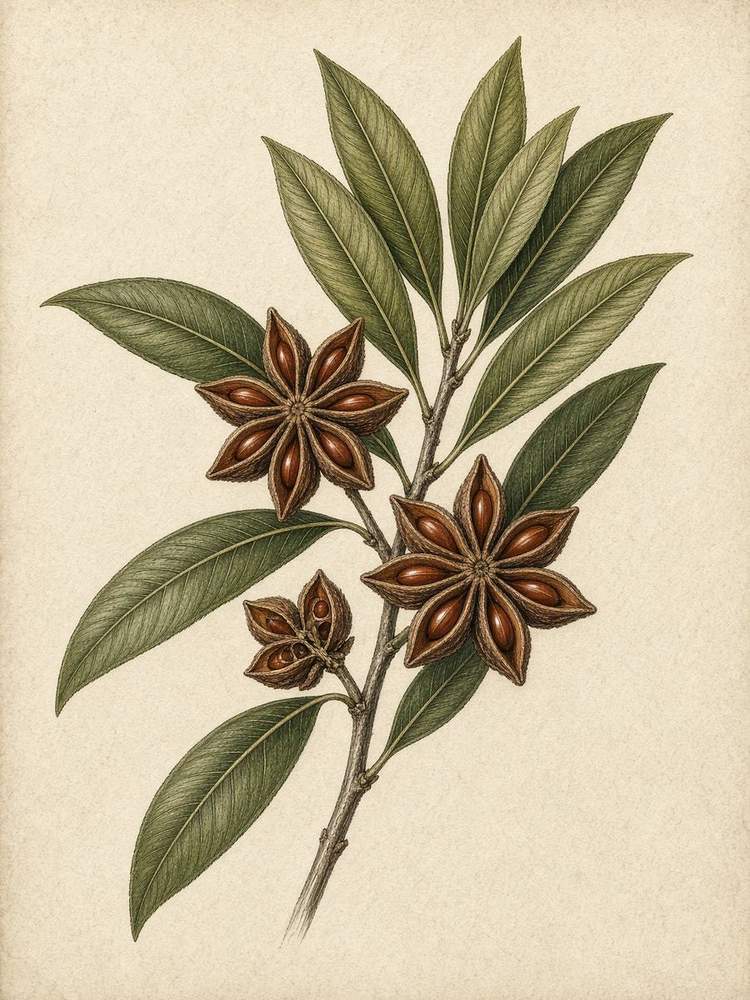
Star anise
Illicium verum
The eight-pointed spice of pho and five-spice — a licorice star with a lookalike that does not belong in a pot.
Licorice, sweet-hot, a little woody. One star perfumes a quart of broth.
Harvest: Several years to first stars; the kitchen crop is purchased
The Chinese name is bājiǎo, eight horns. Tamiflu’s first industrial route started from shikimic acid in this fruit, which is how a soup spice briefly became a strategic crop. Victorian Europe met it as a cheaper stand-in for true aniseed, then learned to like the star for itself.
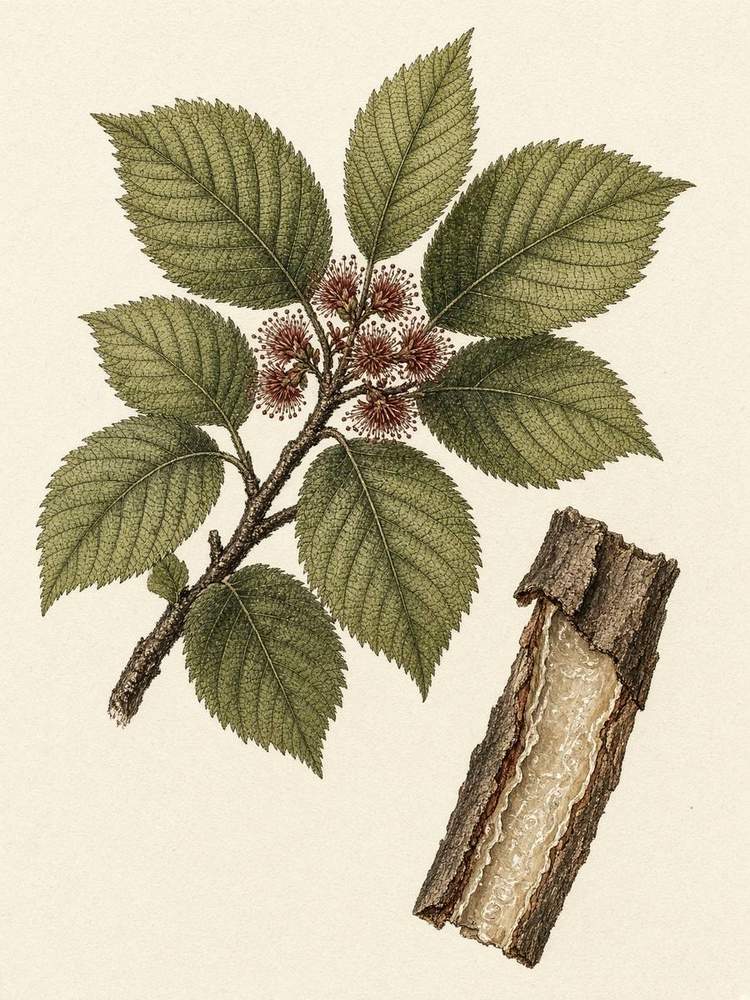 No. 126
Slippery elm
Ulmus rubra
The mucilaginous inner bark of an American elm — a slippery tea for a raw throat and a raw gut.
Bland, maple-sweet, slippery — more texture than taste. Cinnamon helps the cup.
Harvest: A tree is years; the honest kitchen crop is purchased powder
Indigenous nations of the east used the inner bark as food and as a wound poultice; settlers wrote it into every domestic book as ‘elm food’ for invalids. The 19th-century Eclectics put it on almost every raw surface. Dutch elm disease later made the standing tree rarer than the lozenge aisle, which is the wrong way around.
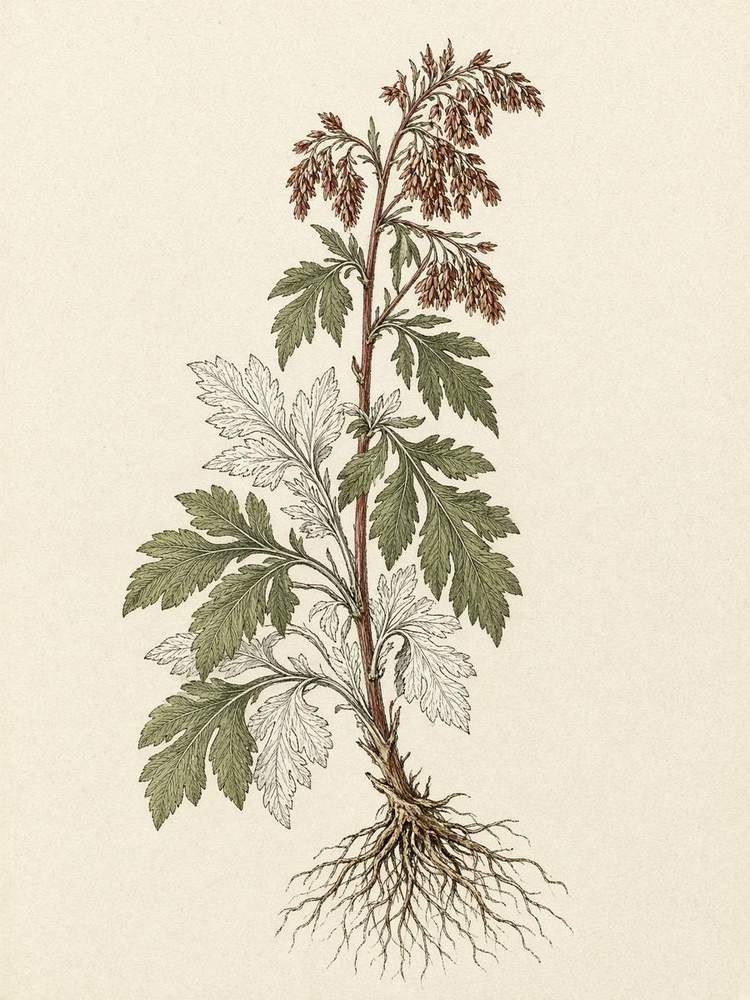 No. 127
Mugwort
Artemisia vulgaris
The roadside Artemisia of dream pillows and roast goose — a bitter with a long folklore and a thujone limit.
Camphor, sage, a little bitterness. A pinch with pork; a handful is a hedge.
Harvest: 60–80 days from a planted piece; established patches are ready when you notice them
Roman soldiers were said to put it in their sandals for the march; the name may be ‘mug’ as in beer, or moth, or the old English moughte. St. John’s Eve bunches of it hung on doors. In Japan a sister species is mochi filling and moxa. The dream-pillow reputation is later English folklore that never quite died.
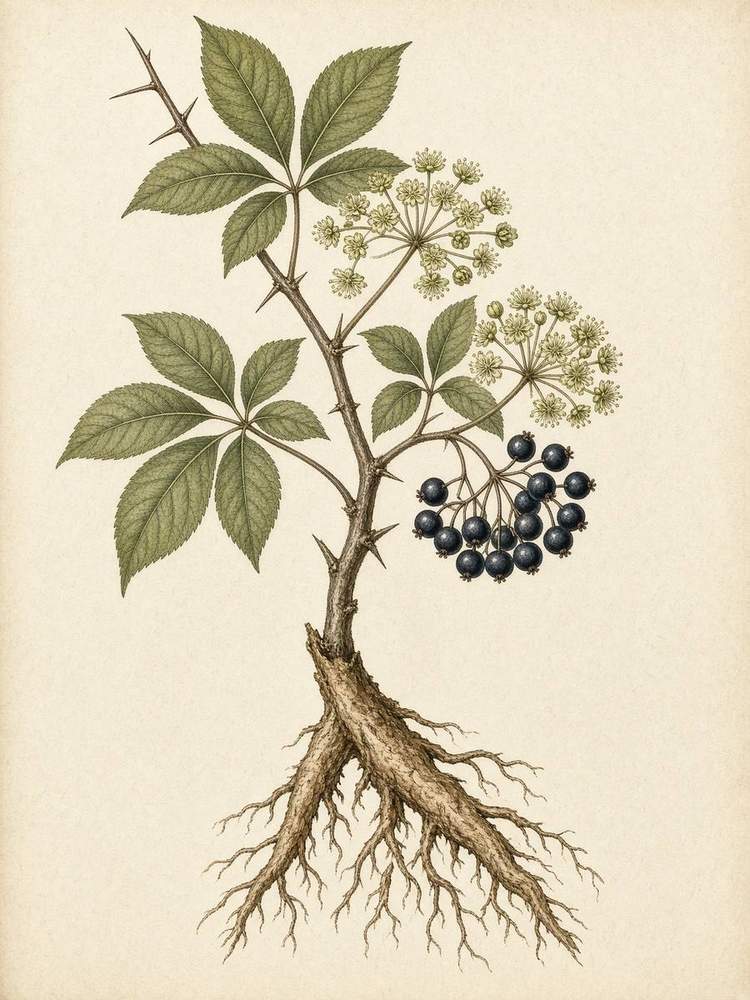 No. 128
Eleuthero
Eleutherococcus senticosus
The Siberian cousin of ginseng — a thorny adaptogen of cold woods, not the man-root on the other plate.
Woody, mildly sweet, a little pepper. Quieter than Panax.
Harvest: 1,200–1,800 days (year 4–5) for a first decent root
Soviet sport scientists made ‘Siberian ginseng’ a Cold War export when Korean ginseng was dear. The plant had been cí wǔ jiā in Chinese medicine long before a lab in Moscow needed a substitute. The name still fools shoppers into thinking they bought Panax. They did not.
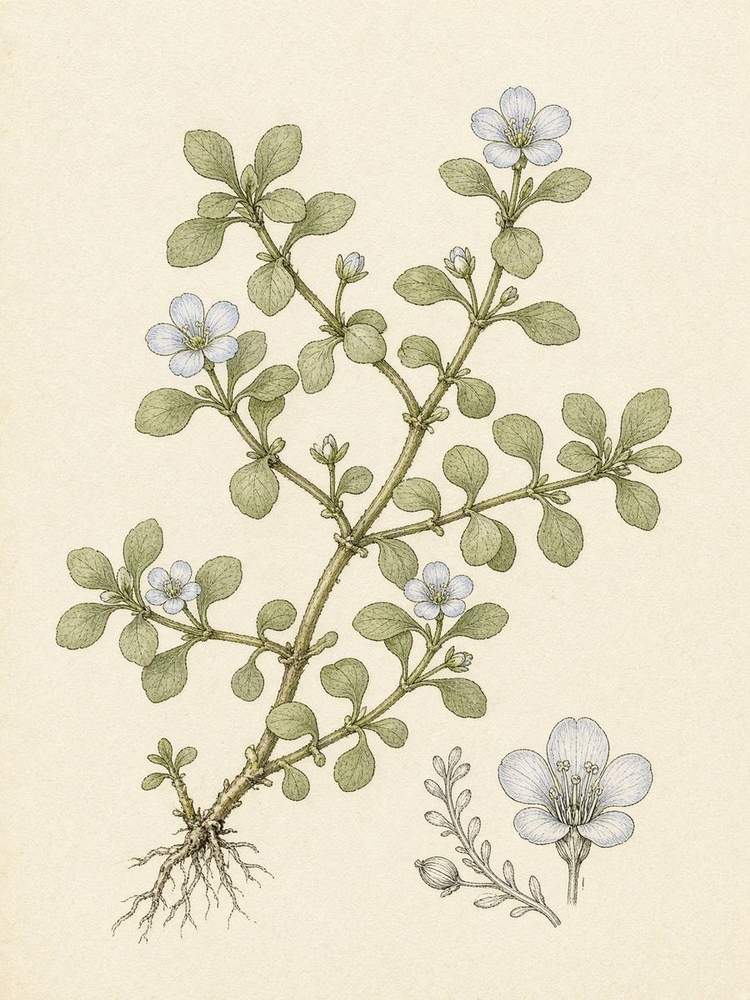 No. 129
Bacopa
Bacopa monnieri
A pond-edge succulent of Ayurvedic memory folklore — a small white flower, a bitter leaf, a slow herb.
Bitter, green, a little succulent-salt. Honey is how people swallow it.
Harvest: 40–60 days from a cutting to a useful mat
Sanskrit brahmi is named for Brahma, which is already a large claim for a mud creeper. Students in India still meet it as a memory herb; Western nootropic blogs found it later and spelled it wrong. The other brahmi is gotu kola, a different plate. The pond does not care which name you use; the shop should.
 No. 130
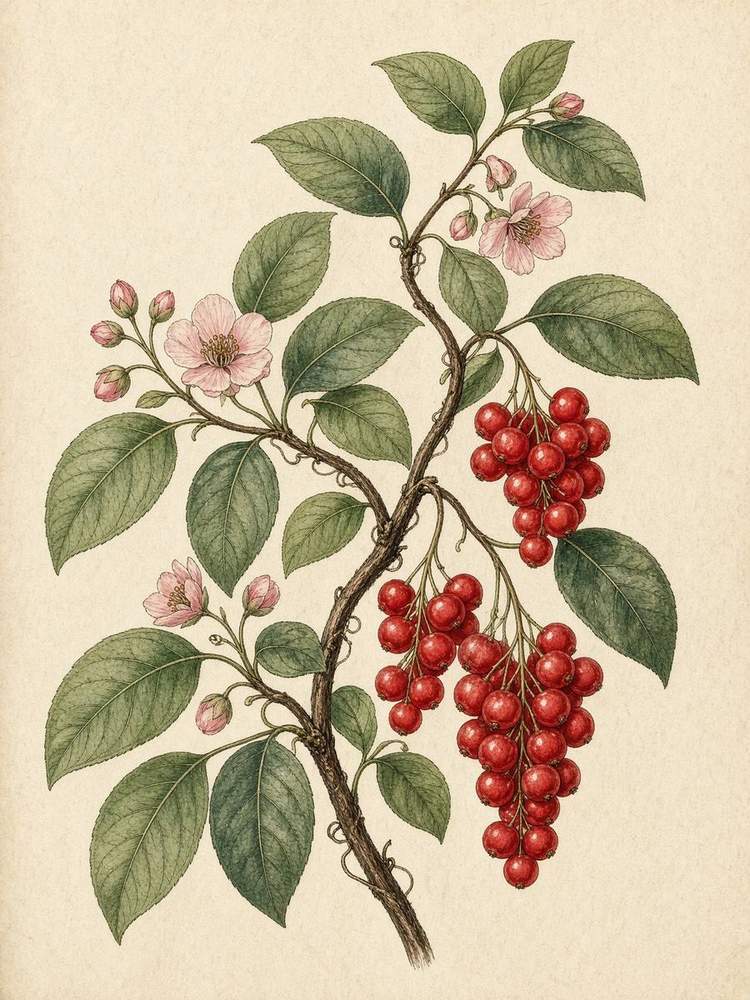
Schisandra
Schisandra chinensis
The five-flavor berry of Chinese tonic medicine — sour, sweet, bitter, pungent, and salty in one hanging cluster.
Sour first, then sweet-bitter, a little salt and spice. Cranberry’s serious cousin.
Harvest: 700–1,000 days from a young vine to a first decent crop
Wǔ wèi zǐ means five-flavor fruit, and the Chinese materia medica treats the berry as a gatherer of scattered qi. Hunters in the taiga were said to carry it against fatigue. Soviet researchers later studied it as they did eleuthero — another cold-forest tonic that arrived in the West with a lab coat over an old name.
 No. 132
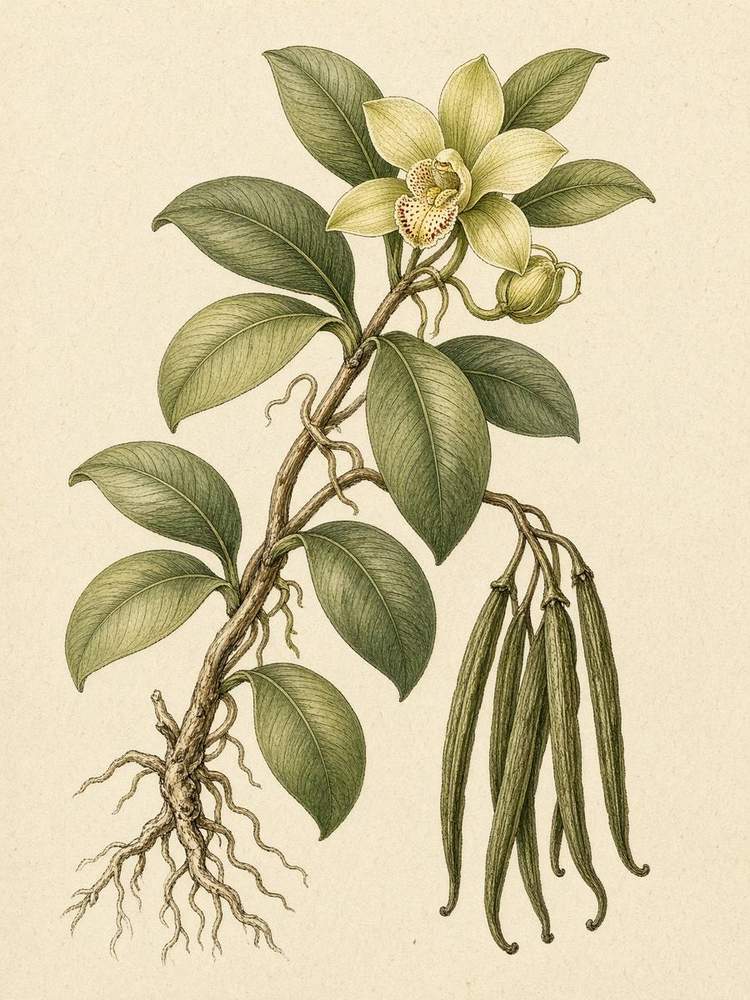
Vanilla
Vanilla planifolia
A climbing orchid whose green bean is cured into the world’s dessert spice.
Cream, tobacco-sweet, a little woody. Real bean has more to it than vanillin.
Harvest: Years to first flowers; pods 8–9 months after pollination
The Totonac of Veracruz cured the pod long before Cortés. The name is Spanish vainilla — little sheath — for the fruit. For three centuries Mexico held the secret: the flower needs a local bee, or a human thumb. Edmond Albius, a twelve-year-old enslaved on Réunion, solved the pollination in 1841 and the monopoly ended.
 No. 133
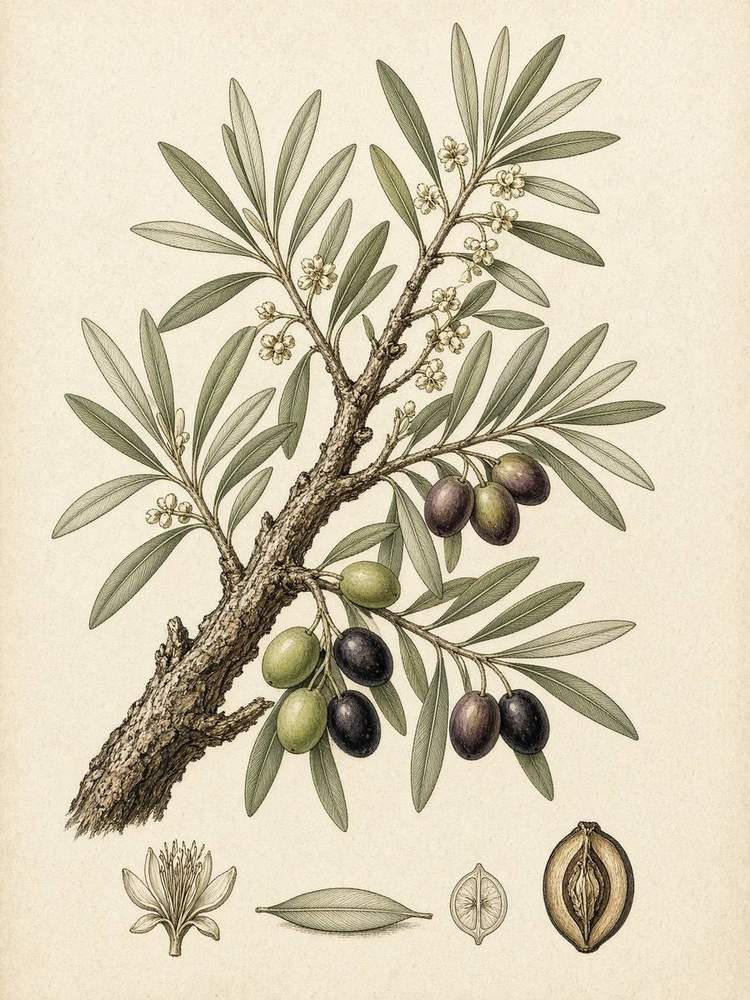
Olive
Olea europaea
The silver tree of the Mediterranean — oil, fruit, and a bitter leaf with a long heart-folklore.
Oil is grassy, peppery, or buttery by cultivar. Leaf tea is bitter-green.
Harvest: Leaf in year 1 from a nursery tree; fruit in 3–6 years
Athena’s gift to Athens was an olive, not a horse. Homer’s heroes are already rubbing with the oil. Trees on Crete are measured in centuries; some groves are older than the languages spoken under them. The leaf that did not make the bottle still made the old bitter cup.
 No. 134
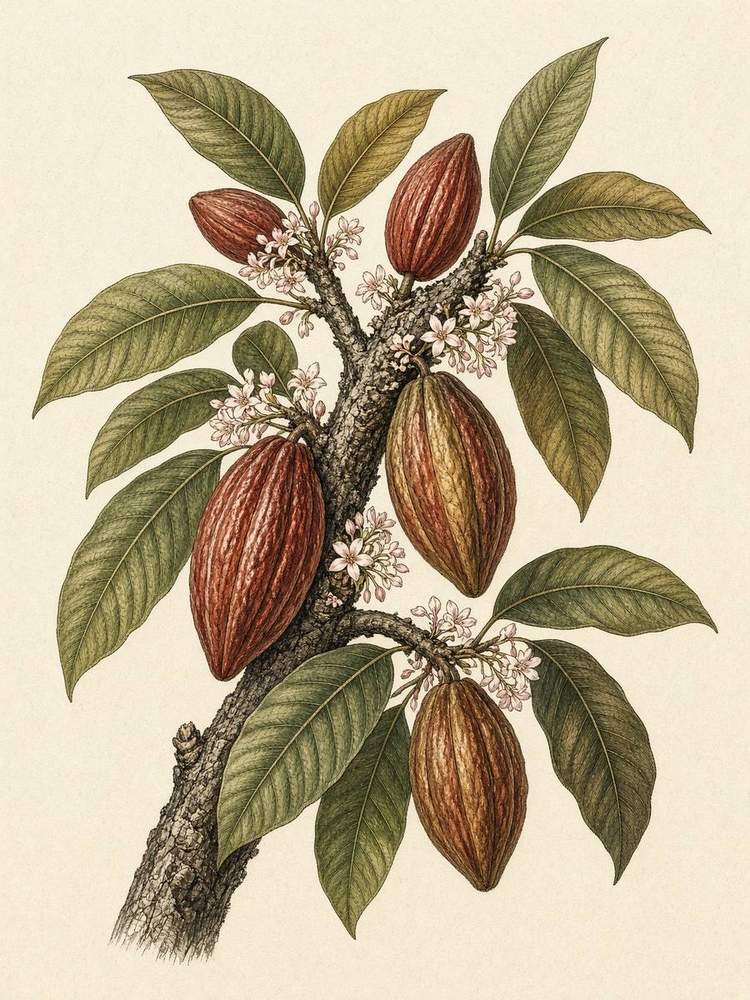
Cacao
Theobroma cacao
Food of the gods — a cauliflorous rainforest tree whose seed became chocolate, and a traditional bitter tonic before it became dessert.
Bitter chocolate, fruit, a little tobacco. Sugar is a later idea.
Harvest: 3–5 years to first pods in the tropics
Theobroma means food of the gods, Linnaeus’s rare joke. Maya and Mexica drank it bitter with chili and achiote; sugar and milk are a Spanish afterthought. Cacao beans were currency. A 16th-century load of beans could buy a slave or a canoe, depending on the market.
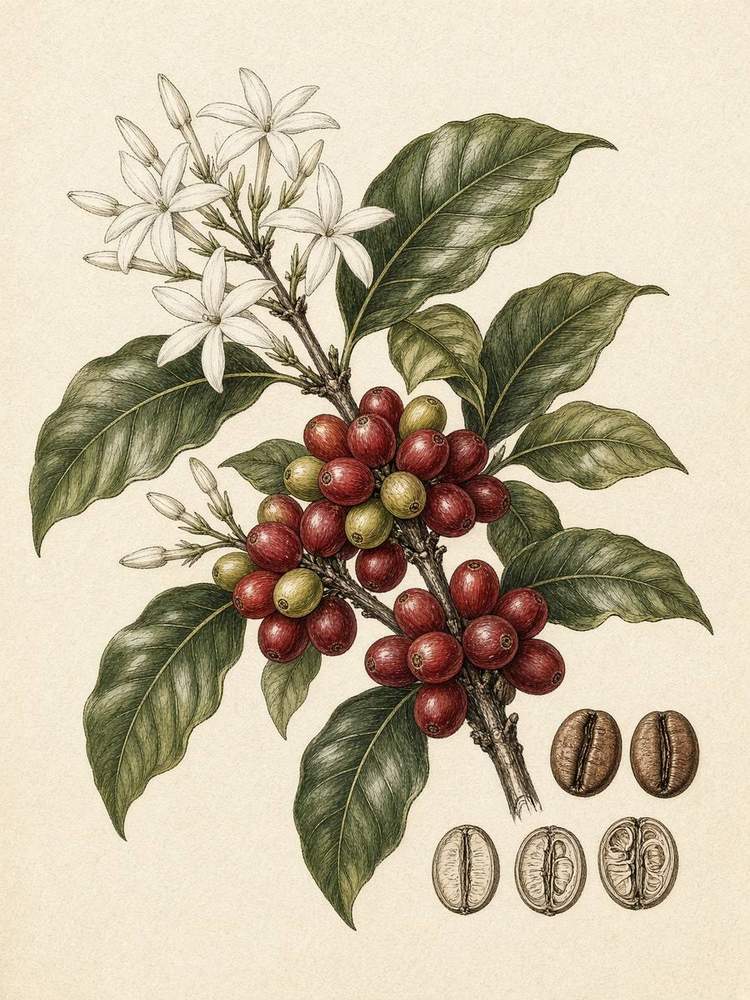 No. 135
Coffee
Coffea arabica
The cherry that runs the morning — a highland shrub whose roasted seed is the world’s most popular bitter.
Roasted: chocolate, fruit, smoke, or rubber, depending on the roast. Green is grassy and sour.
Harvest: 3–4 years to first cherries in the tropics; a house plant may never crop
A goatherd named Kaldi is the folk origin, goats dancing on Ethiopian berries. Yemen’s Sufi houses used it to stay awake for prayer; Venice met it as a curiosity, then a vice, then breakfast. The word is Arabic qahwa. Pope Clement VIII was asked to ban it as Muslim wine and, the story goes, baptized it instead.
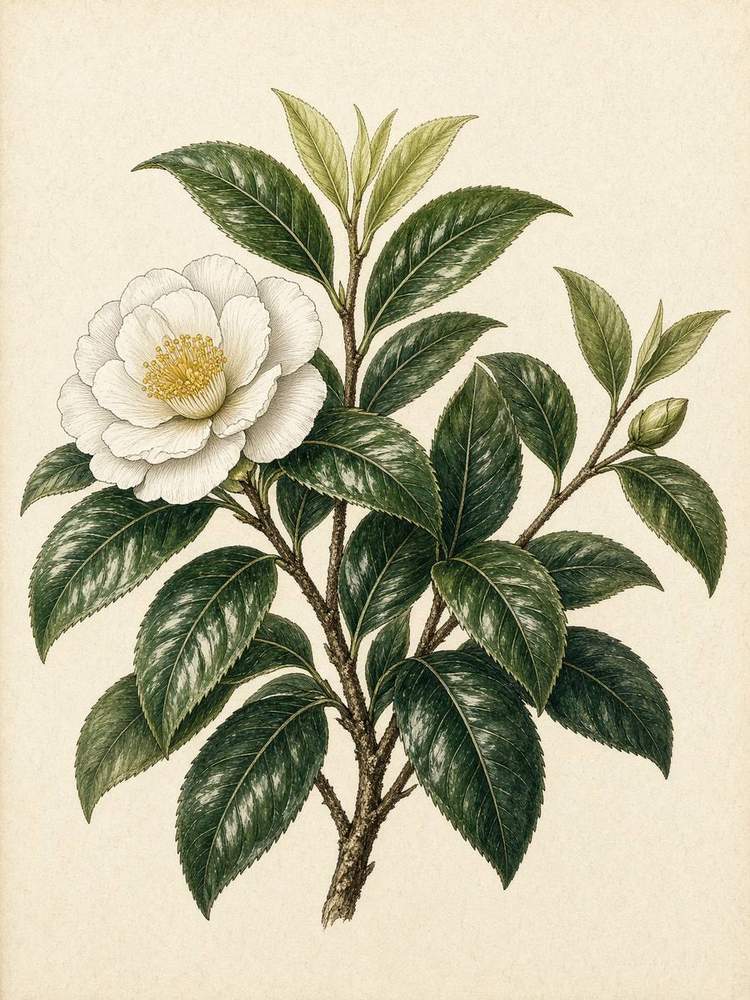 No. 136
Tea
Camellia sinensis
The camellia that filled the kettle — one shrub, a thousand names, and a caffeine cup older than the porcelain.
Green is grass and chestnut; black is malt and dried fruit; white is quieter. Overbrewed is tannin.
Harvest: 2–3 years from a nursery shrub to a useful pick
A Chinese emperor’s wind blew leaf into the pot, says the story, and the drink was an accident that lasted 3,000 years. Lu Yu wrote the first tea book in the 8th century. Britain lost a colony arguing about a tax on it. All the colors in the tin are still this one camellia.
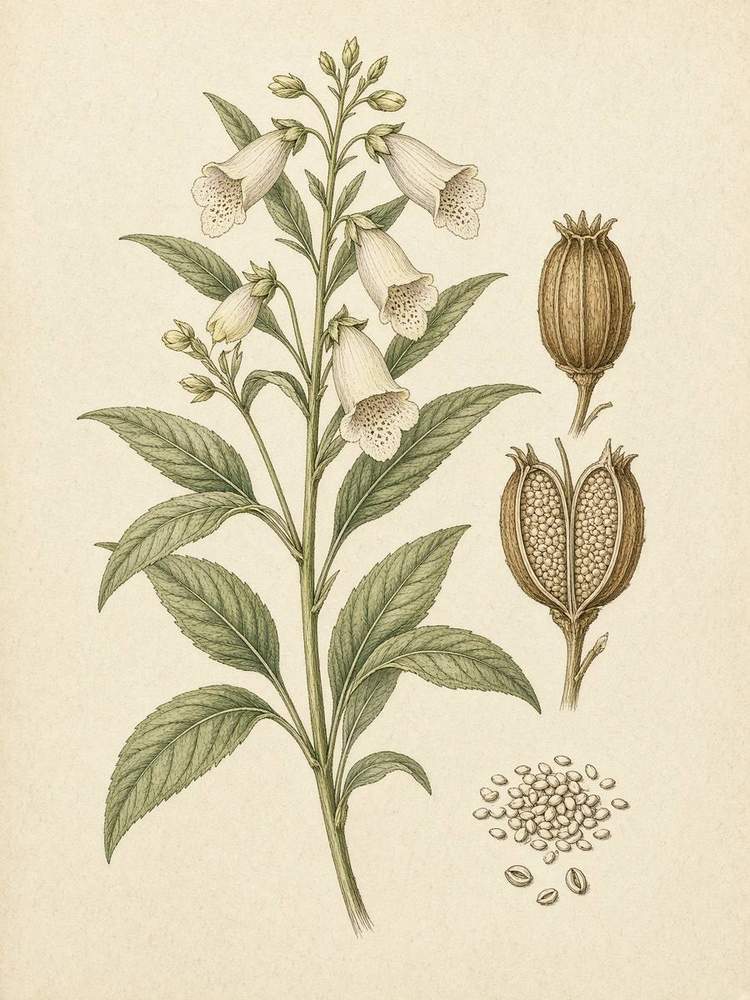 No. 137
Sesame
Sesamum indicum
The seed that opens — a hot-season crop whose paste is tahini and whose oil is the quiet fat of a dozen kitchens.
Toasted is nutty, warm, a little bitter. Raw is milder. Oil is the same idea, liquid.
Harvest: 90–120 days from sow to ripe seed
Open sesame is a real agronomy joke: the capsule splits with a snap. Assyrian gods were said to have drunk sesame wine before they made the world. The seed is in Tutankhamun’s tomb and in every tahini jar. Ali Baba was late to the field.
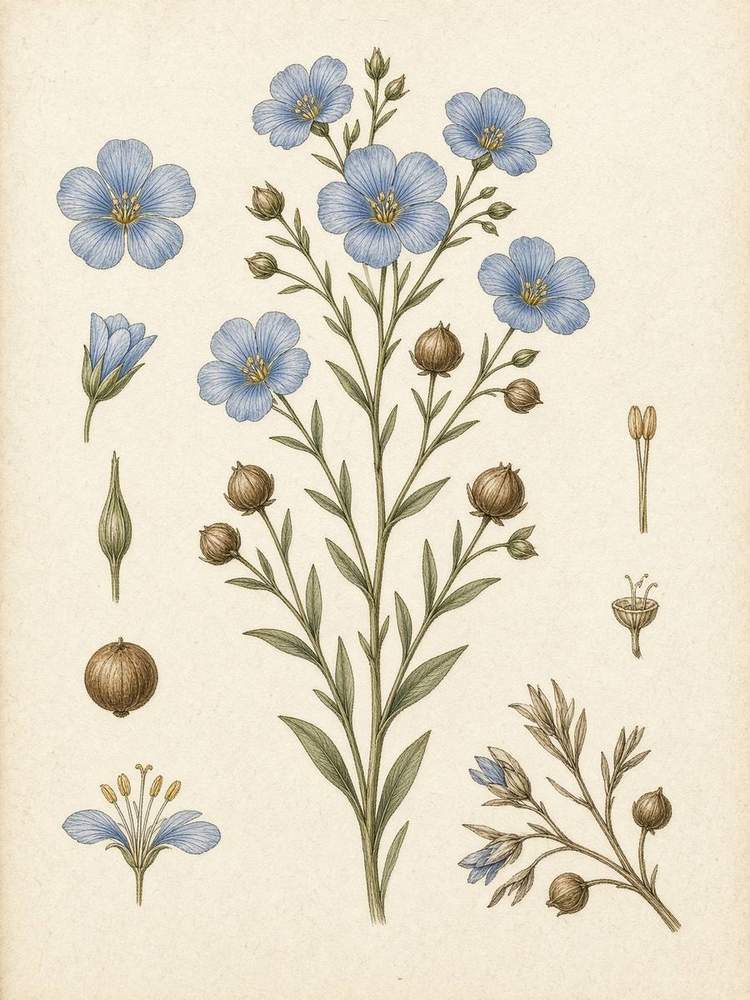 No. 138
Flax
Linum usitatissimum
Blue flower, brown seed, linen in the stem — a cool-season crop for porridge, oil, and cloth.
Nutty, mild, a little paint-box if the oil is old. Fresh-ground is the test.
Harvest: 90–110 days to ripe seed
Egyptian mummies were wrapped in it. The word linen is flax; the word linseed is the same plant after the weaver left. Irish and Baltic fields ran blue in flower. A medieval tax was sometimes paid in ells of linen, which is to say in flax that had been beaten, spun, and woven by hand.
 No. 139
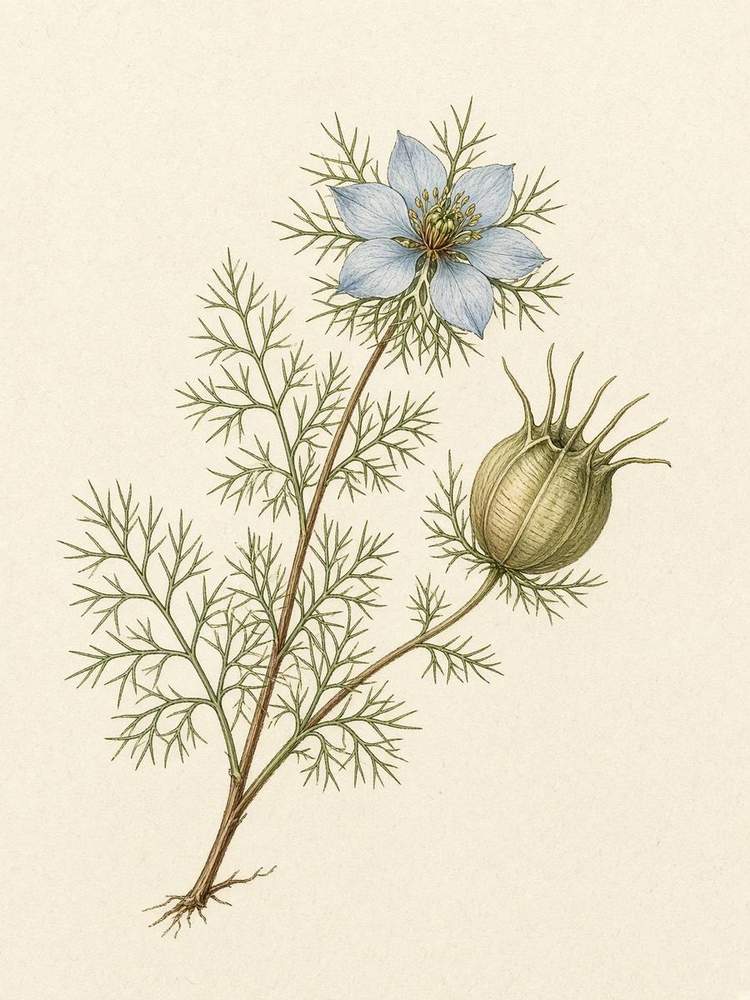
Nigella
Nigella sativa
Kalonji — the small black seed on naan, a peppery-oregano spice with a long West Asian kitchen record.
Oregano, pepper, onion-seed. A dry toast wakes it.
Harvest: 80–100 days from sow to ripe seed
A hadith calls it a cure for every disease except death — which is already too much to ask of a bagel seed. Tutankhamun’s tomb held it. The Latin nigella is ‘little black.’ Kalonji on naan is the same plant as the old bottle of black-cumin oil, at a kinder dose.
 No. 140
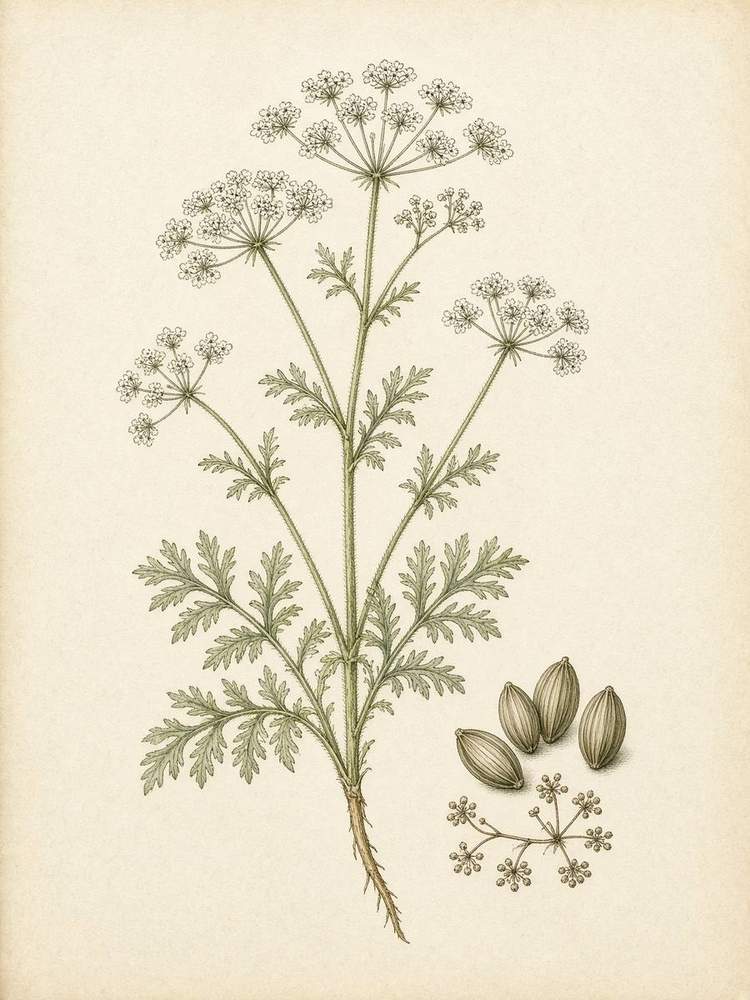
Anise
Pimpinella anisum
The licorice seed of Mediterranean baking — a carminative kitchen spice, not the toxic Japanese lookalike of star anise.
Sweet licorice, warmer than fennel seed, less medicinal than star anise.
Harvest: 100–120 days from sow to ripe seed
Pythagoras advised anise to keep a clear head. Romans stuffed it into mustaceum, a spiced wedding cake, which is why a modern wedding still tastes of this seed if the baker is old-fashioned. The word is Egyptian via Greek. Mice, the old books insist, will not stay where it is scattered — a claim no mouse has confirmed.
 No. 141
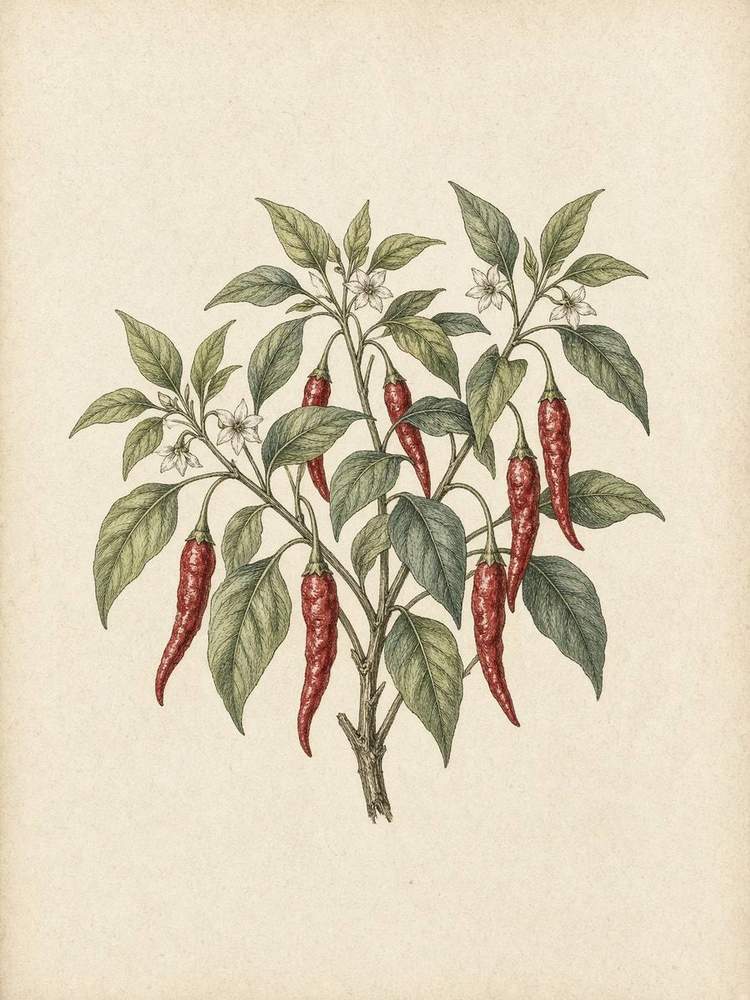
Cayenne
Capsicum annuum
The slender red chili that taught Europe heat — a kitchen spice and a traditional circulation pungent.
Clean heat, a little fruit, then fire. Dried is toastier than fresh.
Harvest: 70–90 days from transplant to first red peppers
Capsicum is a New World plant that Columbus, looking for Piper, misnamed pepper and never corrected. Cayenne is a river in Guiana and then a color. Hungarian paprika, Italian peperoncino, and this red dust are cousins arguing about heat. The Scoville scale is a 1912 tasting panel, not a law of nature.
 No. 142
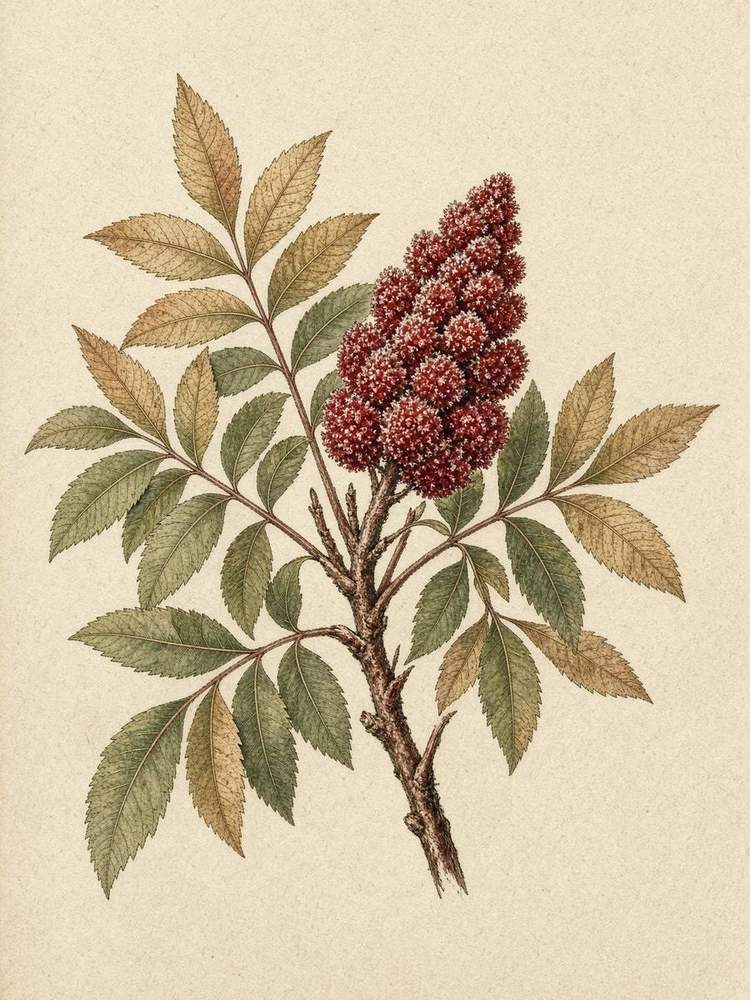
Sumac
Rhus coriaria
The sour red dust of za’atar — a Mediterranean berry-spice, not the white-berried swamp plant that raises blisters.
Lemon, salt, a little tannin. The red powder is the spice; the seed is woody.
Harvest: 2–4 years from a shrub to a first spice crop
The Romans used it as a sour before lemons were common in Europe. The Arabic summāq is the same red dust on a kebab. Leather tanners used a different sumac for the tannin; the kitchen kept the fruit. If your field guide says white berries, you have left the spice aisle.
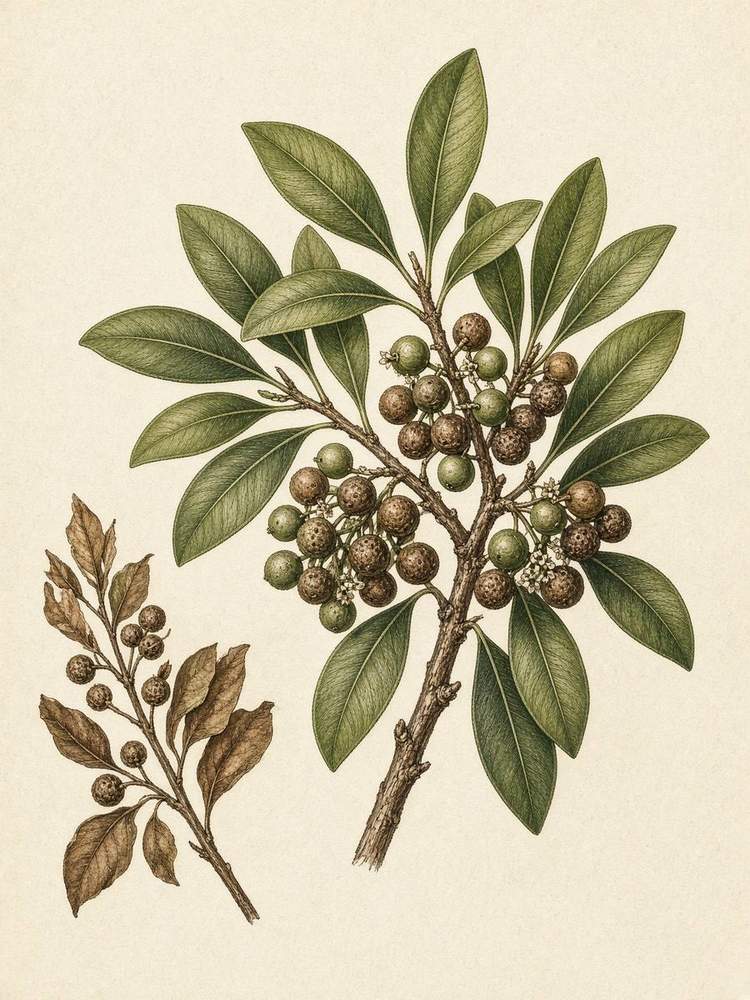 No. 143
Allspice
Pimenta dioica
A Jamaican myrtle berry that tastes of clove, cinnamon, and nutmeg at once — the stew spice of the Caribbean and of winter baking.
Clove first, then cinnamon and nutmeg. One berry is a bouquet.
Harvest: Several years to first berries in the tropics; the kitchen crop is purchased
The Spanish called it pimienta, pepper, and the confusion stuck in ‘pimento.’ English ‘allspice’ is a 17th-century grocer’s pitch that happened to be accurate. Nelson’s navy was said to use it in the mess. Jerk is a Taino word; the berry is the smoke’s cousin.
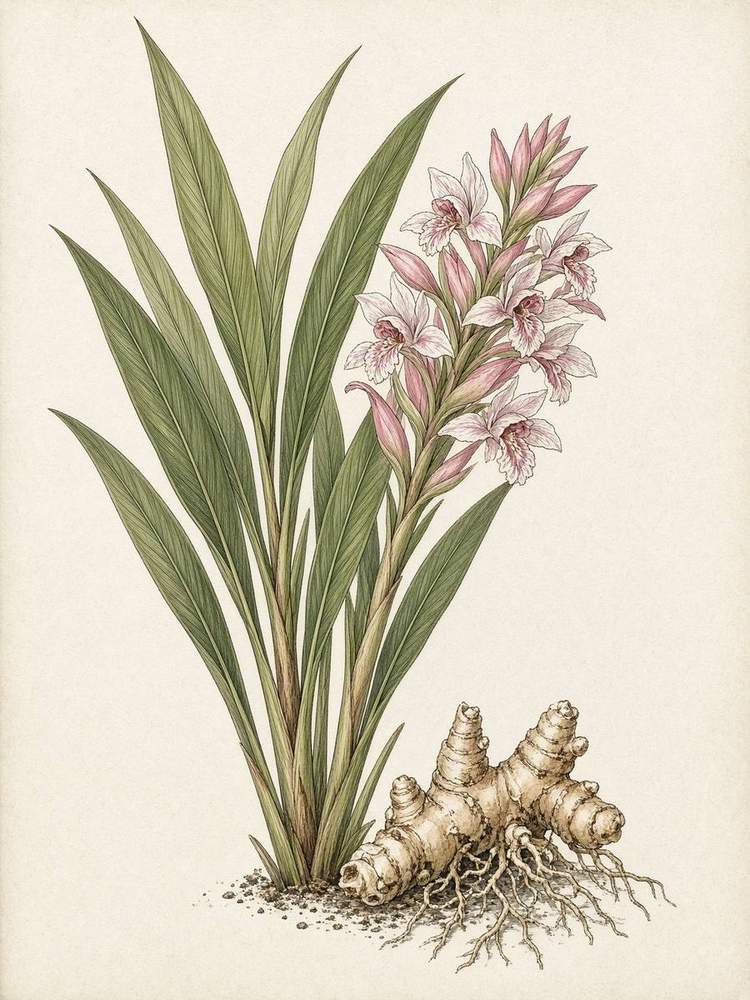 No. 144
Galangal
Alpinia galanga
Ginger’s sharper Thai cousin — pine, camphor, and pepper in a rhizome that tom kha cannot do without.
Pine, white pepper, camphor, citrus-wood. Less sweet than ginger.
Harvest: 240–300 days of heat for a first kitchen piece
Medieval Europe knew a dried galangal as galingale and put it in hypocras. The fresh rhizome that Thai and Indonesian kitchens want is a later reunion. Hildegard of Bingen called it the spice of life. The word is Chinese gāoliángjiāng by way of Arabic — a passport stamp in a root.
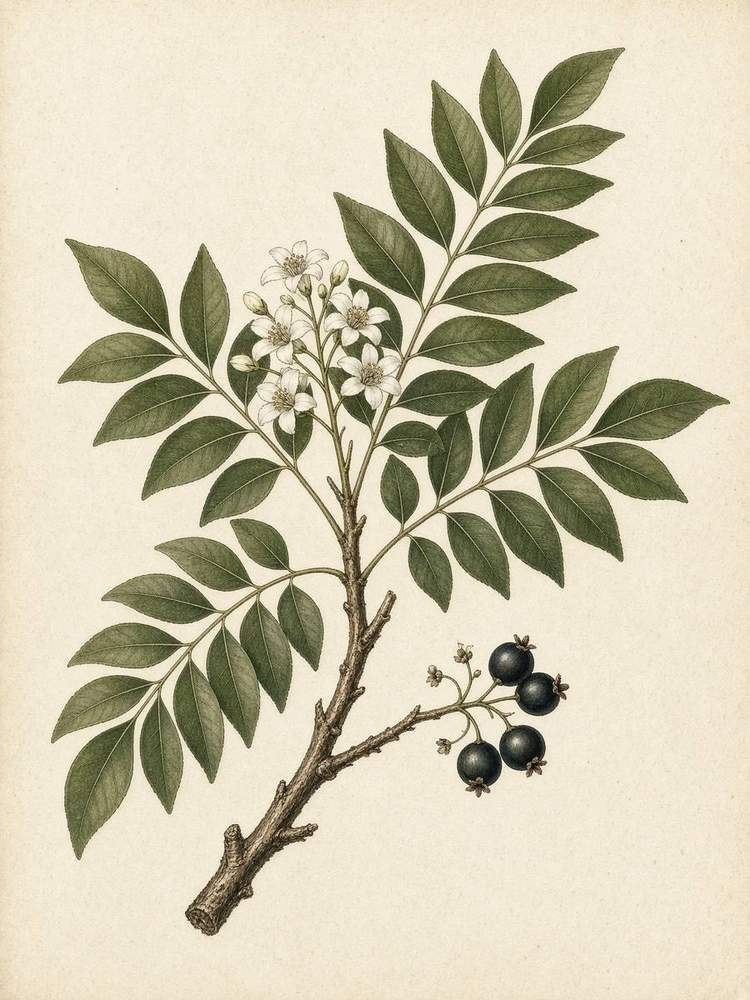 No. 145
Curry leaf
Murraya koenigii
The leaf that makes a South Indian tadka smell like itself — a citrus-family tree, not a jar of powder.
Citrus, resin, toasted peanut, a little rue. Heat in oil wakes it; a long boil dulls it.
Harvest: 90–150 days from a small plant to a useful bush
The Hindi kadipatta is the leaf of the kari tree, which the British heard as ‘curry’ and then applied to a spice blend that does not include it. South Indian and Sri Lankan kitchens never needed the confusion. A tree by the kitchen door is a status as ordinary as a bay tree in Provence.
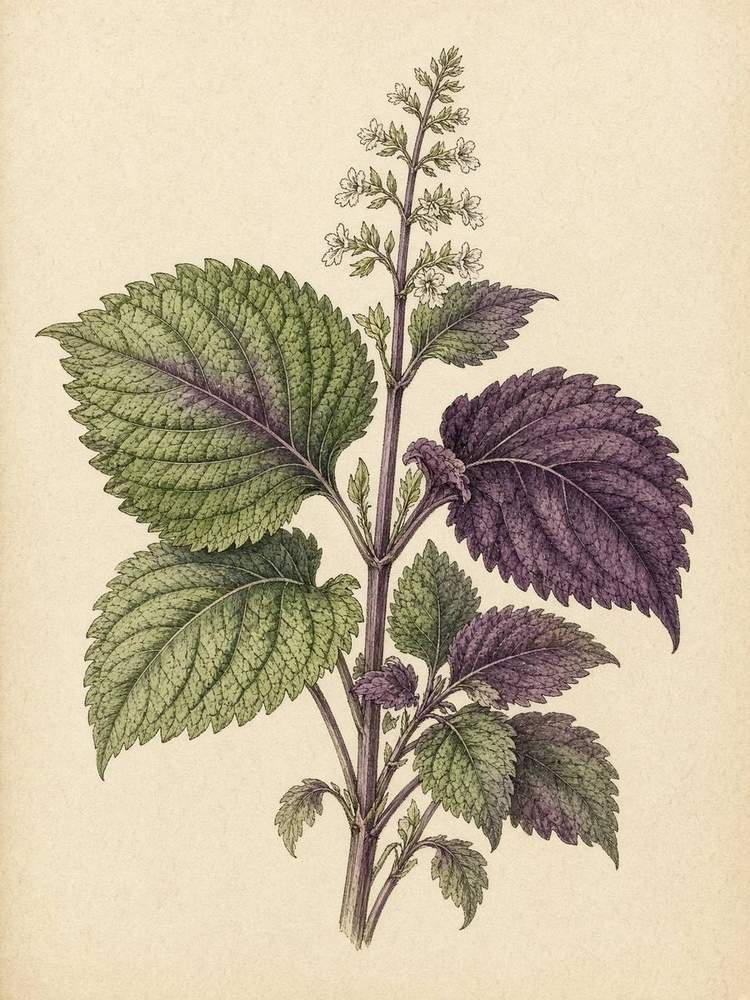 No. 146
Shiso
Perilla frutescens
The ruffled mint of Japanese and Korean kitchens — cumin-basil-citrus in a leaf that pickles plums and wraps rice.
Cumin, basil, cinnamon, citrus peel. Red is earthier; green is louder.
Harvest: 40–60 days from sow to a useful bush
The Japanese name is Chinese in origin — zǐsū, purple perilla. Korean kkaennip is the sesame-leaf cousin in the same genus. Umeboshi is red because of this leaf, not because of the plum. A 16th-century Japanese pharmacopeia already treats it as both food and medicine, which is the honest dual citizenship of a kitchen mint.
 No. 147
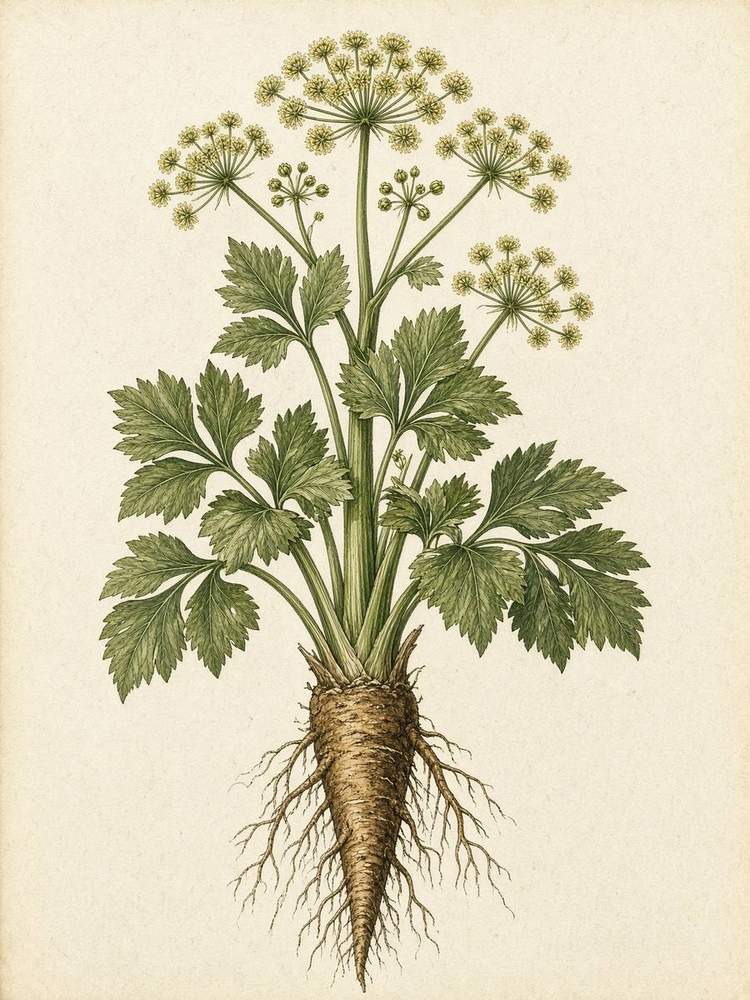
Lovage
Levisticum officinale
A perennial celery that forgot to be polite — Maggi-herb of European yards, a stock leaf with a long digestive record.
Celery, parsley, a little Maggi cube. Loud. A leaf is a bay leaf that shouts.
Harvest: 60–80 days from a division to a useful leaf; seed in year 2
The name is a mash of ligusticum and ‘love-ache’ — a medieval aphrodisiac joke that outlived the evidence. Charlemagne listed it in the Capitulare de villis. Central European kitchens still call it Maggi-kraut because a leaf tastes like the cube. A monastery garden without lovage was, for a while, not trying.
 No. 148
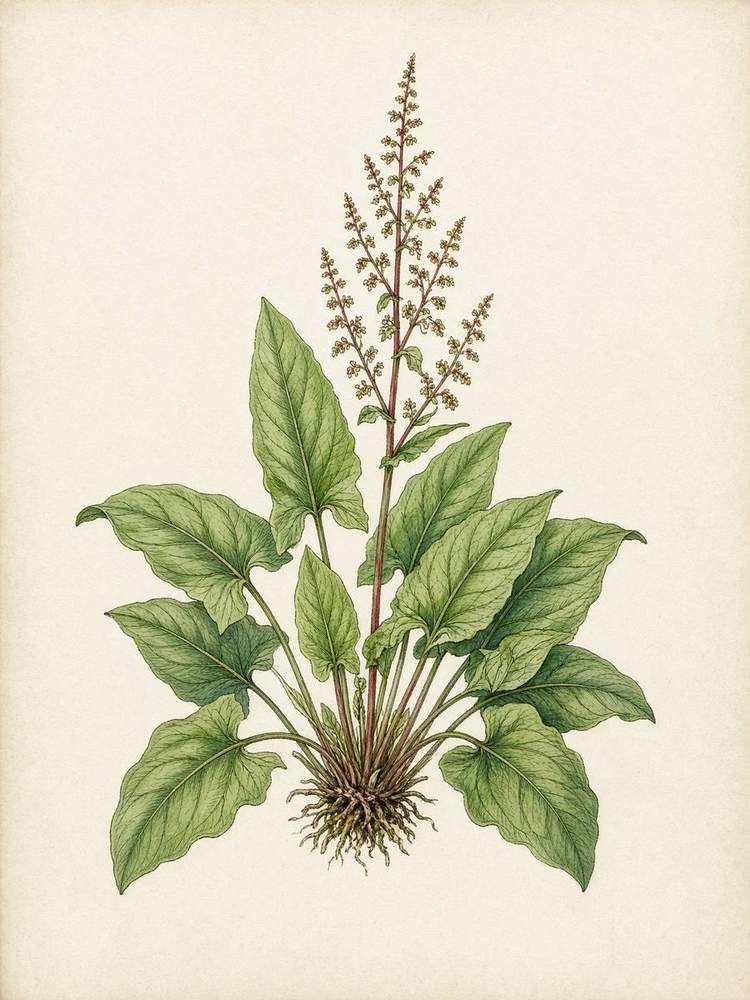
Sorrel
Rumex acetosa
The lemon of the temperate garden — arrow leaves that sharpen soup and fish, with a French pedigree.
Bright lemon, green, a little spinach. Cooked it goes olive and silkier.
Harvest: 40–50 days from seed; days from a division
The French made it a sauce; the English put it in a pie with sugar and called it a tart. The Latin acetosa is ‘the vinegary one.’ Medieval herbals used it as a scurvy green, which is not wrong — it is a spring vitamin with a sour joke attached. Copper pans turn it an unfortunate gray; the old kitchens knew.
 No. 149
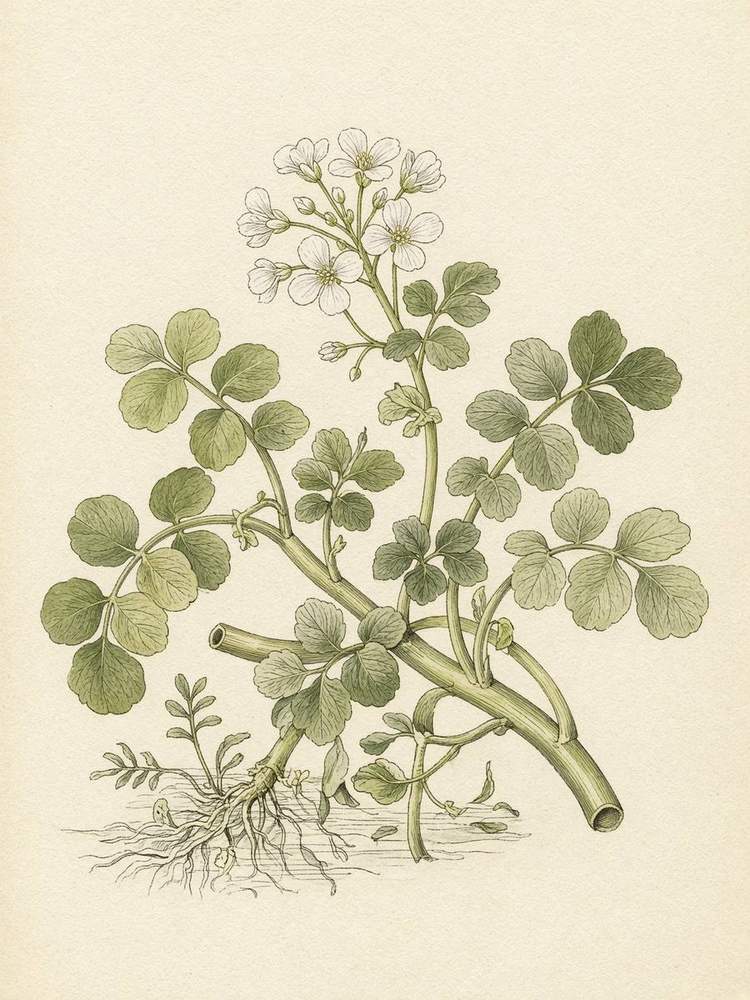
Watercress
Nasturtium officinale
The peppery brook green — a mustard that lives in clean moving water, and a Victorian breakfast plate.
Pepper, mustard, cucumber-green. Hotter than lettuce, kinder than horseradish.
Harvest: 20–30 days from a cutting to a first snip
Xenophon fed it to the Persians for vigor. London’s working breakfast was a bunch of it in paper, sold by watercress girls from the beds of Hampshire and Hertfordshire. Hippocrates already has a cress. The Victorian ‘poor man’s bread’ was this pepper, a roll, and nothing else.
 No. 150
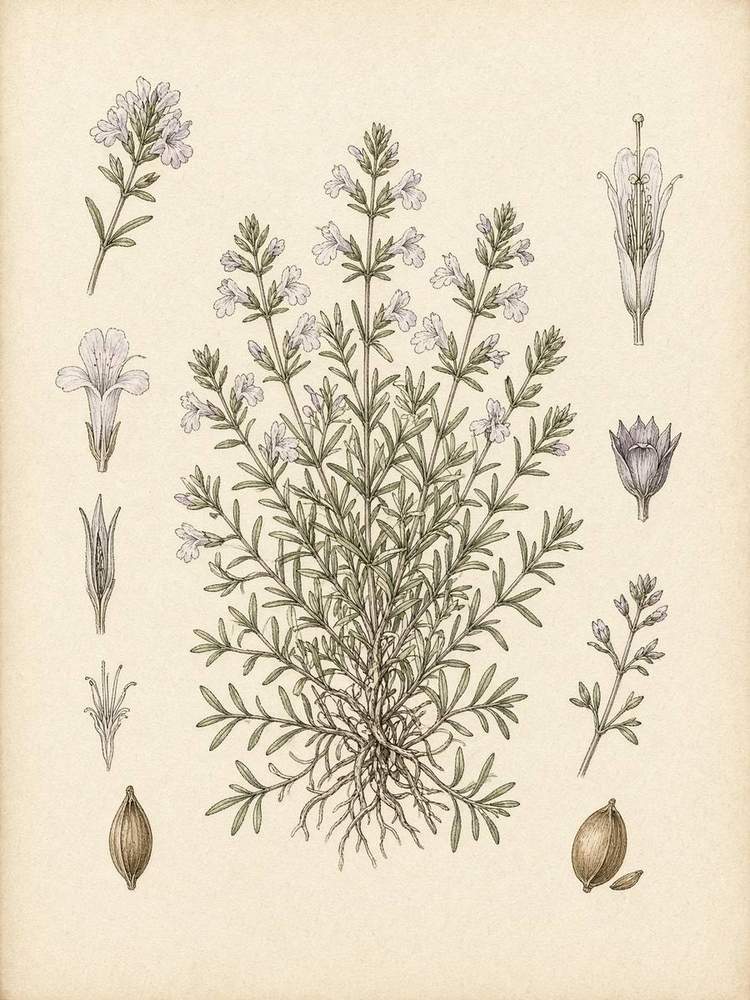
Summer savory
Satureja hortensis
The bean herb — a peppery summer mint that German and Balkan kitchens still put in the pot with pulses.
Pepper, thyme, a little pine. Dried is toastier; fresh is greener.
Harvest: 50–70 days from sow to a useful bush
The Romans called it satureia and thought it a satyr’s herb, which is how you get a bean garnish with a reputation. Charlemagne ordered it planted. In German it is Bohnenkraut — bean-herb — which is the most honest name a mint ever received. A dash in lentils is older than the digestive-tea aisle.
 No. 151
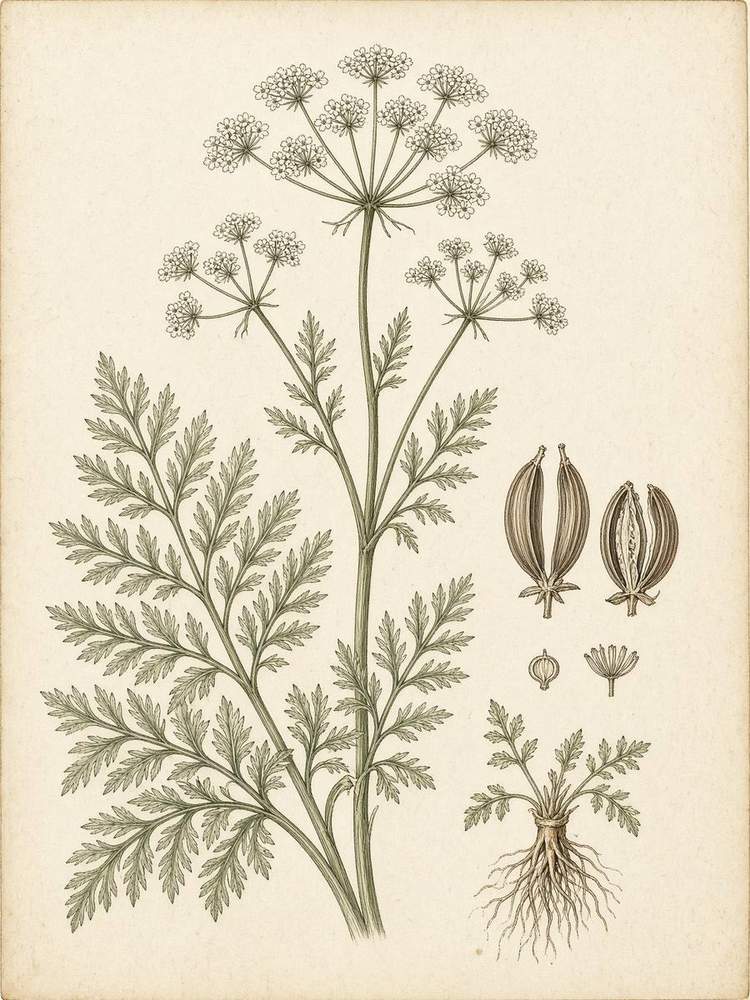
Caraway
Carum carvi
The rye-bread seed — a biennial umbel whose crescent spice is the carminative of Central Europe.
Rye, dill, a little citrus-wood. Warm, not sweet like anise.
Harvest: Leaf in 50–70 days; seed ~400 days in year two
Caraway is in the Swiss lake dwellings of the Neolithic. Shakespeare’s Justice Shallow offers a pippin with a dish of caraways. German Kümmel is the seed and the liqueur. A medieval superstition held that the seed kept lovers — and pigeons — from wandering, which is a lot to ask of a rye crust.
 No. 152
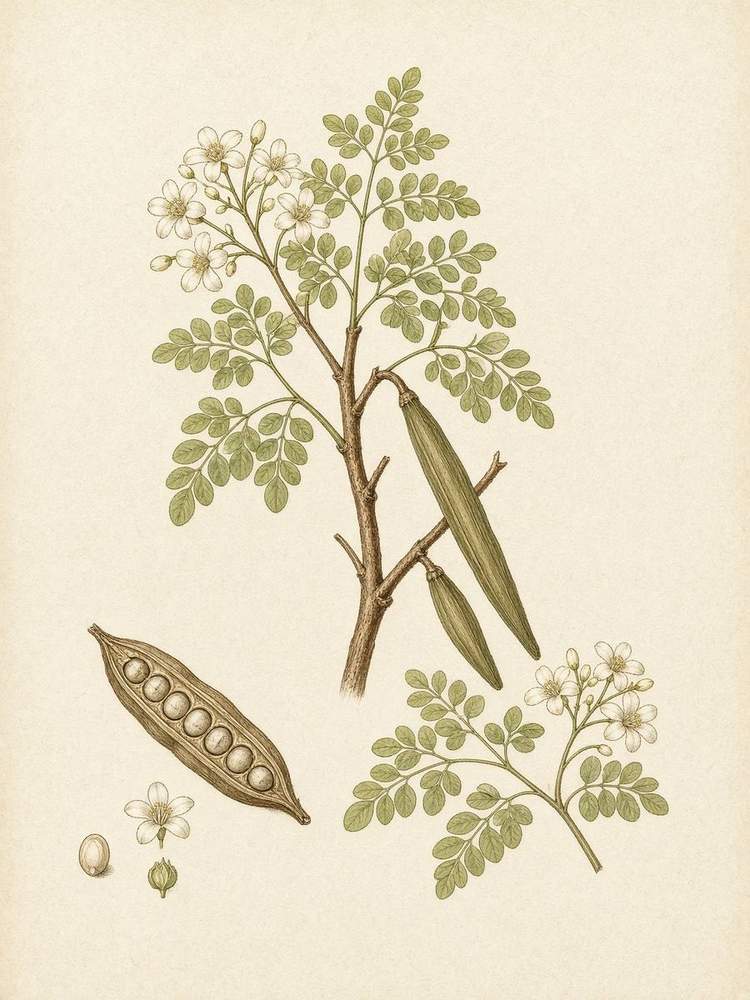
Moringa
Moringa oleifera
The drumstick tree — a tropical leaf-and-pod crop sold as a miracle, and honestly just a very good green.
Leaf is spinach-peanut, a little matcha. Pod is asparagus-bean. Seed oil is bland and fine.
Harvest: 50–70 days to leaf; 5–8 months to a first pod in heat
Sanskrit texts already have shigru. The English ‘drumstick’ is the pod in a Raj kitchen. A 19th-century British report called it the horseradish tree for the root. Modern wellness turned a village green into a powder. The tree did not ask.
 No. 153
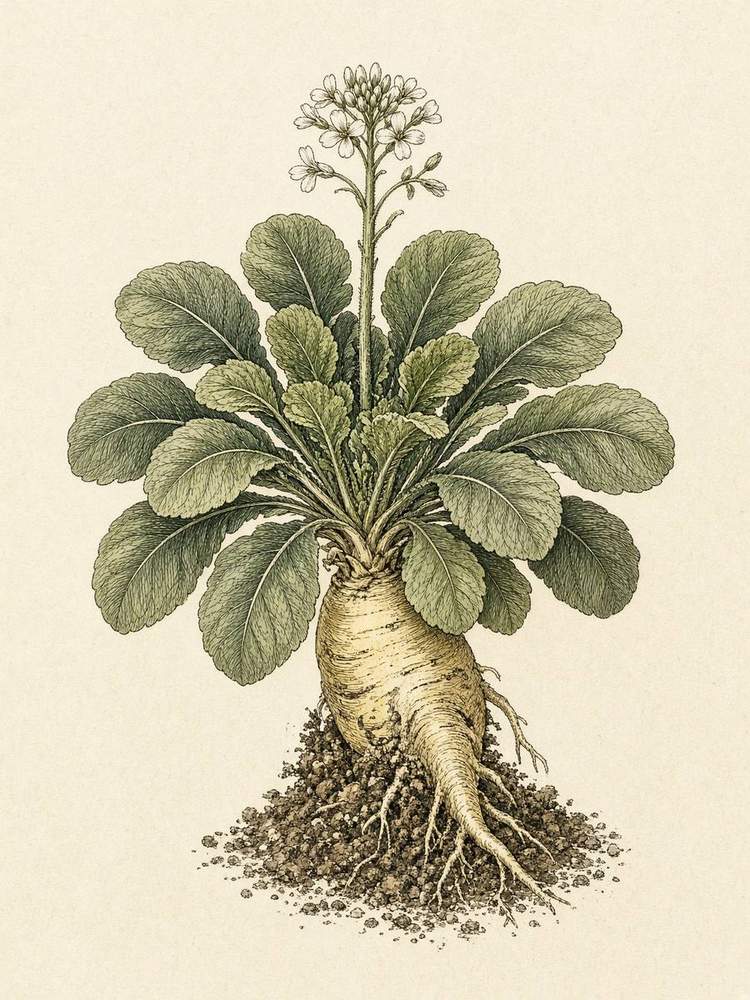
Maca
Lepidium meyenii
An Andean mustard whose swollen root is a staple above 4,000 meters — stamina folklore in a radish.
Butterscotch, radish, malt. Cooked is nutty; raw powder is mustard-dusty.
Harvest: 240–270 days in the Andes; most kitchens purchase
Quechua and Aymara kitchens dried it in the sun until it was a shelf-stable malt. Spanish chroniclers noted it as a camelid fodder and a human staple. The 1990s export boom made it a gym powder. In Junín it is still a root in a stew.
 No. 154
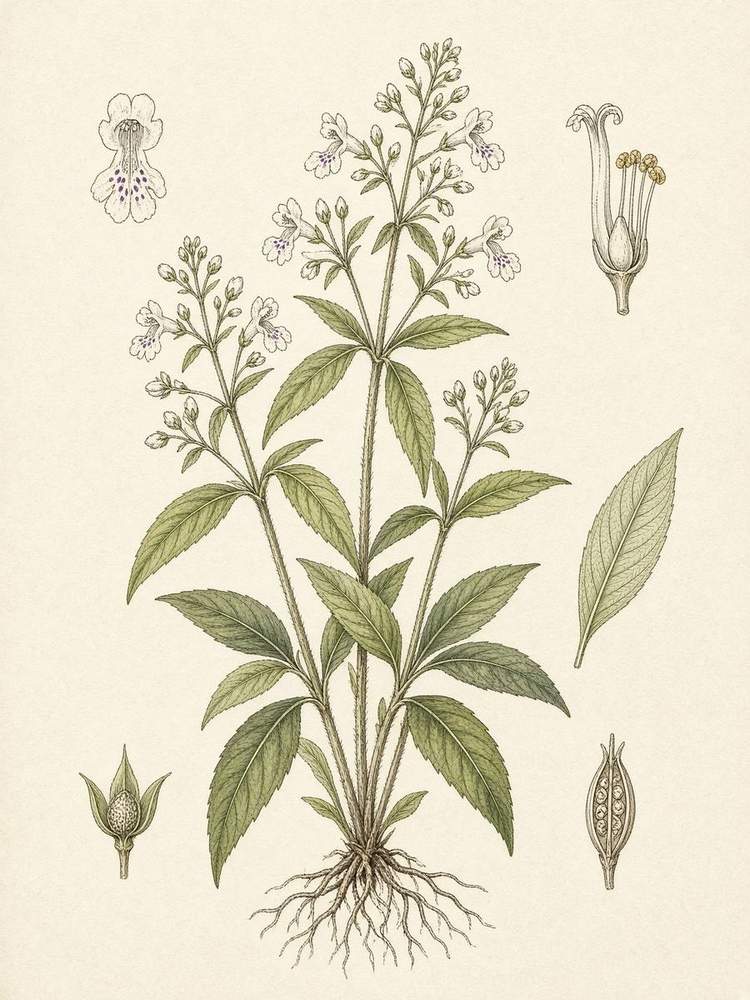
Andrographis
Andrographis paniculata
King of bitters — a South Asian annual whose leaf is a short-course cold folklore, and one of the bitterest cups in the folio.
Relentless bitter, green, a little smoke. Honey is a kindness and a confession.
Harvest: 70–90 days from transplant to a first bitter cut
The Tamil name nīlavēmpu already warns you: it is a neem of the field, a bitterness with a job. Scandinavian cold products made it famous in Europe in the 1990s. Chinese chuān xīn lián means ‘thread-the-heart lotus,’ which is how the bitter feels going down.
 No. 155
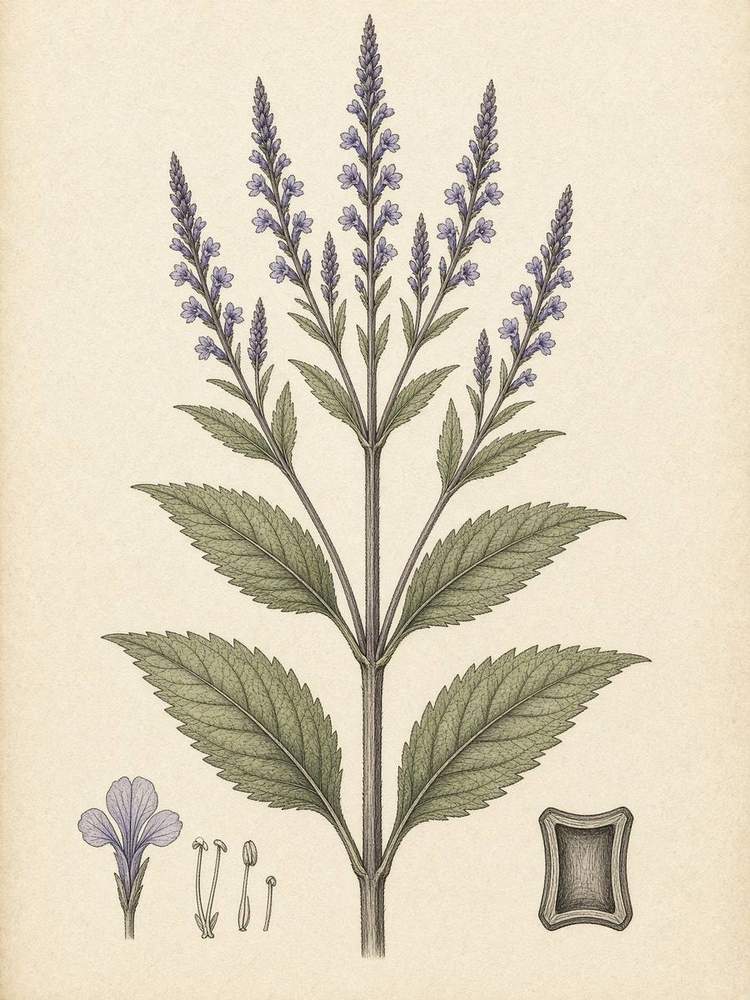
Blue vervain
Verbena hastata
A candelabra of purple spikes in wet ground — a bitter American nervine of the old Eclectic physicians.
Bitter, green, a little earth. Honey helps and does not hide it.
Harvest: 90–120 days from a plant to a first flowering
Vervain was a Roman altar herb — herba sacra — and then a Druid rumor the Victorians could not leave alone. The American species inherited the name and the nerves. Eclectic physicians of the 19th century used it for ‘nervousness with a tight neck,’ which is still the picture.
 No. 156
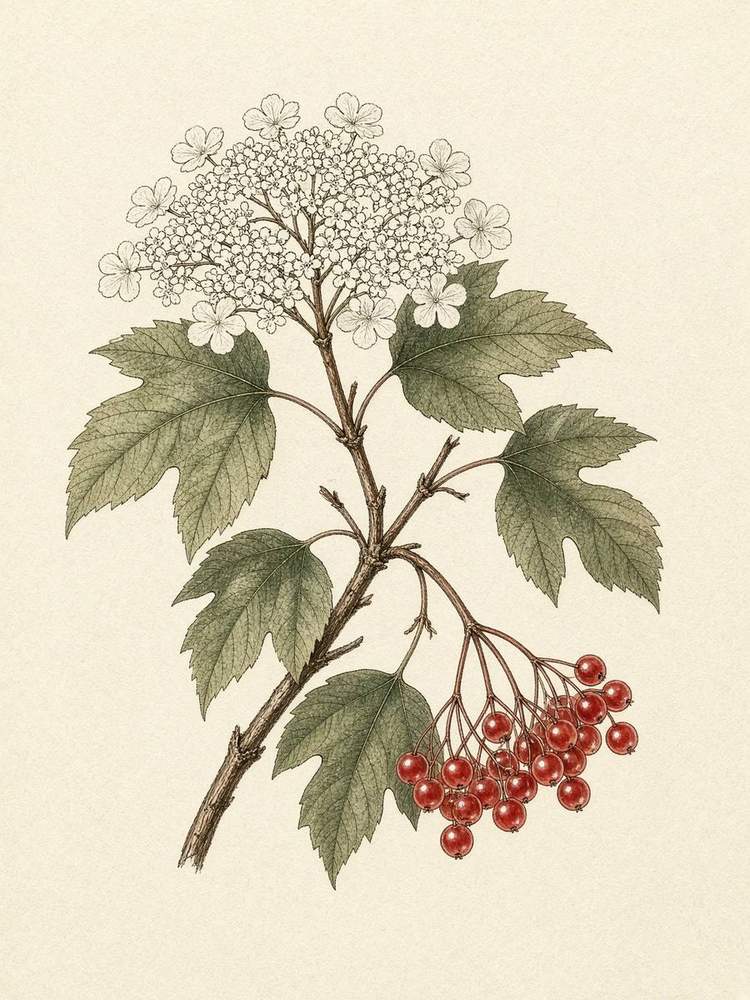
Cramp bark
Viburnum opulus
A hedge viburnum whose bark is the old antispasmodic of European midwives — a cramp folklore, not a candy.
Bark tea is bitter, astringent, a little viburnum musk.
Harvest: 3–5 years from a shrub to a first careful prune
Guelder rose is named for Gelderland. Ukrainian kalyna is a national plant, embroidered and sung, the berry more than the bark. Anglo-American herbalism kept the bark for cramp. The snowball viburnum in a front yard is often a sterile cousin that will not give you fruit or much bark folklore.
 No. 157
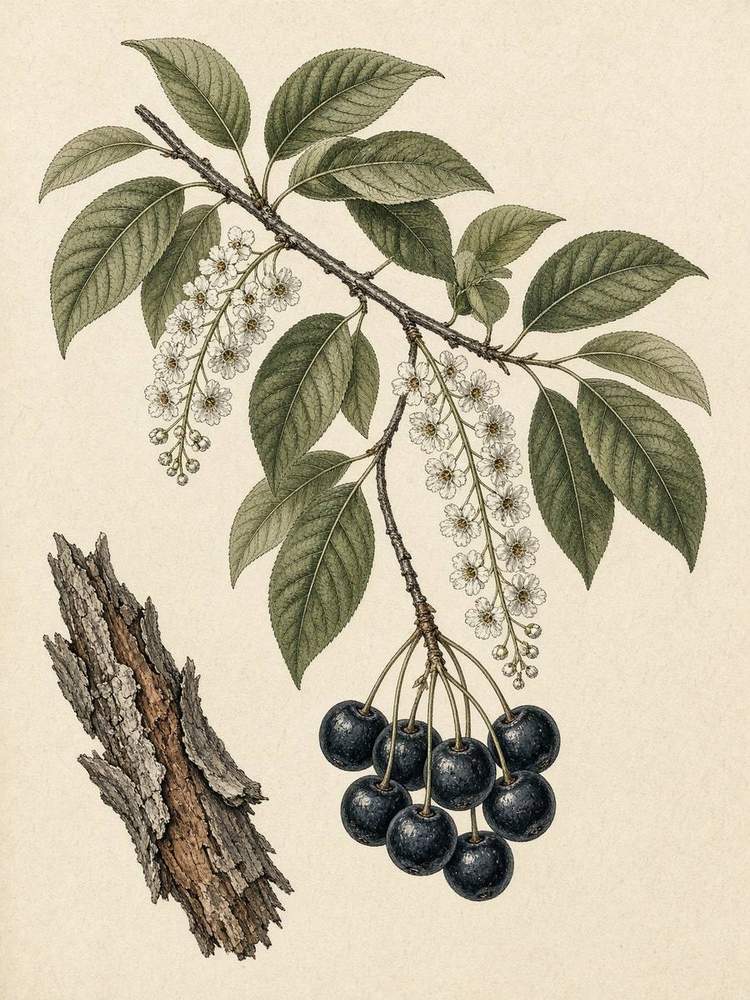
Wild cherry
Prunus serotina
Black cherry of eastern woods — a cough-bark folklore, and a tree whose wilted leaves are a livestock warning.
Bark syrup is almond-cherry, bitter, a little medicine-cabinet. Fruit is astringent-sweet.
Harvest: Fruit in 5–8 years from a whip
The American cough drop is this bark in sugar. Eclectic physicians wrote of Prunus virginiana and P. serotina almost interchangeably. Cabinetmakers prized the wood. A wilted branch in a hayfield is a different, uglier story — cyanide is the same family trick as bitter almond.
 No. 158
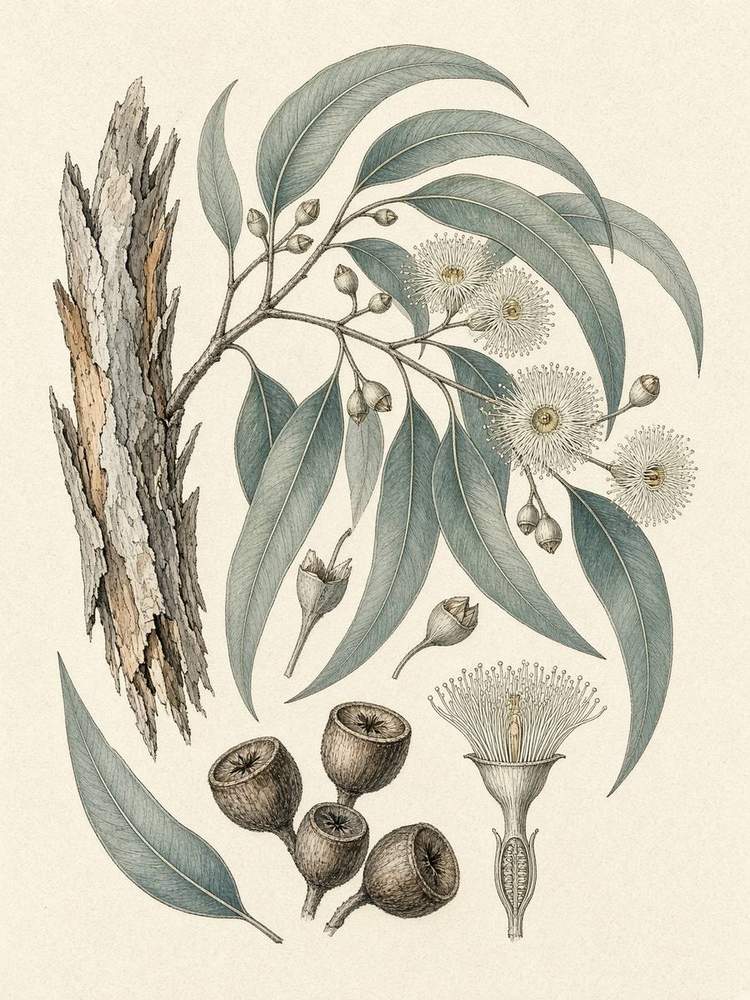
Eucalyptus
Eucalyptus globulus
Blue gum — the fever tree of Australia, a steam-inhalation leaf, and an oil that does not belong in a cup.
Camphor, menthol, solvent-sweet. A steam, not a soup.
Harvest: 180–365 days from a sapling to a useful leaf pick
The British planted it in malarial marshes on the theory that a thirsty tree would drain a swamp. Sometimes the swamp died; sometimes the tree became a weed. Tasmanian blue gum is the oil of the pharmacy. Aboriginal uses of many eucalypts are older than that bottle and are not this one species.
 No. 159
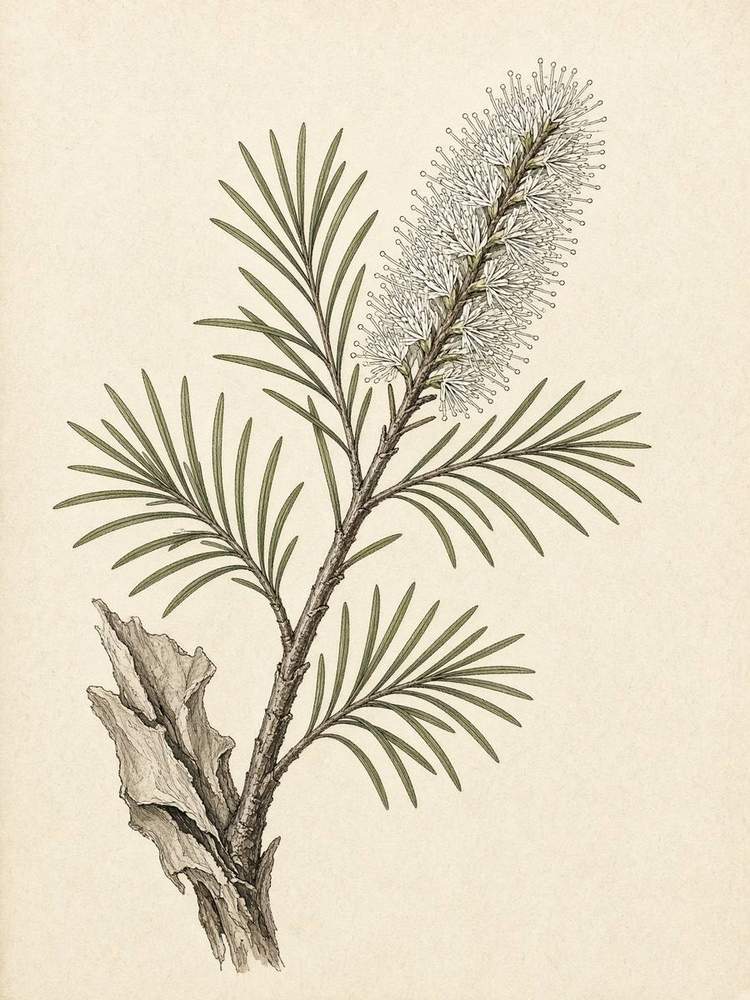
Tea tree
Melaleuca alternifolia
Paperbark of New South Wales — a topical oil plant, famously not the tea camellia, and not a beverage.
Not a flavor. Medicinal, cineole, nutmeg-solvent. Keep it off the tongue.
Harvest: 2–3 years to a bushy cut in a warm wet climate
Bundjalung people of New South Wales used crushed leaf on skin long before a Sydney factory distilled it. Captain Cook’s men made a grog of it and complained. The 1920s Australian chemist A. R. Penfold put the oil into modern pharmacy. The ‘tea’ in the name is a sailor’s joke that outlived the brew.
 No. 160
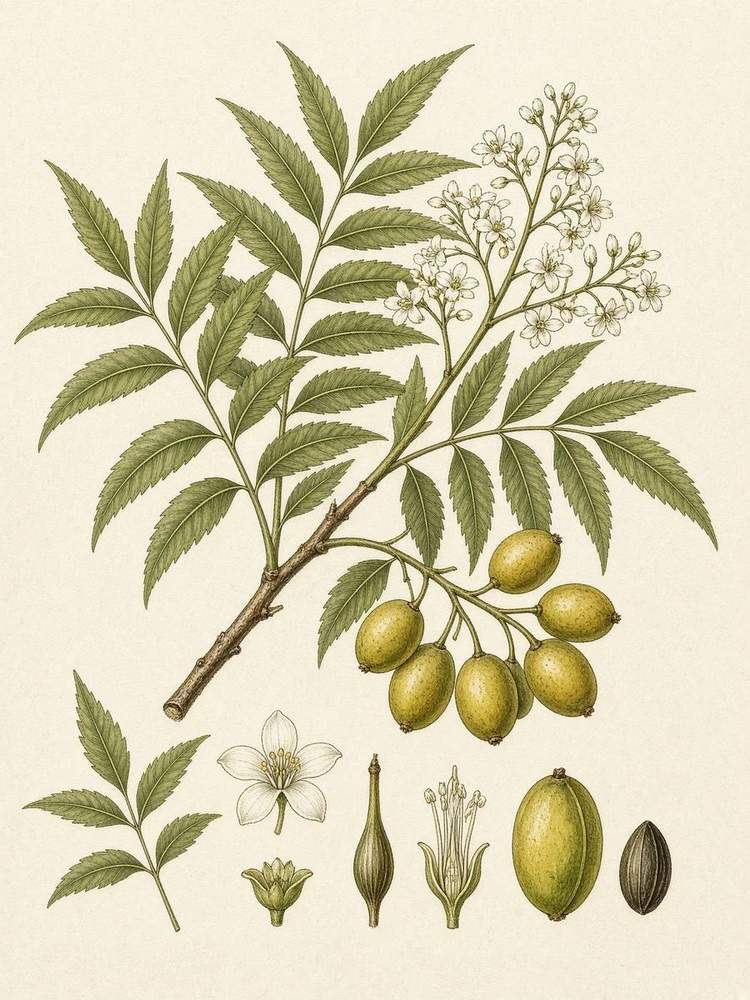
Neem
Azadirachta indica
The village pharmacy tree of South Asia — a bitter leaf for skin and pests, and a seed oil that does not belong in a mug.
Garlic-sulfur bitter. The smell is the warning.
Harvest: 90–150 days from a sapling to a useful leaf pick
Sanskrit nimba. Gandhi wrote of the tooth twig. A UN report once called it the tree the world could not afford to ignore, which is how a village bitter became a pesticide patent fight. The seed is azadirachtin; the leaf is the gentler, older neighbor.
 No. 161
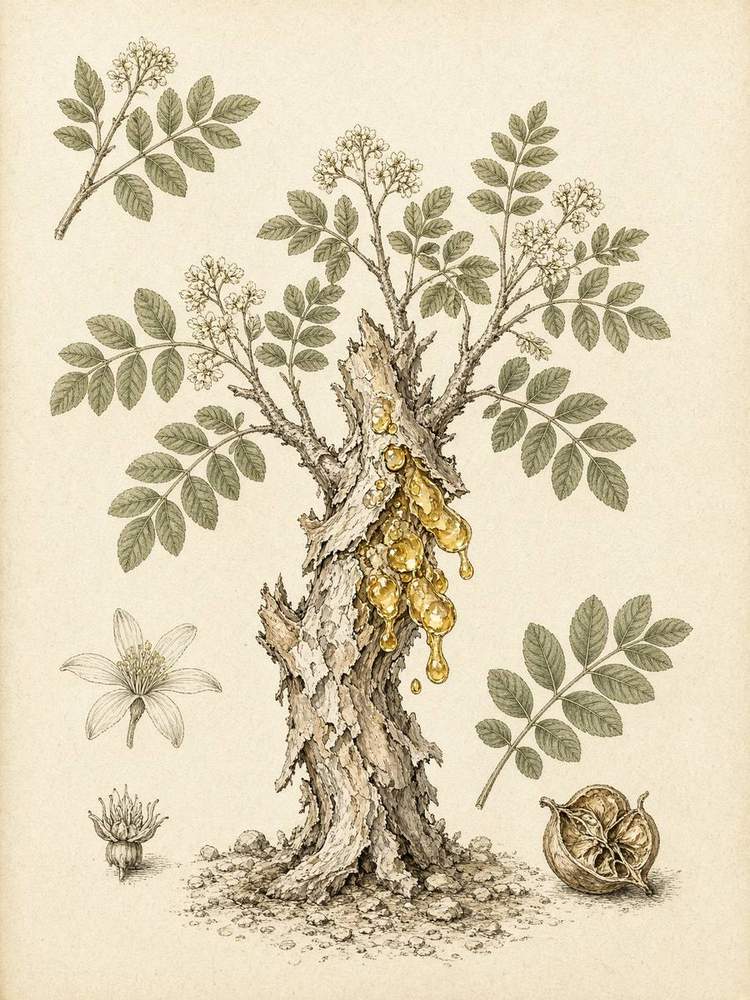
Frankincense
Boswellia sacra
The tears of a desert tree — temple smoke, and a boswellic-acid joint folklore in a resin that should be farmed, not stripped.
Pine, lemon, church. A chew of resin is bitter-pine; a capsule has no flavor on purpose.
Pliny already complains of the price. The Magi brought it because it was what you brought a king. Queen Hatshepsut’s expedition to Punt was, in part, a shopping trip for this tree. The Arabic lubān is ‘milk’ — the sap. Oman still grades it like wine.
 No. 162
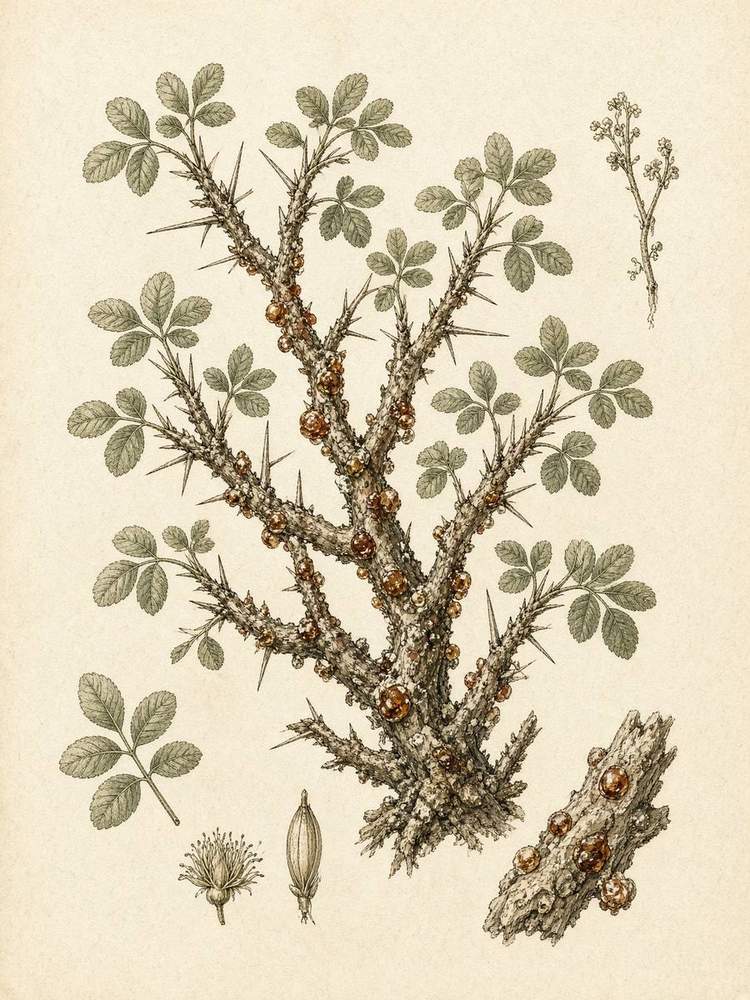
Myrrh
Commiphora myrrha
The other temple resin — a thorny Somali and Arabian shrub whose bitter gum is incense, a mouthwash, and a nativity prop.
Bitter, medicinal, a little mushroom-earth. The smell of a sacristy.
The Egyptian word was bol; they used it to perfume the dead. The Greek myrrha is bitter. In the nativity it is the gift that smells of tombs, which the old sermons never tired of. A medieval toothache was a myrrh problem. The shrub is still harvested by tapping, not by planting a row.
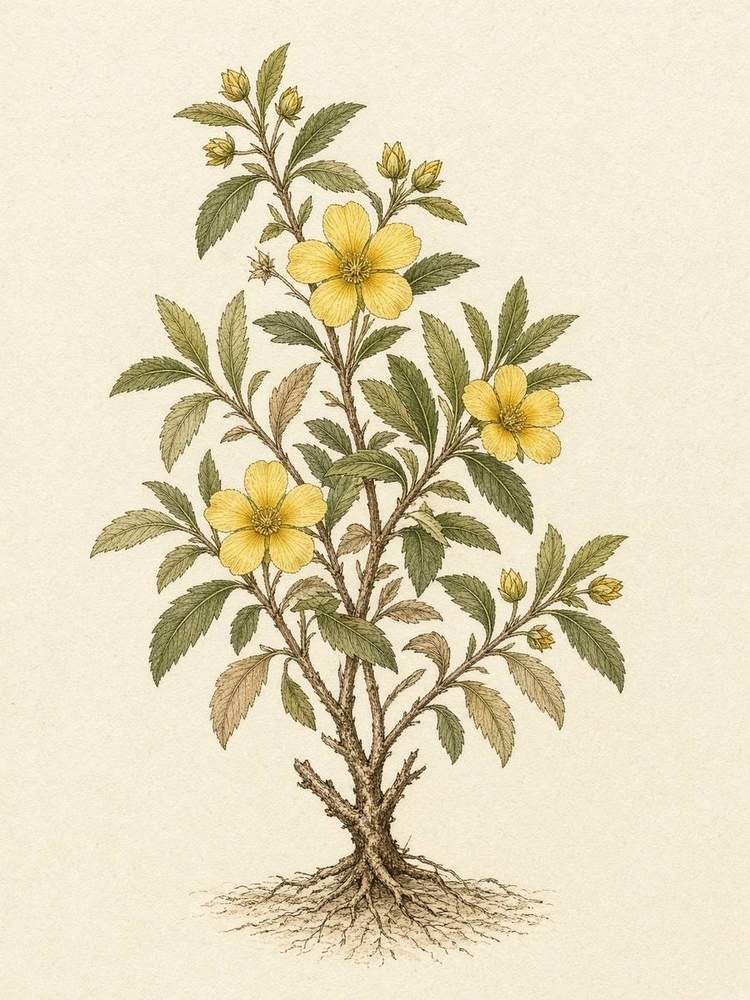 No. 163
Damiana
Turnera diffusa
A small yellow-flowered shrub of Mexican dryland — a bitter-aromatic tea with a long bedroom reputation it has not entirely earned.
Fig, chamomile-bitter, a little spice. Better blended than alone.
Harvest: 90–120 days from a small plant to a first cut
The Spanish recorded it as a Mexican leaf for love and nerves. A 19th-century American patent medicine, Damiana Bitters, did the rest. Turnera was later moved near passionflower, which is a taxonomic wink. The yellow flower is shyer than the reputation.
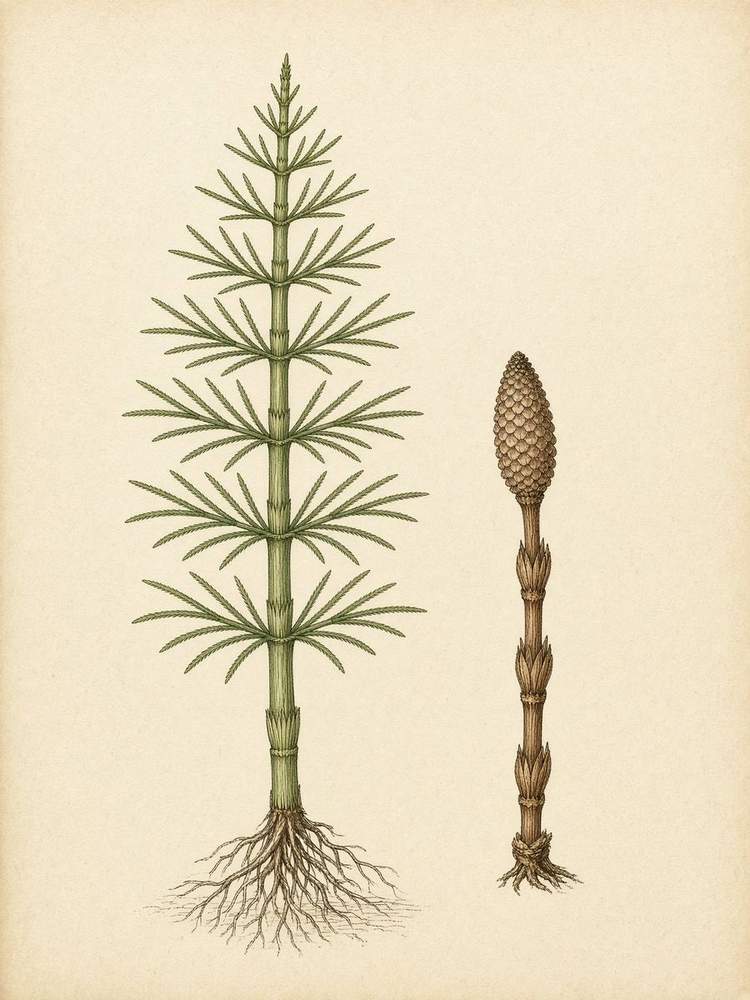 No. 164
Horsetail
Equisetum arvense
A living fossil of jointed green stems — silica folklore for hair and bone, and a weed that will own a wet bed.
Green, grassy, a little metallic. Not a dessert.
Harvest: Volunteers are ready when you notice them; a contained pot in 60–90 days
Equisetum is older than the dinosaurs. Victorian furniture-makers used it as sandpaper — the silica is real. Culpeper wanted it for wounds. The fertile brown shoot is a Japanese spring vegetable in a different species (E. arvense tsukushi), which is why this plate keeps saying: name it, then decide.
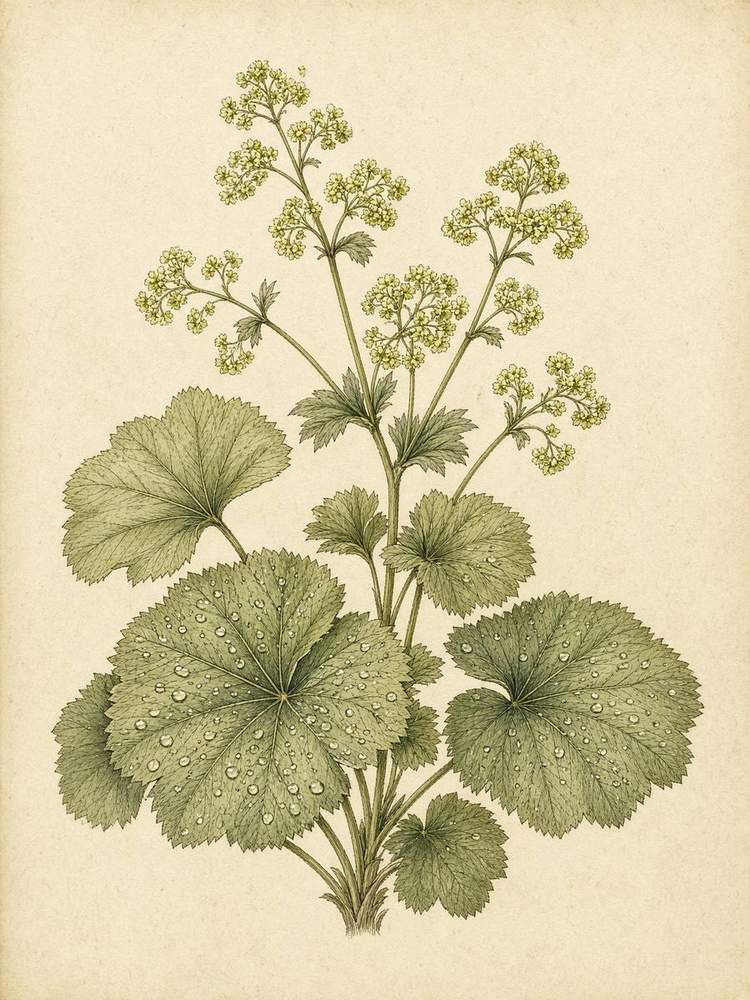 No. 165
Lady’s mantle
Alchemilla vulgaris
Dew-catching scalloped leaves and a chartreuse foam of flowers — a European astringent of the old women’s shelf.
Green, astringent, a little rose-family tannin. Quiet.
Harvest: 60–90 days from a division to a useful clump
Alchemilla is the little alchemist — the dew was supposed to be the purest water for the work. Our Lady’s mantle is a medieval church name for the scalloped leaf. Alpine women wore it in the shoe for a long walk, which is folklore, and drank it for cramp, which is the older job.
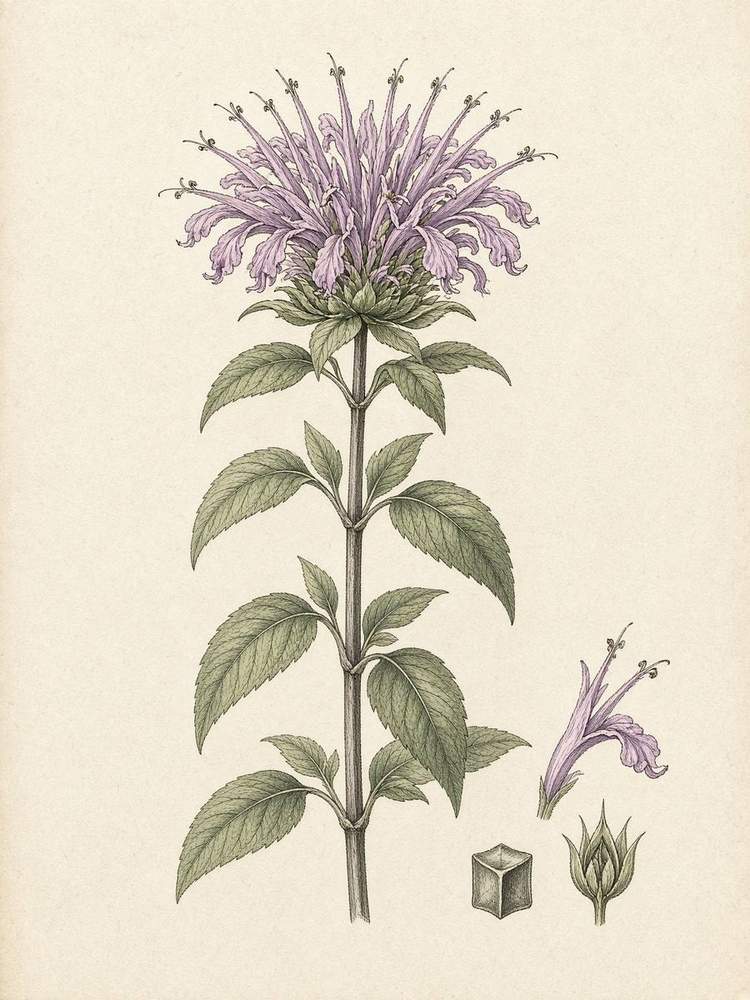 No. 166
Bee balm
Monarda fistulosa
Wild bergamot — a ragged native mint whose leaf is an Earl Grey rumor and a traditional cold tea of the Northeast.
Oregano, thyme, citrus-mint. A wilder cousin of the kitchen mints.
Harvest: 80–100 days from a division to a first tea cut
Oswego tea is named for the people around that river, and for the settlers who drank Monarda when black tea was a tax argument. The bergamot in Earl Grey is a Calabrian orange. Linnaeus named the genus for Nicolás Monardes, who wrote of New World plants without ever seeing this prairie mint.
 No. 167
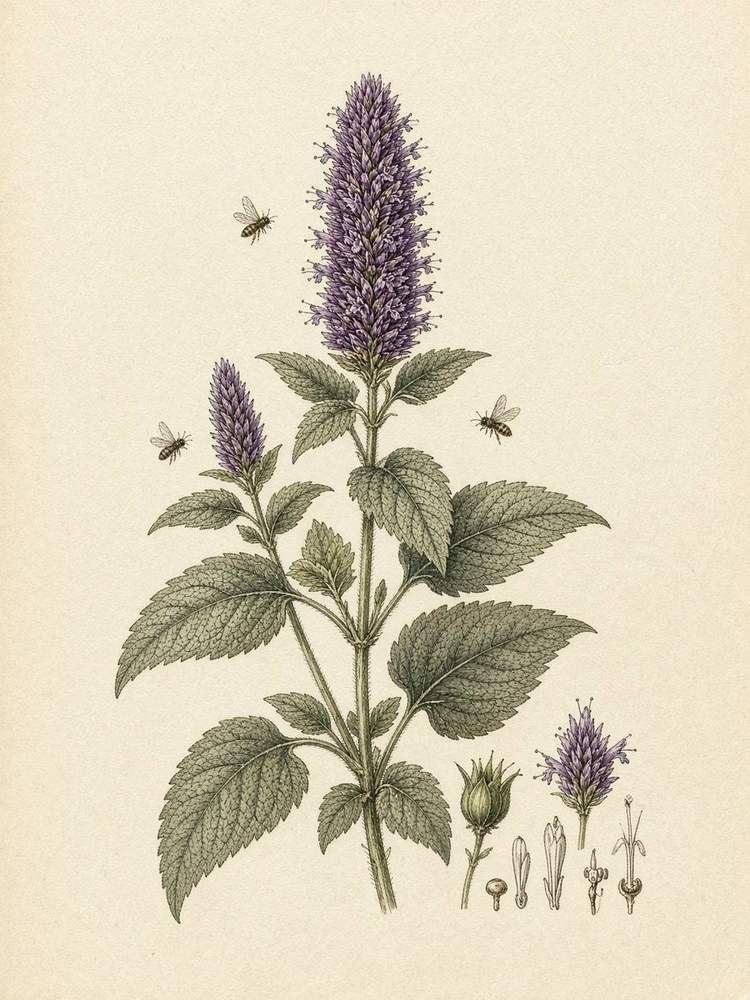
Anise hyssop
Agastache foeniculum
A prairie mint that smells of licorice and basil — a bee spike, a tea, and a name that lies in two directions.
Licorice, basil, mint. Sweeter than hyssop, greener than anise seed.
Harvest: 60–80 days from sow to a useful bush
The Dakota and neighboring nations used Agastache as a tea and a sweetener of other medicines. Foeniculum in the Latin is a botanist smelling fennel. English ‘anise hyssop’ is a market stall with a short pencil. The plant is American. The name is a European cupboard reaching.
 No. 168
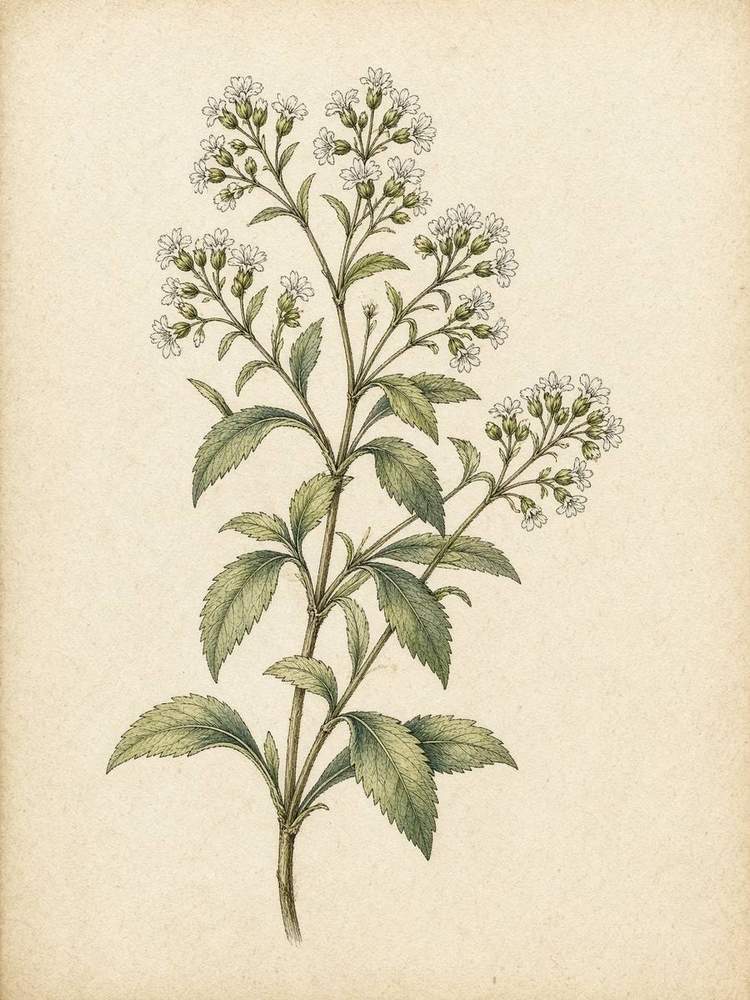
Stevia
Stevia rebaudiana
The Paraguayan sweet herb — a few leaves that sugar a pot without sugar, and a bitter green aftertaste if you overdo it.
Sweet, then a licorice-bitter green if you use too much. A leaflet, not a handful.
Harvest: 60–90 days from a cutting to a useful bush
The Guaraní called it ka’a he’ẽ — sweet herb — and used it in mate. A 19th-century Italian chemist, Rebaudi, got his name into the species. Japan adopted the extract when saccharin was in the dock. The garden leaf is still the older, greener, slightly bitterer truth.
 No. 169
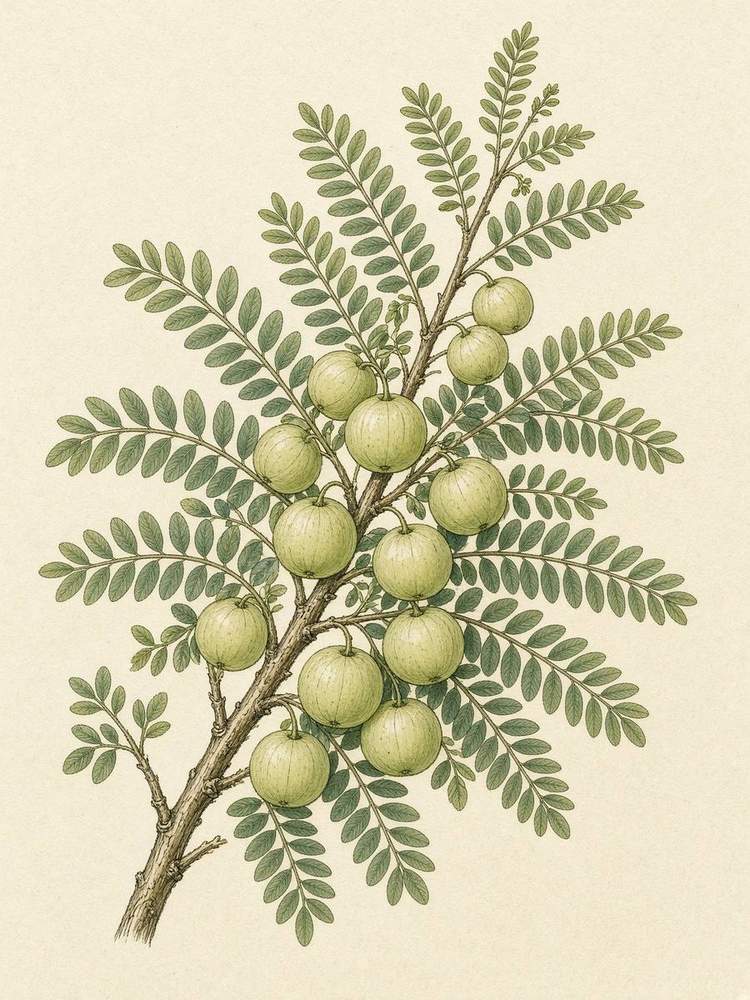
Amla
Phyllanthus emblica
Indian gooseberry — a sour, tannic fruit that Ayurveda treats as a rasayana, and that kitchens pickle in sugar and spice.
Sour, astringent, then a sweet aftertaste. Murabba is the fruit in syrup; powder is tart dust.
Harvest: Several years to first fruit in the tropics
Sanskrit āmalaki. It is said to contain a dwelling of Lakshmi, which is a lot of goddess for a sour marble. Charaka lists it as a rasayana. The British called it gooseberry because they needed a word. Triphala is three fruits arguing in one powder; this is the sour one.
 No. 170
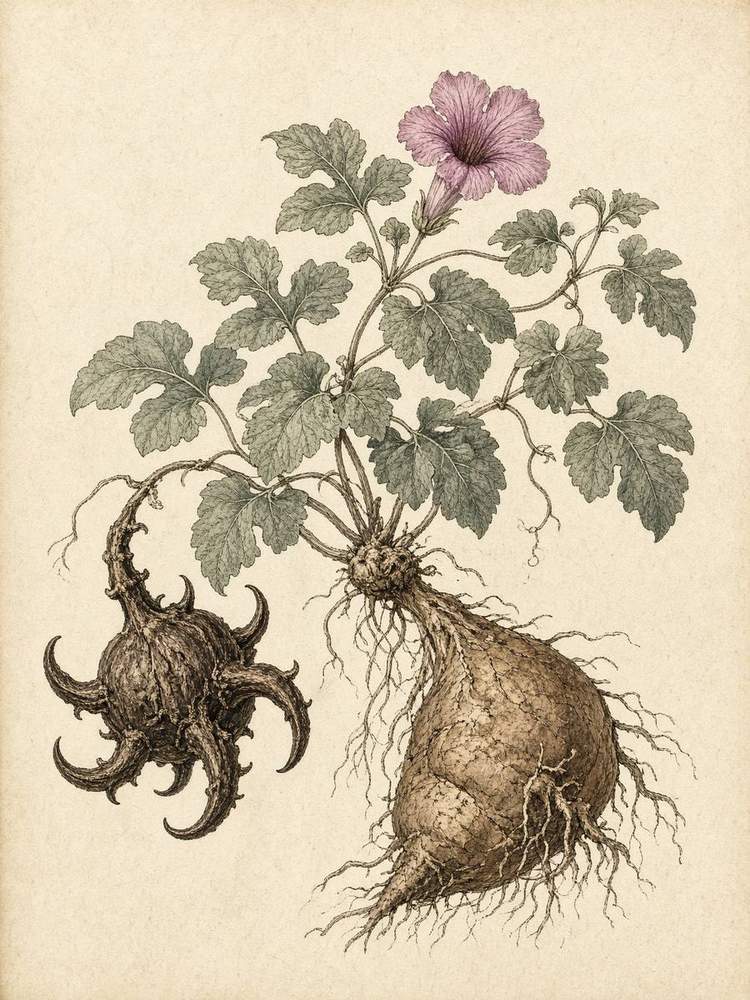
Devil’s claw
Harpagophytum procumbens
A Kalahari trailer whose hooked fruit named it, and whose tuber is a bitter joint folklore — buy farmed, do not strip the desert.
Bitter, earthy. Capsules exist because the tea is an argument.
The Afrikaans dubbeltjiedoring is ‘devil’s thorn.’ San and Khoekhoe use of the tuber is older than the export trade. A 1950s German interest in the bitter made it a pharmacy plant. The fruit still catches sheep. The tuber should not have to catch a market.
 No. 171
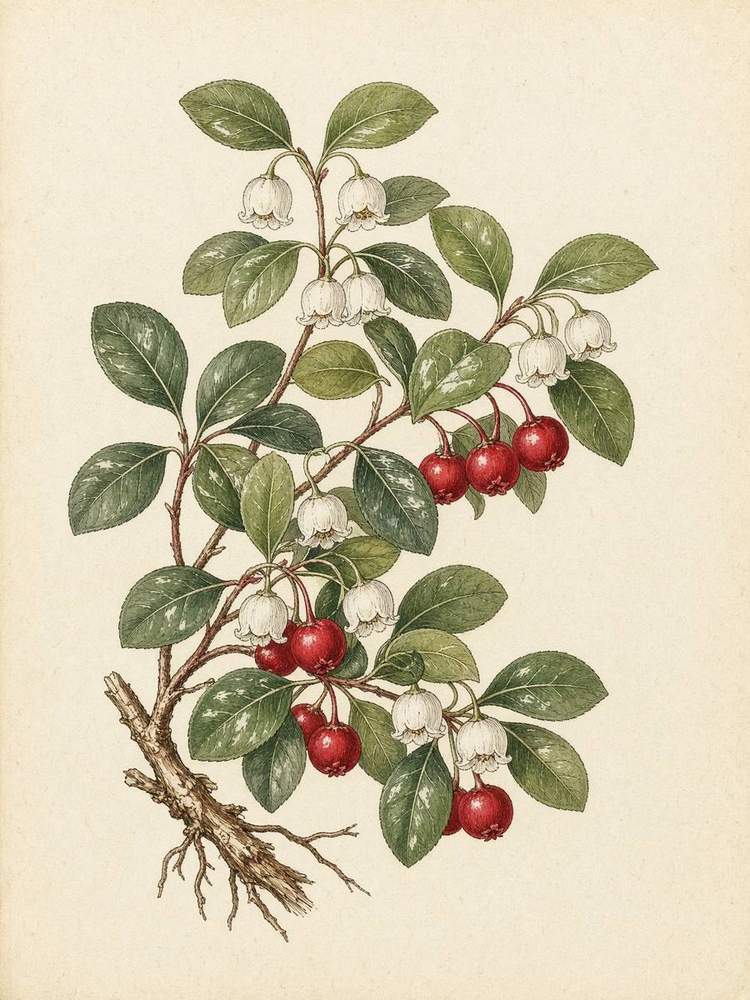
Wintergreen
Gaultheria procumbens
A low eastern woodland evergreen that tastes of toothpaste — a salicylate leaf, and an oil that is a poison-control regular.
Sweet birch, toothpaste, a little mint that is not mint. One leaf perfumes a cup.
Harvest: 365+ days from a liner to a patch you can pick from
The American toothpaste aisle is this leaf in a factory. Indigenous nations of the east used the berry and a leaf tea. 19th-century chemists distilled the oil and then learned to make methyl salicylate from scratch, which is why a cheap liniment can still smell like a woodland that no longer needs to be stripped.
 No. 182
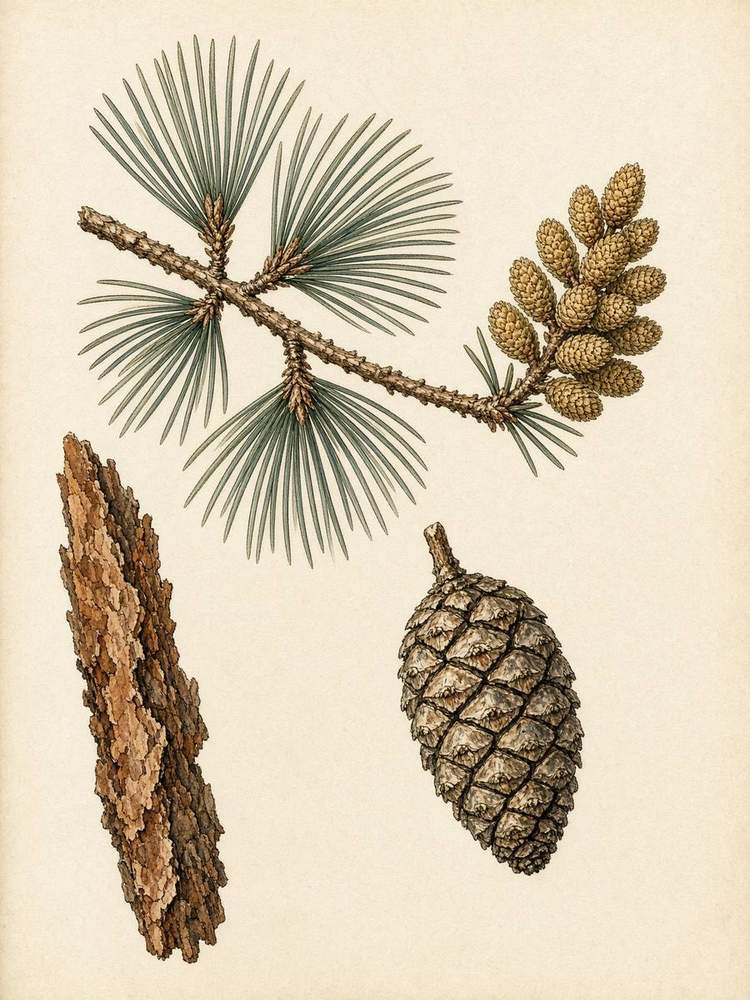
Pine
Pinus sylvestris
A bright, resinous needle tea from a tree you can name — never from a hedge you cannot.
Resin, lemon-peel, a walk in a cold wood. Over-boiled, it turns tarry.
Harvest: Years to a picking tree; needles anytime from an established Pinus
Scurvy-era sailors boiled spruce and pine when citrus ran out. The Cree and many northern peoples already knew the needle cup. Linnaeus named P. sylvestris from the Swedish woods he walked. The English ‘deal’ is the timber; the tea is the leftover brightness of the same tree.
 No. 183
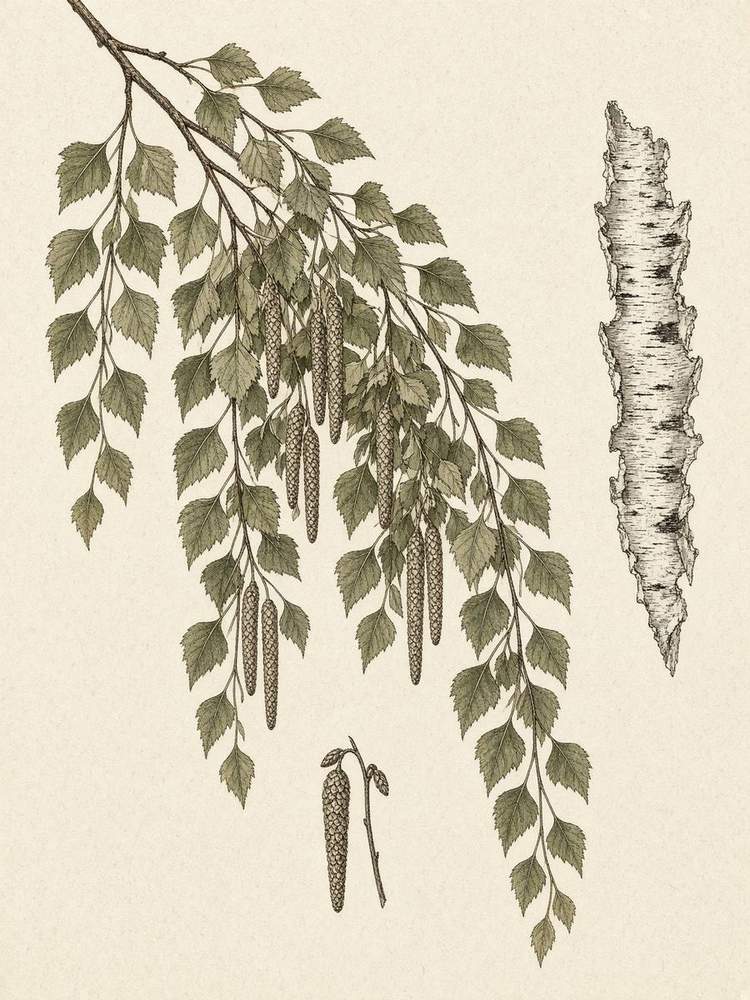
Birch
Betula pendula
A mild, green, slightly wintergreen spring cup from young birch leaf — not a methyl-salicylate binge.
Green, faint wintergreen, a little tannin. Young leaf is kinder than old.
Harvest: Years to a picking tree; leaf in the first lush spring after it is established
Birch was the paper of the north — bark letters, sap wine, a broom, a tea. The wintergreen smell is methyl salicylate, the same family as willow and aspirin. Finnish and Russian spring tables still put young leaf in a pot. The Victorian ‘birch oil’ liniment is why poison control still knows the genus by name.
 No. 184
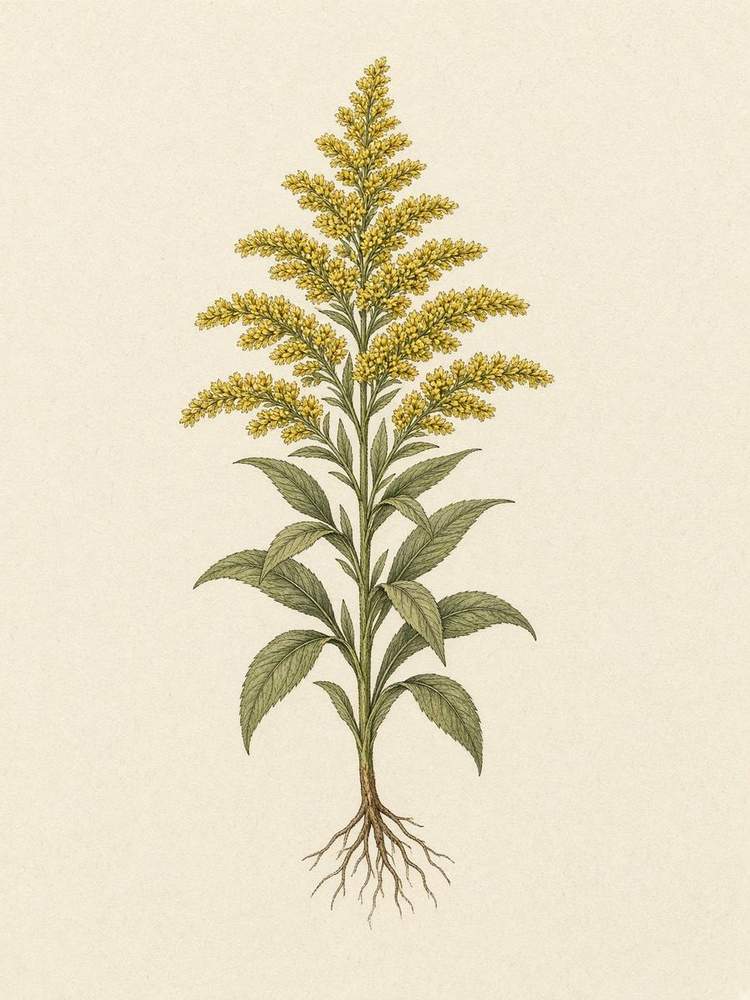
Goldenrod
Solidago canadensis
A hay-scented late-summer infusion, unfairly blamed for ragweed, useful when the head is thick.
Hay, honey, a little bitter green. The flower is the perfume.
Harvest: Second-year bloom from seed; divisions flower the same summer
Solidago means to make whole. American goldenrod went to European gardens as an ornamental and then as a tea. The hay-fever rap is mostly ragweed’s. Eclectic physicians used the tops for a thick head and a dragging bladder. If it is blooming in your hand and you are sneezing, look at the ragweed next to it.
 No. 185
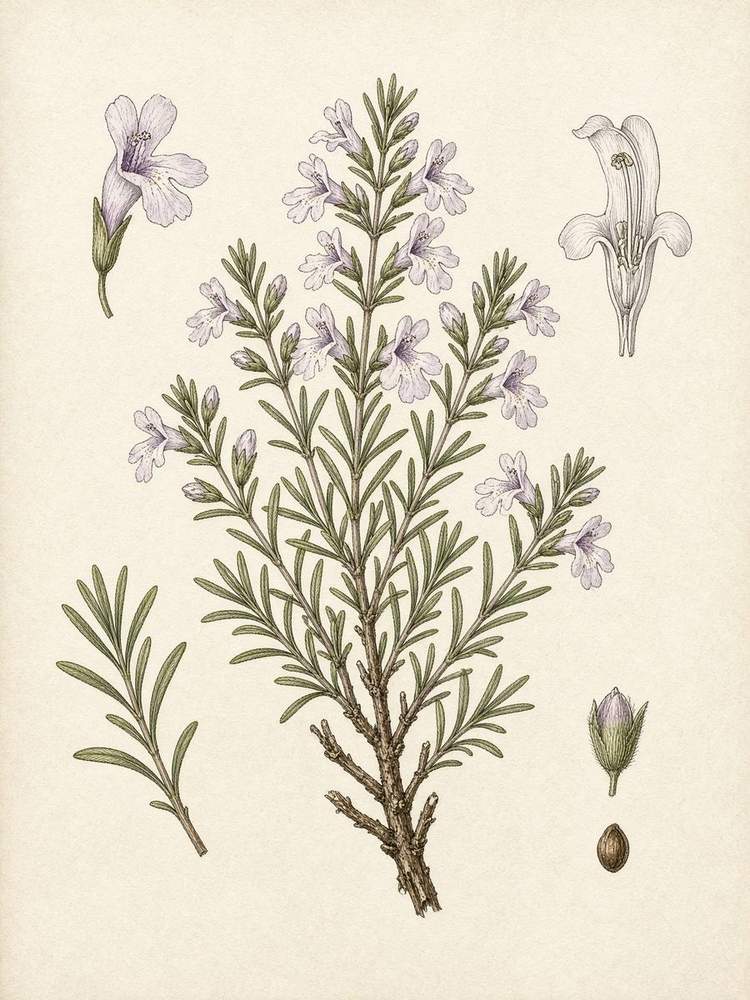
Winter savory
Satureja montana
The tougher bean herb — a shrubby perennial savory that winters over and still belongs in the pot with pulses.
Pepper, pine, thyme. Drier and woodier than summer savory.
Harvest: 60–90 days from a cutting to a useful bush; years as a clump
Virgil already has savory in the garden. The perennial mountain form kept poor European kitchens in a bean herb after the annual had gone to seed. German Bohnenkraut can mean either cousin; the winter one is the shrub you do not have to sow again. Charlemagne’s list of must-plants includes it. The cube came later.
 No. 186
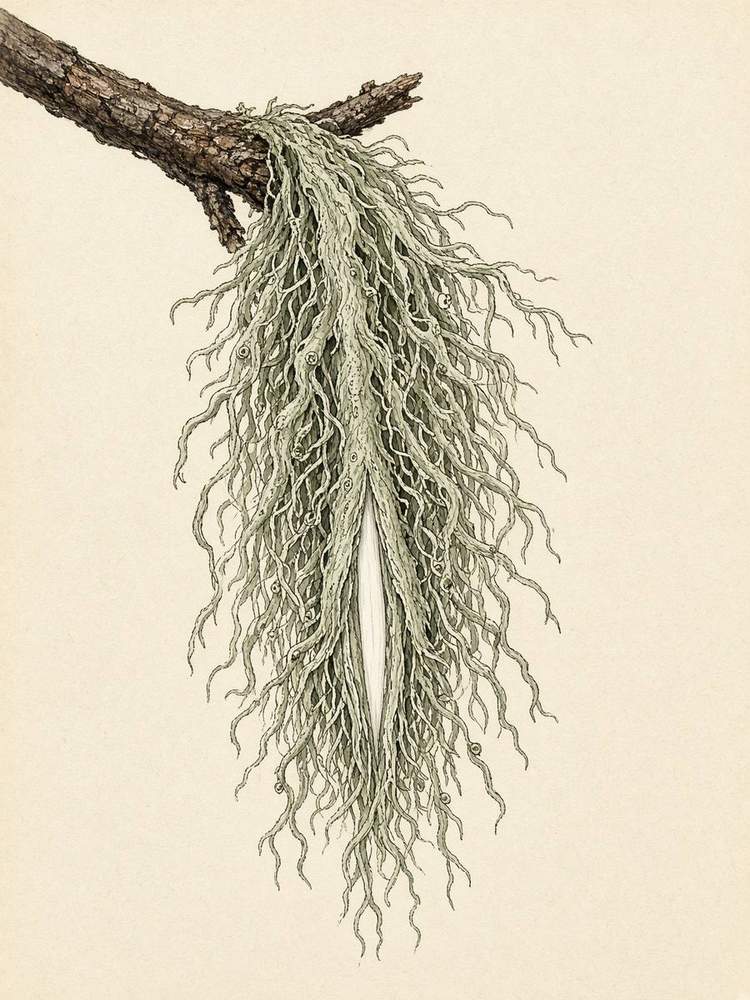
Usnea
Usnea spp.
Old-man’s beard — a traditional lichen gargle and skin wash, habitat-sensitive, not a wild-stripped tea.
Bitter, mushroom-wood, a little iodine. Not a pleasure cup.
Usnea is named for the Arabic ushnah. European herbals used the beard as a wound wash and a throat gargle. Linnaeus filed it with the lichens that hang like hair. Loggers and air-quality maps still know it as a canary: when the beards vanish, the air has changed. The white cord is the whole lesson — look, name, and leave the living tree.