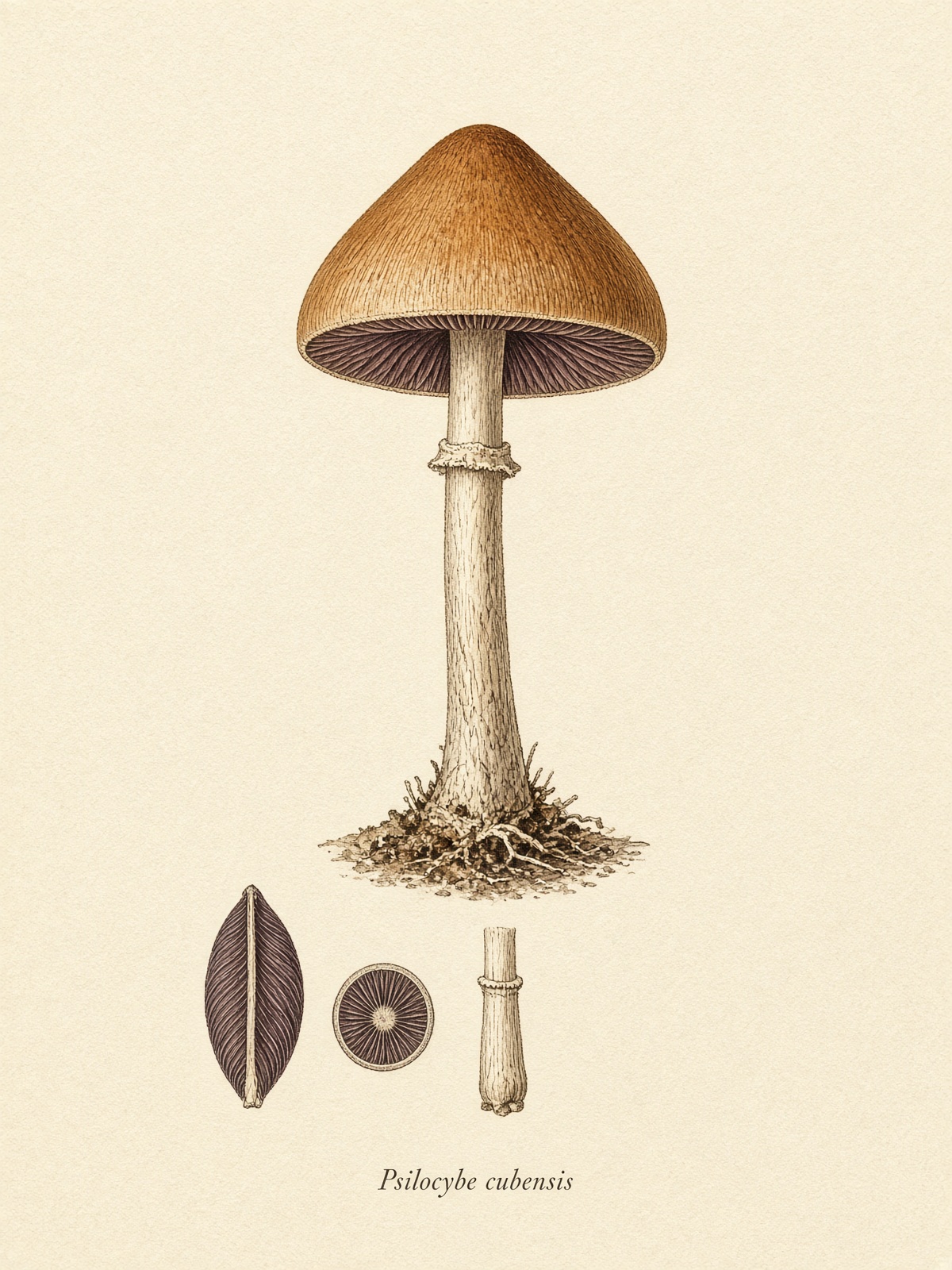
Herb. No. 037 · Hymenogastraceae
P. cubensis is a tropical American grassland species; related species occur on several continents. Map is habitat, not a hunt guide.
Native · Mexico & Central America · South America
Psilocybe mushrooms
Psilocybe cubensis
Regulated or restrictedLookalikes
A well-known psychoactive woodland and pasture genus, now in clinical trials for depression — still illegal to grow or possess in most places.
Psilocybin and psilocin are US Schedule I substances. The mushrooms that contain them are illegal to cultivate, possess, or distribute under federal law, with narrow local decriminalization in a few cities and licensed research/therapy programs. Tennessee has not decriminalized them.
Psilocybin is a prodrug of psilocin, a serotonin 2A agonist. Modern trials (under IND, in clinics) explore treatment-resistant depression and end-of-life distress. That is not the same as unregulated use. Risks include terrifying sessions, precipitating psychosis, dangerous behavior, and misidentification with deadly lookalikes (Galerina, some Cortinarius). This plate exists so the fungus can be named, its legal status seen, and deadly confusion avoided.
Flavor
Fresh mushrooms are farinaceous (raw-dough); dried are dusty and bitter. Not a culinary species.
Parts used
Fruiting body — in licensed research only
Helpful
- Promising clinical signal in supervised research
- Not physiologically addictive in the opioid sense
Cautions
- Federal felony to cultivate or possess in most of the US
- Psychological harm and accidents
- Deadly lookalikes in the wild
- Unregulated dose and adulteration