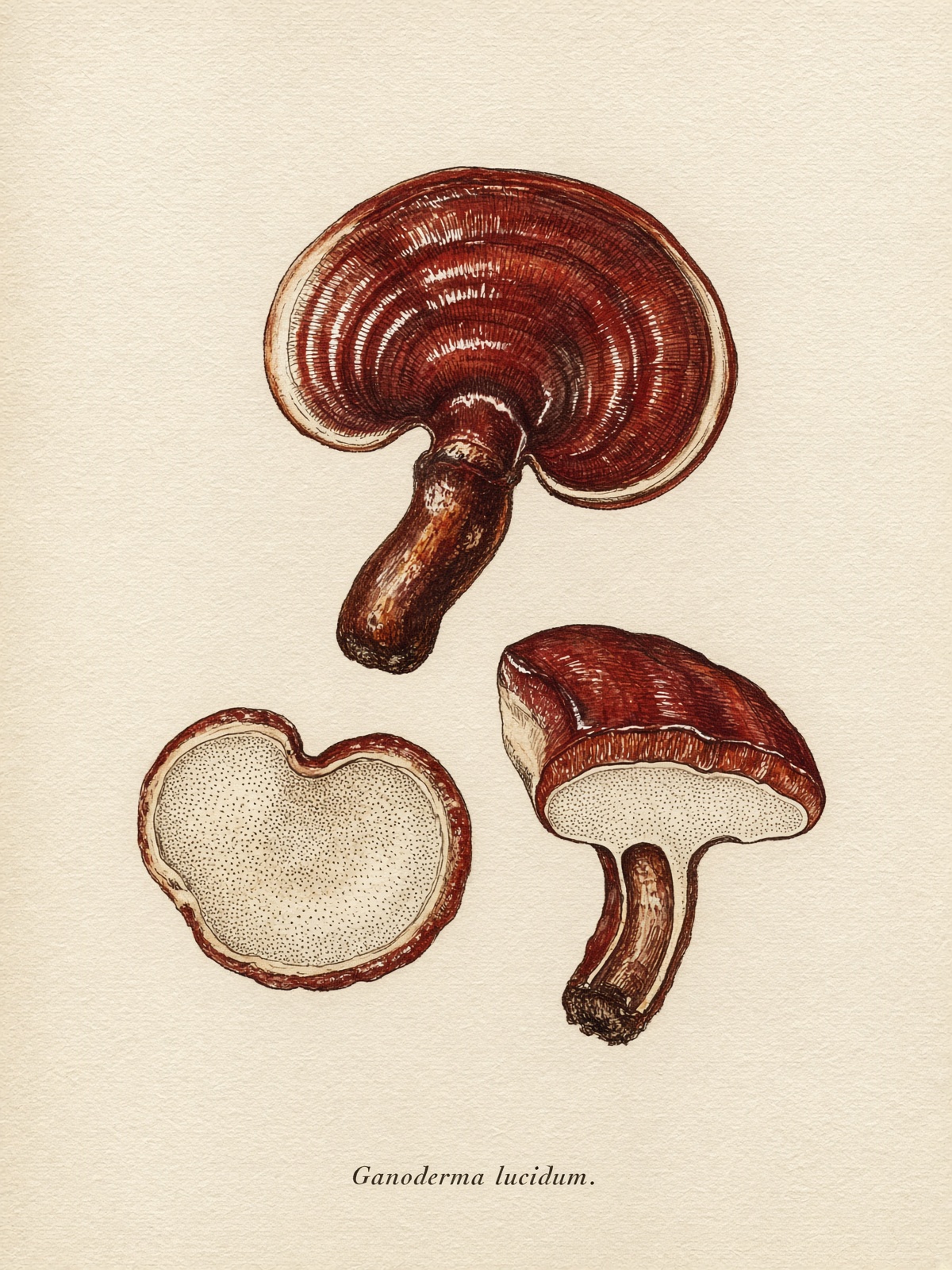
Herb. No. 029 · Ganodermataceae
East Asian hardwood polypore; now fruited on logs and blocks worldwide.
Native · East Asia
Native Also grown
LegalGentlefungus
Reishi
Ganoderma lucidum
The lacquered 'mushroom of immortality' — a bitter decoction for recovery, sleep, and immune tone.
Lingzhi / reishi is a woody polypore, not a frying-pan mushroom. Triterpenes make it bitter; beta-glucans are the immune-modulating polysaccharides. Traditional East Asian use is as a tonic taken for months, not a fever rescue. G. lucidum and G. sichuanense / G. lingzhi are the common cultivated cluster.
Flavor
Bitter varnish and dark wood. A decoction, not a sauté.
Parts used
Fruiting body · Sometimes mycelium (weaker triterpene profile)
Helpful
- Legal to grow on logs or blocks
- Long tonic tradition
- Bitter enough that you will not overdose by taste
Cautions
- Can dry the system (thirst, dry skin)
- Immune modulation is a caution in autoimmune disease and transplants
- Mycelium-on-grain products are mostly starch