The Herbarium
Part VII · Toxic
Herb. No. 076
LegalDeadly
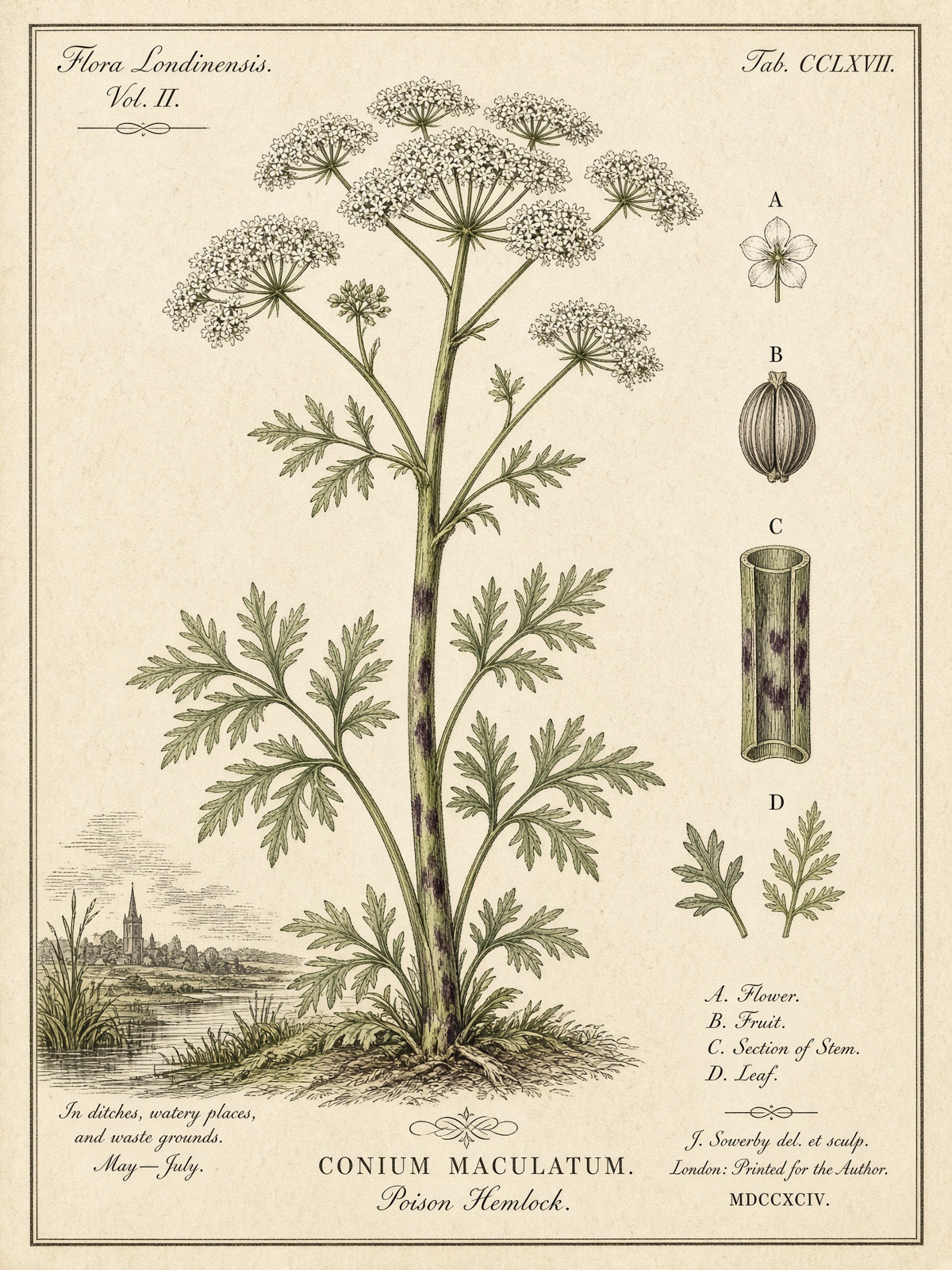
Poison hemlock
Conium maculatum
Apiaceae
Socrates' cup — a purple-spotted parsley that is still mistaken for fennel, carrot, and Queen Anne's lace.
Common roadside weed. Legal as a wild plant. Deadly if eaten. Do not 'wildcraft' unknown white umbels.
- Parts used
- None.
- Traditional notes
- Historical execution and obsolete external anodyne — not a living practice
- Grow · USDA 6b
- Biennial weed, USDA 4–9. You probably already have it on a ditch bank. Do not plant it. Learn it to pull it — gloves, bag the plants, do not compost into a food bed. In work: May · Jun · Jul
- Harvest
- Do not harvest.
- Purple blotches on a hollow stem, mousy smell, no anise. That is the ID.
- Do not put it in a wild-carrot bouquet. Gloves if you pull it.
- This plate exists so fennel and parsley have a named lookalike.
Safety
All use
Lookalikes
- Parsley — Poison hemlock is still pulled as ‘wild parsley.’ A purple-spotted stem is the difference between supper and Socrates’ cup.
- Carrot — Queen Anne’s lace and poison hemlock share a white umbrella. One is a taproot. The other shuts the nerves down.
- Fennel — Anise-scented foliage is not a field test. Poison hemlock has been called ‘wild fennel’ by people who then got very still.
- Dill — A feathery roadside weed is not a pickle herb. Dill is annual and yellow; hemlock is a biennial tower with white umbels.
- Yarrow — Achillea is a flat, ferny aster, not an umbel. People still call any white roadside head ‘yarrow’ — and some of those heads are hemlock.
Lore
Socrates’ cup. Conium maculatum, purple-spotted stem, mousy smell, an umbel that looks like parsley if you are a fool. This plate exists so fennel and dill have a named opposite.
The Herbarium — a teaching catalog, not a clinic. Traditional use is history, not a prescription. USDA 6b dates are a week either way, not a promise. Do not eat, drink, or harvest a plant you cannot name.